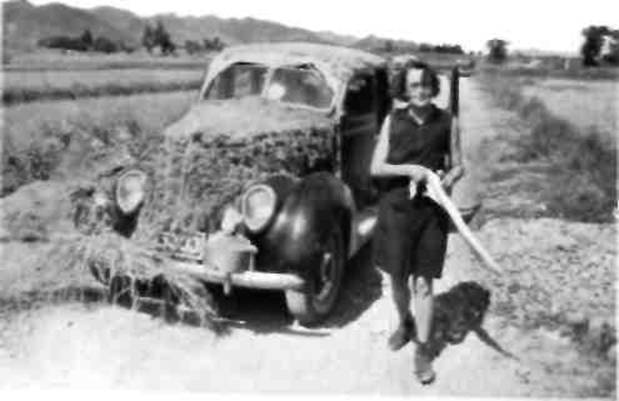
The author beside the camouflaged car of Dr. Loo Chi-teh on the way to the front
|
With the best wishes of the author CHINA AT WAR by FREDA UTLEY FABER AND FABER LTD 24 Russell Square London
First published in
June Mcmxxxix by the same author * lancashire and the far east japan's feet of clay japan's gamble in china |
The author beside the camouflaged car of Dr. Loo Chi-teh on the way to the front
Contents
|
1. |
page 1 |
|
|
|
I.
Hong Kong |
1 |
|
|
ii. The Miracle Railway |
17 |
|
|
III.
Canton |
21 |
|
2. |
31 |
|
|
3. |
86 |
|
|
4. |
119 |
|
|
5. |
154 |
|
|
6. |
187 |
|
|
7. |
229 |
|
|
8. |
258 |
|
|
9. |
281 |
|
|
|
297 |
Preface
|
T |
his book does not attempt an adequate analysis of China's social and political structure, nor does it give an account of her economic problems. My visit to China was too short, and the horrors of the war too close, for any cold appraisal of the ills of China. I have endeavoured to describe, as truthfully as possible, what I saw in China; and to make others see the tragedy now being enacted in the Far East.
That life in China in war-time was not all sadness and horror, but had its gay and pleasant side, these pages will show. Something of the serenity and good humour of the Chinese people, something of their friendliness, cheerfulness, and philosophical acceptance of the good and the ill which life brings, infected all the members of the 'Hankow gang' of war correspondents, among whom I lived for a few months, with whom I visited the Chinese fronts, and with whom I 'tired the sun with talking' through a long Chinese summer.
Intent on the troubles of Europe, fearful of the war which may engulf the western hemisphere, we hardly heed the rumble of the distant drums in the Far East, yet the fate of China's four hundred millions may well seem to the historian of the future the most important event of the early twentieth century. The city states of ancient Greece saw only the conflict of democratic Athens against that prototype of the Fascist State, Sparta. They were oblivious to the growing might of Rome and Carthage, whose eventual conflict was to decide the fate of the Mediterranean world. It may well be that the future of the world is now being decided on the Yangtze and Yellow Rivers, rather than on the Rhine or the Vistula, or in the conference halls of Europe.
The most ancient civilization in existence, and the most pacific of all civilizations, that of China, is struggling not to be overwhelmed by the 'dwarf robbers from the Eastern Isles', who have learnt from the West all the arts of modern war, but have rejected our political conceptions and the humanism which has slightly tempered the ferocity with which we have waged our wars.
Japan aims at world conquest, and her rulers have the singleness of purpose to accomplish it, but neither the requisite man power nor the material resources, unless they can incorporate China into their empire. If China's millions should ever be militarized, either by Japan or in a long struggle to resist her, the world would be faced by a military menace besides which the might of Germany would pale to insignificance. As General Smuts once said: 'It may well be that Western civilization will stand or fall in this matter of its contacts with the immense human masses of the East.'
Should the Chinese despair of the Western democracies who continue to supply Japan with the sinews of war, and should they decide to submit to the Japanese yoke, Japan might become the strongest power in the world.
For nearly two years now the Chinese people have continued to fight—ill-armed, often poorly led, handicapped not only by their primitive economy, but also by having as yet created only the embryo of a modern government and a modern social organization. No one who has seen China at war can doubt the reality of the Chinese renaissance, and, although it would be foolish to be optimistic, it is still possible to believe that Japan will not conquer in the end. But the sufferings of the Chinese people are beyond the capacity of our imagination to realize, and some little encouragement must be given to them, if they are to continue to bear them.
I have dared in this book to criticize China. In spite of my strong desire that she should win this war, I can see her faults and I have been horrified at the neglect of the common people, and especially of the wounded soldiers; and feel strongly that to hide China's weaknesses, or to be over-optimistic, is not to do her a service. China will survive, in spite of the superior armaments of Japan, if ancient injustices, ancient social and financial tyrannies, and ancient ways of thought and methods of administration give way to reforms consonant with the spirit of Young China.
Few people who have lived in China and have been received by the Chinese as friends fail to love them and to admire them. I learnt also in China that no criticism which a friendly foreigner could make equalled the criticisms of the best men and women in the country, who are giving all their strength, and many of whom have sacrificed their lives for the New China which they believe is being created in the agony of this war.
Any one who has read the details of America's War of Independence against England will remember how the incompetence of Congress, the greed of those who saw the war as an opportunity to make their fortune, and the failure adequately to arm and feed the soldiers and militia, nearly lost the war, and nearly gave back to England her dominion over her American colonies. The spirit of the men who fought overcame all these handicaps, and it may be that in China the same thing will happen.
Generalissimo Chiang Kai-shek is as great a man as General Washington, the Chinese guerrillas are not inferior to the militia of New England, and China is more united than was the American union of thirteen states in the eighteenth century.
My thanks are due to the many Chinese friends I made last year, who gave me some slight understanding of the problems of their country, as well as an appreciation of the devotion of those who are working and fighting to save it.
My thanks are also due to the 'bamboo' Americans mentioned in this book, who have lived for years in China, who speak her language, and have not feared to risk their lives at the front and in air-raided towns, nor to incur the enmity of the Japanese in their exposure of the Japanese terror in China to the all-too-indifferent public of the West.
From these men I, an amateur war correspondent, received help, friendship, and the courage to bear the sight of suffering.
Lastly, I would express my gratitude to Mr. Walter Boss-hard, Captain Evans Carlson of the U.S. Marines, Mr. A. T. Steele of the Chicago Daily News, and Mr. Leslie Smith of Reuter's, for permission to reproduce some of the photographs they took in China, while journeying with me to the front, or in Hankow.
Freda
Utley
London, May 1939
Illustrations
The author beside the camouflaged car of Dr. Loo Chi-teh,
on the way to the front frontispiece
Child refugees in Hong Kong facing-page 16
A part of devastated Canton 17
Child air-raid victims in Canton 17
The author and Mrs. Selwyn Clark with Agnes Smedley
in Hankow 32
Photograph by Walter Bosshard, courtesy of Black Star Publishing Co.
Girl scouts holding back the crowd from an air-raid fire in
Hankow 32
Mother weeping over the dead body of her child.
Hanyang 33
Photograph by Capt. Evans Carlson
Dead baby after air-raid. Wuchang. 33
Family with its belongings rescued from burning house.
Hankow air-raid, July 19th 80
Houses set on fire by an incendiary bomb. Hankow,
July 19th 80
Dr. Robert Lim, M.B., D.Sc, F.R.S.E., chief of the
Chinese Red Cross Medical Commission 81
Photograph by Capt. Evans Carlson
Soldiers at the ferry 96
Receiving station for wounded soldiers at Wushemin,
south of Kiukiang 97
Heavily wounded men in a Red-Cross lorry near the
front 97
The author, with Japanese sword presented to her by
Gen.
Li Han-yuan and Leslie Smith of Reuter's, at the
front south of Kiukiang facing page 128
General Li Han-yuan and captured Japanese arms 128
Operation at the 95th Base Hospital, Changsha 129
Dr. Loo Chi-teh, M.D., Surgeon-general of the Army
Medical Service 129
Model field hospital of the Army Medical Service at
Tayeh,
bombed by Japanese two weeks after our visit 144
Photograph by Walter Bosshard, courtesy of Black Star
Publishing Co.
Dr. Richard Brown on the march in
Shansi 145
Transport of wounded by the Eighth Route Army 145
Having a wash outside a farmhouse on the way to the
front 160
Photograph by Walter Bosshard, courtesy of Black Star
Publishing Co.
Dr. Moe of the Java unit tells me to come to breakfast 160
Photograph
by Walter Bosshard, courtesy of Black Star Publishing Co.
Lunch on the way to the front 161
Photograph by Walter Bosshard, courtesy of Black Star Publishing Co.
Dr. Loo Chi-teh and the author snatching a hasty meal en
route 161
Soldiers ill with malaria near the front 176
Photograph by Walter Bosshard, courtesy of Black Star Publishing Co.
Chinese Red Cross wayside dressing station near
Yangsin 176
Photograph by Walter Bosshard, courtesy of Black Star Publishing Co.
Soldiers and packhorses loaded with small guns near the
front line west of Juichang, September 1938 177
Soldier on hillside in the front line West of Juichang 177
General Tang En-po, commander of 200,000 troops 192
Children in a village a mile and a half from the front line 192
A. T. Steele, correspondent of the Chicago Daily
News 193
Photograph by Walter Bosshard, courtesy of Black Star
Publishing Co.
Captain Evans Carlson, United States Marines 193
Photograph by Walter Bosshard, courtesy of Black Star
Publishing Co.
Mme Chiang visiting a Hankow military
hospital on
September 18 th
facing page
208
Photograph by Walter Bosshard, courtesy of Black Star Publishing Co.
Agnes Smedley in Hankow 208
Photograph by Capt. Evans Carlson
Waiting for an air-raid on the roof of
the Lutheran Mis
sion tower. George Hogg (U.P.), Jack Belden
(U.P.), and the author
209
Agnes Smedley with Walter
Bosshard and Capa (Hun
garian cameraman who helped to film Spanish Earth
before coming to China)
209
Generalissimo Chiang Kai-shek 240
Photograph by Capt. Evans Carlson
Autographed photo of Mme Chiang Kai-shek and the
Generalissimo 241
Map of China at the end of the book
PARADISE TO PURGATORY: HONG KONG AND CANTON
I. HONG KONG
|
E |
arly in the morning of a July day I arrived in Hong Kong after three weeks' lazing and basking in the sun through the Mediterranean, the Indian Ocean, and the Pacific. I had left England fearing that Hankow might fall before I got there, and this sense of urgency prevented my staying more than a few days in one of the lovely cities of the world to study the 'Hong Kong mind', if there is such a thing. Certainly even my brief stay convinced me that there is to-day more of the old 'Shanghai mind' to be found amongst the English in Hong Kong than in Shanghai itself. For although the very existence of Hong Kong, and the livelihood of its inhabitants, white or yellow, depended on a Chinese victory, many of the English still thought of China as the China of a decade ago, and were more afraid of Chinese nationalism than of Japanese imperialism. Even the wealthy Chinese British subjects of Hong Kong had been more generous in contributing to British war funds in 1914 than to the call of their own people to-day.
Hong Kong in the summer of 1938 was one of the most prosperous cities of the world. Since the loss of Shanghai to Japan in the autumn of 1937 it had become the main port for all trade with China, as distinct from trade with the Japanese
1
PARADISE TO PURGATORY
in China; it was also the magnet for all the liquid capital of China. Being a British Crown Colony, although a part of China, it was in and yet not in the war. Profiting enormously from the war, Hong Kong, unlike the Chinese cities, had neither Japanese bombers nor gunboats to fear. Obviously its very existence depended upon access to Canton and the Chinese hinterland; once cut off politically as well as geographically, it was doomed to become a kind of Eastern Vienna, an organism deprived of nourishment. Yet, unlike Shanghai, where the presence of Japanese troops and the arrogance and insolence of the Japanese were a perpetual reminder of what was in store for the ' white races' all over China should Japan win, Hong Kong remained curiously detached from the war. The English continued to lead the leisurely and pleasant lives which they have always lived in the East, whilst the wealthy Chinese flooded the restaurants and cafes and had no shame in flaunting their affluence. Hong Kong was even reluctant to set up refugee camps for the destitute who had fled from Canton, and it was easier to collect money for China from Chinese residents in Singapore or the Dutch East Indies than in Hong Kong.
There were many refugees of another kind in Hong Kong; not the starving, ragged, miserable hordes which trudge inland in hundreds of thousands along the roads of China, or crowd the streets of as yet unconquered Chinese cities; not again the hopeless men, women, and children who sleep in the streets of Shanghai and die off slowly in their daily hundreds. Hong Kong's refugees were for the most part well fed, well dressed, and well to do. Families which had left Canton to escape the constant bombings, or had left some other part of China with their capital—intending to remain wealthy whatever the outcome of the war—and the wives and children of officials in Canton or Hankow, placed here for safety. All in Canton who could afford it, except the most patriotic, fled to Hong Kong, or at least sent their families there. There was exchange control in China and it should theore-
2
HONG KONG AND CANTON
tically have been impossible for so much Chinese money to find its way to Hong Kong. But in addition to the fact that incorruptibility amongst officials is a new thing in China there was the difficulty inherent in the existence of foreign settlements on Chinese soil and the position of foreign banks in China. Real control of Chinese capital was impossible without the full co-operation of the foreign banks. It is true, also, that for the moment the fact that Hong Kong belonged to Britain, and was therefore outside the war zone, helped China; but its existence, like that of the Shanghai International Settlement, enabled the rich Chinese to escape taxation and transfer their wealth outside China.
Prices in Hong Kong were soaring and business booming. Every hotel was packed and had doubled its prices. The cafes, restaurants, and shops were full of people. As the cities of China bled in the devastation wrought by the war, Hong Kong waxed fat.
It was none the less an uneasy prosperity. At any moment the Japanese might launch an attack on Canton and cut Hong Kong off from the sources of its wealth. Might not the Japanese even attack Hong Kong itself, men asked? Would Britain defend it? In whichever way Japan chose to act, the writing on the wall was plain for all to read and the gaiety of Hong Kong was a little hectic.
No docks in the world can have been as busy as those of Kowloon in the summer of 1938. Kowloon is the 'leased territory' opposite Hong Kong on the Chinese mainland whence starts the 550-mile railway line to Hankow via Canton. The German boat on which I had come proceeded to unload, at top speed, its cargo of munitions for China, before proceeding to Kobe to unload a similar cargo for Japan. Next to it an Italian freighter discharged other war supplies. British, French, Russian, and American ships could all be found tied up in the docks. China was buying munitions wherever she could get them and rushing them up to Chang-sha and Hankow along the daily bombed railway which the
3
PARADISE TO PURGATORY
Japanese never succeeded in destroying. China was utilizing all the foreign currency and silver reserves she had deposited abroad before the war began, and exporting as much tea and tung oil, manganese, antimony, tungsten, and other merchandise as she could, to provide new means of payment. China knew that at any moment the Japanese might attack Canton, or at last succeed in taking Hankow, and she was feverishly laying in all the armaments she could for that day. When, in October, Hankow and Canton both fell to the invader, the Chinese Government said it had laid in supplies sufficient for a further nine months of war.
There was no particular secrecy about these shipments. There could not be, since Hong Kong was a free port and British. One could walk at will over the vast docks, see the coolies sweating under the heavy cases, or lying in exhausted sleep near the water-front, note whence came the freight. I met an Englishman who was first mate of a ship flying the British flag, owned by French nuns in Hong Kong, whose captain was an American and whose engineer and second mate were Japanese, and which had brought a cargo of munitions from Odessa in Soviet Russia. Such is the internationalism of the shipping trade, or for that matter, of the armaments business. It was said in Hong Kong that the only armament firm which did not sell to both sides was the Czech firm of Skoda. It was difficult to preserve any illusions about wars for democracy in Hong Kong. Rather did one remember the now extinct post-war literature warning us of the machinations of the world armament rings which foster war and rumours of war, whilst men fight in the names of ideals —or ideologies. Later I was to hear a cynical old French priest in China say that the war would go on until Britain, France, and the U.S.A. had made about all they could expect to make out of both sides.
The typical foreigner in Hong Kong had little thought for the miseries of China, nor could he readily admit that such a thing as Young China or a Chinese national renaissance
4
HONG KONG AND CANTON
existed at all. There was plenty of scandalmongering and mockery concerning the venality of the Chinese officials. Every one saw the results of the old Chinese individualism and nepotism and refused to see the New China being strengthened in the fires of war. China to-day is like an animal changing its skin. Plenty of the old hide remains, but beneath it appears the new coat, if one gets close enough to see.
Moreover, the Westerners—and particularly the English —forget that in war-time in all countries there are profiteers, and that more veiled and 'gentlemanly' forms of corruption exist even in Britain. Japan, as every one who has ever read the Japanese press knows, is riddled with corruption; and Japanese history shows that the corruption of high officials and generals was most naked in the great days of the Meiji era, when she first started to become a modern State.
The trouble in Hong Kong was that the bad side of China at war was the only side visible. It was here that the unpatriotic wealthy congregated and here that the munition buyers and sellers met. No one had seen the Chinese fighting, or felt the spirit of Young China. Or if they had, it meant to them only memories of 1924-7, when they had trembled for their profits, if not for their lives, before the anti-imperialist wave of those years. When I visited Shanghai three and a half months later I was struck by the contrast in the British attitude. For in Shanghai the new quality of China had been seen; in Shanghai British officers could wax lyrical over the galantry of the Lone Battalion and the courage of the Chinese soldiers who, ill-armed and fighting under every disadvantage, had held the Japanese back for nearly four months. In Shanghai, too, there were few who had preserved the illusion that Japan would let Britain or the United States do any more trade in China should she win the war.
There were a number of interesting people to meet in Hong Kong: Chih-Ling Soong, the widow of Sun Yat Sen and sister of Madame Chiang Kai-shek; T. V. Soong, her
5
PARADISE TO PURGATORY
brother, ablest and most honest of Chinese banker-officials; Eugene Chen, just returned from years of exile in Paris, kept at arm's length by Chiang Kai-shek and attacking his policies in the Hong Kong and Shanghai papers, but expecting, or at least hoping, that in time he would be called back to office.
Eugene Chen's name had once been for the British the most feared and hated of Chinese names. That was in the days when he was Foreign Minister and negotiated the rendition of the British concession at Hankow to China—the famous Chen-O' Malley agreement of 1927. He now lived in a small house in Kowloon, ignored by the British and mistrusted by his own countrymen. In British eyes he represented the most uncompromising Chinese nationalism of the revolutionary Kuomintang period; his name recalled the days when it was China, not Japan, that was insulting the British and attacking their imperialist interests. In the Generalissimo's eyes he was the one important Chinese of any faction who had never bowed down before him or ceased from openly criticizing him. The Communists, for their part, mistrusted him as too much of an individualist, and although he is all for their policy of collaboration with the U.S.S.R., compromise with Western imperialism, and ' mobilization of the people', they also cold-shouldered him or ignored him. It may be, of course, that they are too nervous of the associations of his name for the British, or of Chiang Kai-shek's enmity towards the opponent of the 'Soong Dynasty'. In any case, for both the British and the Chinese governments, his name is too unwelcome a reminder of the days when China's struggle for independence was waged under anti-British slogans for it to be at all likely that he will be recalled to office. Nevertheless, there were recurring rumours that he was to be appointed Minister of Foreign Affairs, and there is little doubt he would have made an astute and clever one. His vitriolic articles and downright criticisms are a healthy, even if a bitter, tonic for China, whose Government is a little too accustomed to face-saving eulogies, and a too complacent
6
HONG KONG AND CANTON
satisfaction with the way in which the war is being carried on.
One might perhaps describe Eugene Chen as a kind of Trotsky of the Kuomintang Party, who never ceases to remind it of its original aims, nor fears to tell Chiang Kai-shek that he is not a superman and should not try to run everything himself and keep all power in the hands of his family and personal friends. Eugene Chen, born abroad and resident abroad for the greater part of his life, sees political problems with a Western eye; Chiang Kai-shek, who knows no foreign country except Japan, and speaks only the Chinese of his native province, sees the problem of keeping China united and resisting Japan as problems to be solved in the Chinese way by Chinese methods. Their views are obviously irreconcilable.
I found Eugene Chen a most stimulating talker and an acute observer and thinker. Perhaps he is ambitious, but who amongst outstanding personalities is not? He certainly understands the Western world and its policies as few Chinese do. He is as keen as Madame Sun Yat Sen on closer collaboration with Russia, but he has no illusions about the U.S.S.R. He is prepared to 'go along with' Britain to-day and for so long as China's and Britain's interests are the same. He is a realist and not an idealist. Perhaps that is why he is disliked by so many people. The count against him is also that, born and reared in the West Indies, and unaccustomed even to speaking Chinese, he is a foreigner to China and Chinese ways of thought and does not understand his own people. His count against Chiang Kai-shek, on the other hand, is that the latter is too Chinese in his methods, too feudal-minded, and too little aware of the realities of the world outside.
I had two long interviews with Eugene Chen in his little house on the outskirts of Kowloon. Over and over again he emphasized the fact that China's lack of armament factories was the dominating factor in the situation.
'China,' he said, 'cannot win alone. She must have allies.
7
PARADISE TO PURGATORY
We ought to have a diplomatic front as well as a military front, but Chiang Kai-shek envisages the problem as purely a military one. Japan is waging a totalitarian war against us and our resistance should also be a totalitarian one. Chiang Kai-shek should have realized that the diplomatic front is of paramount importance, yet for him it hardly exists.
' In 1932 Japan had no modern air force. We have had the opportunity since then to create an air force. Yet, although millions have been raised in China to buy aeroplanes, we only had between 158 and 167 when the war began. They put Madame Chiang Kai-shek at the head of the air force. She had good intentions, but she was just a well-meaning girl who knew nothing about the subject. It was quite crazy and the Russians refused to send planes if she remained in charge.
'Then there is the question of the German advisers. They were sent out originally when the Germans had a theory that it was Chiang Kai-shek's historical mission to liquidate the war-lords and transform China into a vast market for German capital goods. After Hitler came to power, Chiang Kai-shek's "mission" was held to be that of an instrument against the U.S.S.R. Military aid, armaments, and advisers were supplied to China because Ribbentrop imagined it was possible to reconcile the victim and the aggressor by bringing them both into a bloc against the U.S.S.R. He failed to realize the contradiction inherent in such a policy. The war, as it progressed, made the realization inevitable, and so, following Hitler's speech in January 1938, the German advisers were withdrawn. Hitler had realized that he must choose between losing China as a market and losing Japan as a military ally. Germany's economic interest was sacrificed to her political interest.
'The German advisers erred concerning fortifications and our air force. Their theory of a Hindenburg line of fortification which could not be broken was useless in so vast a country as China. They were good drill sergeants, but this is
8
HONG KONG AND CANTON
not what we wanted and their conceptions and tactics were unsuitable in China.'
I was to remember this part of my conversation months later when, on the night I left Hankow, I paced the air-field with Captain Stennes, captain of Chiang Kai-shek's bodyguard and his confidential adviser. Stennes is a German who was a Left-Wing National Socialist and a friend of General Schleicher. He had been enabled to escape from a German concentration camp by his wife and was now an exile in China. The perfect type of adventurer, absolutely fearless, intelligent, physically a splendid specimen, and with an attractive personality, he loathed Hitler and had a very real loyalty, affection, and admiration for the Generalissimo. In his view the German advisers had been invaluable to Chiang.
'The French,' he said, 'are too arrogant and impatient to be of any use as military advisers in China. They tell the Chinese command what it should do and then shrug their shoulders when it doesn't get done. The British are too lazy; only the Germans have the necessary patience. You should have seen the tact and patience with which Von Falkenhausen got his views adopted. He would never say, "I think this ought to be done." He would say, " I think the best strategy would be that plan you suggested a week or two ago," and then proceed to outline his own plan.'
'What about the Russians?' I asked.
'Not bad, but their psychology is too similar to that of the Chinese. Their nichevo ("can't be helped") and the Chinese mei yu fa-tze ("nothing to be done about it") are too similar. Besides, their military advisers are too specialized. Each knows just one thing and no more. For instance, their technical advisers just understand one particular make of gun, and that is hopeless in China, where we have armaments from all over the world.'
He went on to say how greatly he admired Chiang Kai-shek. 'He knew he must wait a few years if he were going to resist the Japanese successfully. That's why he gave way to
9
PARADISE TO PURGATORY
them time and again until he should have built up his military strength. But he was forced to fight in 1937 by the pressure of the Communists and the Left intellectuals.'
Yet, although Stennes might have been accused by Eugene Chen of thinking of warfare entirely in terms of the training and equipment of armies, he was well aware of the factor of morale. 'Give me five men who really believe in what they are fighting for,' he said, 'and I will lead them against a hundred.' It is also of interest that he told me that night on the air-field that my interview about the neglect of the Chinese wounded (see Chapter 6) had done good, and that Von Falkenhausen had pressed for years to get a proper army medical service organized and trained.
To return, however, to Eugene Chen. When I asked him whether it was true, as so many people said, that T. V. Soong was being prevented from exercising his great talents in China's interest by the jealousy of his sisters, who maintained Dr. Kung in office, Eugene Chen answered as follows:
'T. V. Soong is himself one of the architects of the counter-revolution which has been dominant in China since 1927. The Nanking Government is the creation of the counterrevolution. It has spent 3,000 million dollars on new roads and railways, which now only help the Japanese to advance the faster. The paradox of the situation is that, since the policy of the Government was objectively basically wrong, all its work of reconstruction to-day benefits only Japan. T. V. Soong represents the banker-comprador wing of the counter-revolution. They see only the financial side of reconstruction. Soong himself is a clever politician who sees the deluge coming and is concerned above all to save his reputation, which is so high amongst the foreigners. Since the financial headquarters of the bankers and compradors has been destroyed by the Japanese in Shanghai, Soong has tried to reestablish it in Hong Kong, whence he maintains financial control over the Chinese banks. He pretends that there is a feud between him and Kung, but in reality he, Soong, com-
10
HONG KONG AND CANTON
mands on the financial front. He could have any position in the Government which he desires, but he doesn't want to assume any responsibility unless he is sure of a British loan. He himself really put Kung in office and maintains him there as a useful scapegoat; for T. V. is despondent and pessimistic about the outcome of the war. He, like his sisters in Hankow and the Generalissimo, conceives of China as the property of one family.'
He went on to speak of the 'united front' in China, saying he had been in favour of it because it brought in the Communists, and because Chiang Kai-shek sees treachery everywhere.
'But the united front has now outlived its usefulness. What we now need is a national front, which is something quite different. When you get to Hankow and ask questions you will find that both a Kuomintang man and a Communist will ask himself before he answers you, " Is my answer consistent with my membership of my party ?'' Neither will think "Is it consistent with the national interest?" '
'We have a long tradition of secret societies in China and in some sense the Chinese Communist Party is one of those secret societies. Russia gives it a modern leaven; if fully independent the Chinese Communist Party would become as exploiting and parasitical as the Kuomintang. But its organizational link with the Comintern prevents its degenerating as the Kuomintang has done.'
Eugene Chen, as I have already remarked, is a realist, but it seemed to me that he nevertheless had too great faith in the possibility of China being able to obtain far greater assistance from Russia if only the latter did not still distrust Chiang Kai-shek. One could only agree with his argument that China must seek allies; but was it really possible for her to get them even if she paid more attention to the 'diplomatic front'?
Again, his insistence on the mistake Chiang Kai-shek makes in keeping all power in his own hands, and trying to do more himself than any mortal man could ever do, was all
11
PARADISE TO PURGATORY
very correct. But could Chiang admit others to equal power with himself, could group leadership be substituted in China for a one-man leadership, without renewed political disunity? Eugene Chen is clearly inclined to paint his political opponents blacker than they really are and to ignore their difficulties.
In a later interview, he made himself clearer on the political issue and the foreign policy which, in his view, China should pursue.
'The essential point is that we can't manufacture our own weapons. Our military leadership, experienced only in civil war, confuses the conditions of civil war with those of war against Japan. The plain fact is that we cannot win the war without the assistance of Britain and the United States. Only immediate assistance can be given us by the U.S.S.R. It cannot suffice us but it can help us to fight until Anglo-American assistance comes into play. It is clear that Russia will avoid being drawn into the war. I myself have never been, even in the old days, in favour of throwing Britain and America out of China, but I insist to-day, as in the past, that they must obey the laws of China, i.e. that extra-territoriality must go. This can be accomplished in an orderly way, by negotiation. If only our diplomacy were more intelligent and forceful we could get aid in so many respects, since we have so large a common interest with Britain and America against Japan. The basis of co-operation lies in the fact that we have millions of men to bear arms, but no arms factories.
' It is a miracle that we have survived so long. The war has gone on already for a whole year. It shows the inherent strength of the Chinese nation. It is only our leadership which is at fault. The Chinese people are fighting the Japanese people, a totalitarian war is being waged; so that the struggle is not purely a military one but also an economic and diplomatic one. We must have group leadership instead of the present one-man leadership. A suitable and able man should be in charge of each department with absolute authority. The heads of each department should constitute the
12
HONG KONG AND CANTON
war leadership. The full resources of the country must be mobilized if we are to resist Japan.'
Interviewing Ching-Ling Soong, widow of Sun Yat Sen, after Eugene Chen, meant passing from an atmosphere of pitiless realism, bitterness, and frustrated ambition into an atmosphere of sublime idealism and unselfishness. Madame Sun wanted much the same things to be done as Eugene Chen; she criticized the conduct of the war as openly as he did, but her ideas as to what should be done were far vaguer, and she, unlike him, obviously had no personal ambition. She wanted reform because, quite literally, her heart bled for her people. He wanted them because he felt he could run China much better than Chiang Kai-shek and was annoyed at what he considered the incompetence, the pretences, and the stupidities of the ruling Kuomintang group.
She opened the door to me herself when I called upon her by appointment in her small flat up on the Peak. A beautiful woman, the fairest of the Soong sisters, she is also the simplest and most modest. There is a dignity about her which is completely unconscious and unstudied, and a grace which is typical of Chinese women. She seems far less Americanized than her brother and her sisters, both in voice and manner and in thought. European influences have formed her mind and outlook, and even her accent is English, not American. Talking to her one felt, and it is an unusual feeling to have with the Chinese, that the sufferings of the people move her profoundly, and that it is their suffering, not the awareness of national humiliation or the desire for power, which is the mainspring of her actions. One almost felt that, Christ-like, her heart is pierced by the death, mutilation or starvation of her countrymen. It was the deep feeling behind her words and her obvious sincerity which redeemed her views from a certain narrow-mindedness or naivete. She sees the political world in black and white: wicked Kuomintang bureaucrats, good Communists, good National Salvationists. Her political views were uncritical and second-hand and unrealistic. Russia
13
PARADISE TO PURGATORY
is helping China, therefore the Stalinists are good people, and purges and concentration camps and executions can be ignored; journalists who appear to favour Japan must have been bought by the Japanese, else why else should they favour Wrong against Right? Revolutionaries who do not approve of the Comintern line are 'those terrible Trotskyists'. Living in a world of ideas, she appeared to have little understanding of political realities, and to be too prone to uncritical acceptance of the professions of these who seemed to be working for the same ends as herself. One could love her and respect her, but one would be chary of trusting her judgements, and she could never play a leading political role.
For Madame Sun Yat Sen the third of her husband's Three Principles (the San Min Chu, which are supposed to be the creed of the Kuomintang Party), 'the livelihood of the people', is the most important of the three and the most neglected. Because she would never accept a government which neglected this principle she had torn herself away from her family and gone to Moscow in 1927 when Chiang Kai-shek started massacring the Communists and trade-unionists, and converting the National Revolutionary Government into his personal military dictatorship. Because of this she to-day ignores the darker side of Communism, since it is the Communists who appear to be most concerned with the sufferings of the mass of the Chinese people. Because of this she alone, amongst the members of her family, is poor, and lives with a single servant in a tiny flat. She is of the stuff of which martyrs are made, not political leaders or the unifiers of nations in the state of China. One understands easily the antipathy between her and her forceful, realistic, perhaps unscrupulous and certainly power-loving sister, Mei-Ling Soong, the wife of the Generalissimo; or the coldness between her and her worldly and materialistic elder sister Madame Kung.
She, like Eugene Chen, but from purer motives, will
not pretend that all is well in China so long as the mass of the poor peasants
are ignored and the soldiers neglected. Her
14
HONG KONG AND CANTON
views of the situation were, in fact, as gloomy as those of Eugene Chen. She has no patience with the pretences of the New Life Movement and wrote of it as follows before the war: 'When I consider the New Life Movement I think it unfortunate that, well meaning as the author doubtless meant to be, he has not yet realized that the most fundamental need of the Chinese masses is economic development. In other words, to improve the people's livelihood as Doctor Sun taught. In the New Life Movement there is nothing new to be found, it gives nothing to the people. Therefore I propose to replace this pedantic movement by another—that is a great campaign to improve the people's livelihood through improvements of methods of production, especially in agriculture. The aim of revolution is the material welfare of human beings or masses. If that is not reached then there has been no revolution.'
It was Madame Sun, first of any one, who tried to get help from abroad for the wounded soldiers. For this purpose she founded the China Defence League, of which she herself is chairman and T. V. Soong president. She works indefatig-ably, and has not even a secretary to assist her with her vast correspondence and the many articles she writes. She visited Canton frequently before it fell and was there received with the utmost enthusiasm. There is a particular feeling for her there, in the cradle of the National Revolutionary Movement, not only because she is the widow of the great leader, but because it is felt that she alone has remained true to the principles and beliefs of Sun Yat Sen. One of China's tragedies is that those principles were so vague. His widow, even if her political beliefs are even vaguer, has obviously preserved the spirit of the dead leader and will not be put off by pretences and shams, or lulled into acquiescence in social injustice by the fruits of office.
Madame Sun hardly ever meets her sister, Madame Chiang, and never her sister Madame Kung. She has never been invited by the Generalissimo to the capital to take a
15
PARADISE TO PURGATORY
place in the Government. But she is on good terms with her brother, T. V. Soong, the President of the Bank of China.
Vincent Sheean, in his In Search of History, has painted a masterly picture of T. V. in 1927—the liberal minded middle-of-the-roader who could not make up his mind between the military dictatorship of Chiang Kai-shek and the slowly expiring 'legitimate' Left and majority Kuomintang government at Hankow, disliking and mistrusting both. T. V. is a modern-minded Chinese, without his youngest sister's idealism, or the energetic Y.M.C.A. spirit of his other sister, Madame Chiang, but very gifted and with an attractive, almost boyish, personality. He has a real desire to modernize China and would stick to the rules of sound finance, and thus secure foreign loans, to do it. He is very rich, but his fortune is largely a modern-made fortune, owing little to the devious ways of old China. He would modernize and enrich China and enrich himself with her, but this is a very different thing to enriching oneself at the expense of China, as so many officials and other bankers have done.
It was T. V. who was largely responsible for securing League of Nations experts to aid China, and for the Chinese currency reform of 1935. In fact, he is the outstanding representative of those capitalist interests in China which, whilst prepared to utilize the military to keep 'internal order', are opposed to any kind of 'national socialist' regime in China. They want to see China's productive forces developed on capitalist lines, and they want a moderately democratic political system. They would rely on foreign credits, the remittances of overseas Chinese, and the capital accumulation of the large Chinese banks. It is possible that China would find it somewhat easier to get credits abroad if T. V. were the Finance Minister, instead of Dr. Kung,who has been accused of venality, or of turning a blind eye to the venality of his close associates. Dr. Kung's methods of running the finances of the country are certainly more old-style Chinese than Western and are criticized by the foreigner, but they may be
16

Child refugees in Hong Kong

(above) A
part of devastated Canton
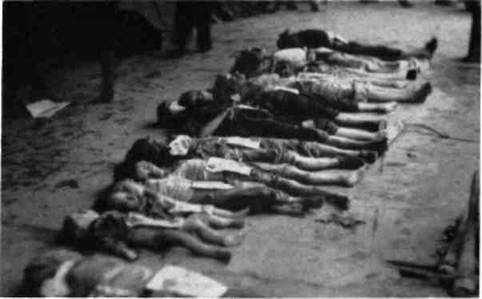
(below) Child air-raid victims in Canton (see pages 16—7)
HONG KONG AND CANTON
the only possible methods at present. T. V. Soong's present function, as President of the Bank of China, that of preventing the exchange value of the Chinese currency from sinking too low, is of equal importance to Dr. Kung's function of raising money internally to carry on the war, and it is perhaps more suited to his talents.
T. V. Soong is thought not to be fully trusted by Chiang Kai-shek, that essentially Chinese politician and leader who prefers to keep Dr. Kung as Finance Minister. For Dr. Kung is more amenable and less of a personality, besides being the husband of Madame Chiang's beloved elder sister. T. V. Soong's efficiency, his occidental manners and methods, and his insistence on an orderly financial system, eliminating all possibilities of 'squeeze', do not endear him to the old-style officials. Perhaps Chiang Kai-shek thinks he would Westernize China a bit too rapidly and alienate too many people who must be kept loyal at this critical time. For the secret of Chiang Kai-shek's strength and power is his skilful balancing between the forces of feudal and modern China.
II. THE MIRACLE RAILWAY
I left the safe haven of Hong Kong at seven in the evening to take the train to Canton, with the knowledge that the Japanese had been bombing the line daily, and frequently also by night, for months past. Those for whom safety was of greater importance than time or curiosity travelled by steamer, but there was actually little danger, since the Japanese had rarely succeeded in hitting a train. Although their bombs seldom found their mark, they sometimes swept low to use their machine-guns to riddle the train with bullets. But the risk was slight enough to add only a little excitement to the journey.
The third-class carriages were packed to the limit with a cheerful crowd, for even if a Chinese is leaving Paradise for Purgatory, he is not outwardly sad. The second-class cars
17
PARADISE TO PURGATORY
were also almost fully occupied, by officials returning to their posts after a visit to their families, and by merchants. Smart Cantonese soldiers guarded each car with revolvers ready cocked; officers patrolled the length of the train lest any Japanese agent attempt to do damage to the line or the train.
The only other European on the train was an Italian correspondent of French newspapers in Indo-China. Speaking no English, he enlisted my aid to convince the Chinese frontier officials that he was an exile, not a Fascist. Not that the Chinese appeared particularly interested in him or his passport, or wanted to keep him out of China, but he was acutely sensitive about his Italian passport, although it was eight years old. When the officials had departed, he made me translate quite a long speech to the occupants of the car about liberty, equality, the brotherhood of man, and his hatred of Fascism. He was young, earnest, and excitable; and as a journalist he came nearer to the romantic cinema conception of a war correspondent than any one I have ever met. In three days in Hong Kong he had discovered more 'secrets' than I was ever to discover in China. He had encountered a Japanese spy in the docks; he knew exactly what munitions were being then unloaded in the docks; he knew how the Italians were selling dud ammunition to China. He knew what the Chinese thought, the British, the French. The way he learned about things was to visit Catholic priests and opium dens, both invaluable sources of information! Within half an hour he had 'discovered', and pointed out to me, which of the occupants of the car was a spy out to watch our movements. He certainly ' got a kick out of his profession and made me feel how unimaginative I must be.
My natural inclination in a train is to read rubbish or to doze. But sitting opposite the Italian, I was galvanized into activity. Like him, I craned my head out of the window; like him I exclaimed at every sign of past bombings and at every sight of the repair squads. He certainly had a lot of informa-
18
HONG KONG AND CANTON
tion, and told me how the munition wagons are protected first by layers of empty earthenware jars, then by a layer of empty baskets, covered over in their turn by earth and matting and bamboo; how when there is a raid the train stops to let the passengers take refuge in the rice fields and then dashes on to hide in the nearest tunnel. However, after we had noticed that there are no tunnels after leaving British territory, we had to discount this particular story. As I learned later, what actually happens is that the engine is uncoupled and also the carriages, so that a direct hit will not damage the whole train. All lights are turned out and even with a full moon the train is not easily visible. Later, also, I was told by the manager of the railway, whom I met at breakfast in Canton, that the story about the layers of protection for the freight cars wasn't true either. I had wondered myself how there could be any room for the munitions themselves.
'Le train des miracles,' the Italian called it, and his excitement at travelling on it communicated itself to me.
We passed out of British territory into the danger zone in the twilight, and as night fell we looked anxiously at the full moon. Luckily it was veiled in mist, and we ordered some dinner with minds fairly easy but with our eyes always fixed on the track, and on each station, for evidence of the damage done in past raids. At almost every station there were partially demolished houses or ruins, and occasionally the train rocked a little as we passed over part of the line which had been bombed and repaired. The two important bridges had never been hit and the small bridges which have been damaged had always been rapidly repaired. Is the Japanese marksmanship bad, or are the Chinese anti-aircraft gunners good, or is it really much harder to bomb a definite objective from the air than the layman imagines? The Chinese had few anti-aircraft guns to defend the people of Canton, but the two vital bridges were defended and the Japanese dared not swoop low. The Kan Sui Bridge, about fifty kilometres from Canton, showed a crack in its concrete support from con-
19
PARADISE TO PURGATORY
cussion or a hit below the water some months earlier, but no real damage had been done and the bridge was as safe as ever.
The real miracle of the railway is the repair work. At the time of my journey there had been 163 raids on the Kow-loon-Canton railway since the previous October, and some 1,600 bombs had been dropped on the line. This meant ten bombs per kilometre and more than one 'visit' per kilometre; yet the trains had never stopped running for more than a few hours. Daily as well as nightly the munitions landed at Hong Kong had been rushed through to Canton, and thence along the even more frequently bombed railway to Hankow. The day I spent in Canton (11 July) there were three separate raids, over sixty bombs were dropped on the two vital railways, and the telephone and telegraph to Hong Kong were put out of action. Yet this was regarded as a more or less normal day, not worth cabling a special report about.
Repair gangs were stationed at every few kilometres along the line, and looking out of the window one could see, every now and then, dumps of repair materials, rails, and sleepers, and also pyramids of baskets. The repair squads quickly investigated the damage after each raid, telephoned through to Canton as to what materials were needed and where. These were rushed to the spot. Meanwhile the repair squads of skilled workers had been mobilized—labourers from the nearest villages. These peasants were paid sixty cents (about sixpence to-day) a day, and worked under the supervision of the repair squads. Within a few hours the line would be repaired and the trains running again. Similarly with regard to telephonic and telegraphic communication. The day I was in Canton the correspondents had only a few hours to wait before the lines had been repaired and they could send out news of the latest raid. The raids that day were at 9.30, 12.30, and 3.30. In the two later raids twenty-four bombs were dropped on Sheklung, near the second of the two bridges we had crossed the previous night, and had seen in the moonlight
20
HONG KONG AND CANTON
with its sentries at each end standing by their little straw shelters. Sixty-five houses were demolished or damaged and twenty or thirty persons killed or injured in the town; but the bridge stood as before. Next day the Japanese airmen resumed the bombing of Canton itself and dropped some sixty or seventy bombs in the different parts of the city.
The organization of the repair work, which would have done credit to any country, showed what the Chinese are capable of, and how they might have transformed their country now that it had achieved political unity, if Japan had not interfered.
III. CANTON
I was met at Canton by the Mayor's secretary and went off in his car, leaving the Italian to reach the hotel by rickshaw. But our car broke down half-way and he arrived long before me. The Oi-Kwan hotel at Canton was a sign and a symbol of modern China. Ten stories high, it towered above the city —almost a skyscraper. Comfortable, cheap, and well run, it had many advantages over the ancient expensive hotel in the British concession over in Shameen; the only disadvantage was that it might be bombed. But in fact, it never was hit. The Chinese must have felt that this vast concrete structure afforded some protection, for the pavements around were crowded with sleeping families. The lobby and lower corridors were full of trunks and cases, for bombs would be unlikely to penetrate lower than the top floors. I had a lovely room on the tenth floor, with a bathroom, and it only cost three shillings. My windows looked out over the Pearl River and I felt it was altogether better than my stuffy small room in Hong Kong, looking over a backyard, which had cost me ten shillings a day.
However, the Italian, who had secured a similar room, thought it too expensive and made me bargain for him for nearly an hour. He would be staying a month, and he, as he
21
PARADISE TO PURGATORY
explained vehemently, was not an American or an Englishman, to pay fabulous sums for his articles. Afterwards, refusing his invitation to visit an opium den (since what would be the use without an interpreter ?), we walked together in the city. The streets were full of houseless people and dozens of rickshaw-men pestered us. Forgetting the brotherhood of man, the Italian swore at them and shouted at them and told me he would kick them if he were in Indo-China. I told him I couldn't see why he should be so angry because hungry men tried to earn a few cents, but, like so many other idealists, he loved humanity only in the abstract.
That walk in the moonlight in the streets of the doomed city of Canton gave me my first sight of the misery and poverty of China. Women with emaciated babies, young children starved and ragged. The homeless in their thousands who from day to day die of want or fall victims to the death which rains from the skies.
Next morning the first air-raid alarm went at 9.15. It was the first time I had heard the ominous screeching of the sirens and my heart beat faster. I descended from my tenth-floor room and went out into the streets. The people seemed to be paying little attention. Indeed, of what use was it to rush to another place when one place was as likely to be bombed as another? For Canton appeared to have no air-raid shelters for the population, although Government offices all had their dug-outs and important officials also had them in their homes. There are so many people in the cities; impossible to build shelters for them all, so of what use to build a few? Or that, at least I suppose, is how the argument went. I was in time to get accustomed to official callousness or negligence of the mass of the people. In fact one cannot really blame China, for first things come first, I suppose, and the maintenance of transport to supply arms for the troops must be the first consideration.
Under an archway outside the hotel a doctor and two nurses were inoculating the passers-by against cholera. Un-
22
HONG KONG AND CANTON
perturbed, the smiling young man appealed continuously to the people passing by to stop and have an injection. The two nurses stuck the needle into one arm after another, at the rate of at least two a minute—men, women, children, babies. Probably it was a method which would have horrified a Western doctor, for the needle was not sterilized between each inoculation, but it was better than nothing, and it was hard to see how those teeming crowds could all have been attended to otherwise.
The second raid was announced two hours later at about 12.30 whilst I was interviewing the Governor of Kwangtung. He took no notice at all, but went on telling me about his rural reconstruction programme, a work which was clearly his main interest in life and which the war had interrupted. Kwangtung, he said, was a commercialized province which had for long suffered from the draining away of capital to Canton. The Cantonese were a mercantile and adventurous people whose energies had been employed in trade; it was necessary to bring back capital and enterprise to the land so that Kwangtung should no longer have to import large quantities of rice. He told me of the plans for the irrigation and drainage of unused land in Kwangtung, for rural education and a public health service. It had been hoped that after three or four years of rural reconstruction each 'honest' farmer would be able to free himself from the clutches of the usurers by being able to borrow at 7 or 8 per cent interest from cooperative societies backed financially by the provincial government. They would also then be able to get credit for the purchase of implements, seeds, and chemical fertilizers from Government factories.
This General Wu Te-chen was an old associate of Sun Yat Sen, and had been in prison under the Manchus. He had gained an enviable reputation for honesty and competence as Mayor of Greater Shanghai before being sent to Canton by Chiang Kai-shek, following the submission of Kwangtung and Kwangsi to the Nanking Government in 1936. Quiet,
23
PARADISE TO PURGATORY
courteous, slim, and benevolent, and dressed in dark silk robes, he offered a striking contrast to the confident, 'live wire', burly Mayor of Canton, who, jovial, dressed in a Western suit and speaking with a strong American accent, might have been a party boss in the United States. Neither of them was of the type to prepare Canton to hold out against Japan's coming attack, but poor Governor Wu, who was removed after the loss of the town, must have been an able peace-time administrator.
Returning to my hotel with the Governor's secretary, I climbed up the ten flights to my room, because the electric current was switched off during raids and the lift was not working. The Italian, whom we met in the passage, wasn't satisfied with the tenth floor, however, and dragged me up on to the roof for a better view. We looked over the roofs of the city in the direction of Formosa for a sight of the dreaded planes, but could see nothing. Returning to my room, I found the Governor's secretary at the telephone. He appeared to act as a kind of information bureau or press service, for as he received the news of the raid he passed it on by phone to the foreign correspondents waiting in the comparative safety of the British concession.
'Twenty-eight planes', he reported, 'have just passed over in two groups. The first squadron of nineteen has already skirted the city and gone to bomb the Canton-Hankow railway. The other nine are at the Bocca Tigris forts, heading for Canton.'
A few minutes later:
'The nineteen planes are returning and are approaching the city, while the nine are bombing Sheklung' (the town on the line to Kowloon where one of the two vital bridges is situated).
Ten minutes later:
'The nineteen planes are now bombing the Canton-Hankow line at Pa Kong, close to Canton.'
Five minutes later:
24
HONG KONG AND CANTON
'The nineteen are bombing the Shuk Wan railway junction on the line to Hankow, while the nine are bombing another section of the Kowloon line.'
Concluding that the planes must by now have dropped all their bombs and were not making for the city this time, we went out to lunch, but the all-clear was not sounded for another hour. The one English and one American news-agency correspondents then in Canton had been asked to meet me. The American had his wife with him, an exceptional thing in China, where the English and the Americans, diplomats or newspapermen, usually send their wives away from the war zones.
These two men, reporting the Canton air-raids to the world, both living in the hotel in Shameen and inevitably thrown together in the tiny foreign community in Canton, were the strangest contrast. One conservative, the other extreme Left in politics; one a blond army-type Englishman, the other a Jew born in Poland; they spent their evenings arguing the same points over and over again, and agreeing on nothing. Yet the conservative Englishman was as sympathetic towards China as the socialist American, and it was he who confessed to me later, over a drink that same evening, that the sights he had seen had so unnerved him that he could not, when he first came to Canton, get to the telegraph office to send his dispatches until he had rushed home and fortified himself with whisky. He further remarked that he always had to restrain himself from telling the full story of the raids, as other wise he was accused of becoming hysterical and too 'pro-Chinese'. The bare narrative of what one sees in China during this war is too terrible for the English or American reader to hear; it must be toned down if a correspondent is to keep his job.
I also met Mr. Lockwood, the Y.M.C.A. organizer in Canton, who told me that 50,000 people had passed through the Y.M.C.A. shelters, all but 2,000 of whom had now found shelter in the villages.
25
PARADISE TO PURGATORY
In the afternoon, while making a tour of the bombed areas, we heard the siren announcing the third raid that day. By that time I was almost as hardened and took little more notice of the alarm than the Cantonese. Since the city itself had been little bombed since the middle of June, and since the morning raiders had concentrated on the railways, one had begun to take it for granted that it was again only the railways which would be attacked now. Some of the people I spoke to in Canton thought the three or four weeks' respite from daily— and nightly—bombing of the civil population was due to the protest meetings in England and the United States at the time of the terrible raids of May and early June, coupled with the blunder made by Ambassador Yoshida in London, who had admitted publicly that the raids were for the purpose of demoralizing the civilian population. Others thought it was only the rains which had kept off the Japanese raiders, and that the systematic bombing of the people of Canton would start again soon. The latter were soon proved right, for the very day I left Canton eighteen Japanese planes came over and dropped sixty or seventy bombs in ten different parts of the city, killing or maiming nearly a hundred people.
Standing in the Wongsha district with the Chinese doctor who had organized the air-raid rescue work, in the midst of acres of ruins with not a single house left standing, I heard about the terrible raids of six or seven weeks before. This doctor, Henry A. Jee, told me how he himself had been machine-gunned by the Japanese, and thirty-five of his helpers killed, whilst trying to give first-aid to the wounded and carry them out of the devastated area.
On a wall at the outskirts of the stricken area were pasted up photographs and descriptions of lost children, and children found whose parents were unknown. After a raid families often do not know for a long time whether their children are dead, or in hospitals, or lost somewhere in the city. I stopped to lean over the waters of a creek, standing on the historic Liapo bridge. On one side of me was devastation, on
26
HONG KONG AND CANTON
the other old China—ancient, picturesque houses hanging over the water and the beautiful old bridge. Next day the bridge and the old houses were no more; the Japanese had created the same havoc here as elsewhere.
Dr. Jee remarked once that he sometimes felt it would be worth suggesting to the people in America and England, who had so generously raised funds for the relief of the airraid victims in China, that they should offer this money instead to the oil companies, asking them to take it instead of the Japanese money for which they sold the oil without which the Japanese bombers could not come over and devastate the Chinese cities.
We walked on to another bombed area, and then another. Here had been a school where seventy-five children had perished; here sixty persons had been blown to pieces or buried beneath the fall of masonry; here ten houses had been demolished, there twenty. In the area a mile away from the station, which was completely deserted and nothing but a mass of rubble and stone, five hundred houses had been demolished. And so on from place to place. A map with red points marking where bombs have fallen showed hardly a single area, except the British concession, untouched. Occasionally one saw a poor family still living in a room with three, or even only two, walls left. One place was as safe as another.
The destruction of Canton was all the more tragic since it was the most modern Chinese city in China. In fact Canton was the one modernized city in China which was neither foreign nor founded by foreigners. With its many wide streets and large concrete buildings, Canton was the concrete symbol of the New China which Japan is determined to destroy.
We visited the Red Cross stations and inspected the volunteer first-aid squads standing at attention. These volunteers seemed to be almost children, girls and boys from the high school and the university. Serious children who have per-
27
PARADISE TO PURGATORY
formed heroic work and looked on terrible sights day after day. Unlike most Chinese, they do not smile.
Canton was estimated then to have lost two-thirds of its population. All who could leave the city had left. The officials remained and the patriotic students, volunteers, and the workers and middle classes who had no relatives in the country and no means.
Many shops not yet destroyed were shut and barred, but in the poorest quarters life seemed to be going on much as usual. There were some refugee centres for the homeless where the city administration supplied food until they could get away to relatives in the country, or be settled on new land in northern Kwangtung, or drafted into the army, if able-bodied men. I visited one such refugee centre. It had seven hundred people, all in one four-storied house. Men, women, children, and small babies were sitting patiently on mats on the floor. An old man with a long white beard like a patriarch, erect and motionless, with an emaciated and almost naked body, sat next to a tiny baby being looked after by a girl of five; on other mats were families of five or six people. The place was terribly crowded, dark and hot, but clean and orderly. It seemed surprising there was so little cholera in Canton. The Chinese doctors and their helpers must have worked hard.
I was in general struck in Canton by the resourcefulness and good organization of the Cantonese. Elsewhere in China, with less terrible problems to face, the air-raid victims and the sick were worse cared for. The Cantonese were proud of the large number of volunteers they had sent monthly to the front on the Yangtze five hundred miles away. They should be equally proud of the fortitude of the civilian population. There were few anti-aircraft guns to defend the city and insufficient shells for them to fire, and there were no planes at all. In Barcelona there was always hope that Government planes might chase away the bombers. But in Canton there was nowhere to hide and no hope that even a single plane
28
HONG KONG AND CANTON
would rise to challenge the invaders. Each family knew that to-day or to-morrow it might be their turn to be killed or maimed, yet although thousands had perished the city remained calm and the artisans continued to ply their trades and the sampans and junks to carry their freight.
My last visits that day were to the training-ground where the young men came for drill and rifle practice in the evening after their work, and to the women's battalion in training outside the city. Here I saw more of the attractive young men and women of China, the sons and daughters of the middle and lower middle classes, whose stake is in the country, and who do not remove themselves to the foreign concessions or to Hong Kong. These boys and girls, like the students in the rescue squads, the doctors, and the slender khaki-green clad soldiers, are the salt of the country. There are still many corrupt officials, and merchants and bankers out only for their profits, but this is true of any country at war as in peace. I saw in Canton the bravery and determination of the people. The city was to fall in October, mainly because of the inefficient manner in which its defence was conducted, but also because its best sons were away in Central China defending the Wuhan cities. When the Cantonese evacuated the city they blew up or burnt the great buildings and the factories and left to Japan an empty shell. As I write now in the spring of 1939, General Pai Chung-hsi, the famous Kwangsi leader and reputedly the best strategist in China, is launching a counter-attack on the Japanese forces in Kwangtung. The Japanese, who took Canton in October 1938, now, seven months later, hold only a small strip of land around it. The young militiamen and the women volunteers I saw on that July evening are somewhere in Kwangtung harassing the Japanese army.
I have often since wished that I had stayed longer in Canton, but I felt I must hurry to Hankow, and I had already booked my seat on the plane for Hong Kong.
Next morning at six I waited on the Bund with a crowd of
29
PARADISE TO PURGATORY
Chinese loaded up with all their belongings in sacks or bags carried on poles or in the hand. They were the lucky ones who were leaving the city of death. All of them had to possess at least twenty dollars to show the British authorities in Hong Kong. Only those who had at least a little money to spend might leave Purgatory for Paradise.
An hour after our ship had left we saw the Japanese planes overhead making for Canton, and that day and for many days after, they attacked the city, killing and mutilating thousands.
30
Chapter 2
THE
WUHAN CITIES
|
F |
oreigners speak of Hankow when referring to the three large cities of Central China situated at the confluence of the Yangtze and Han rivers, three hundred miles above Shanghai. The Chinese refer to them collectively as the Wuhan cities: Hankow on the north bank of the Yangtze; Wuchang on the south bank at the terminus of the Canton-Hankow railway line; Hanyang, the oldest of the three, facing Hankow across the muddy waters of the narrower Han river. Here in July 1938 was the de facto capital of China. Chungking, in far-off Szechuan, had been proclaimed the temporary capital when Nanking fell but most Government departments were still in Wuhan when I arrived.
The Wuhan cities together had a population of a million, and now, in the summer of 1938, they were the last important industrial centre of China being defended against the Japanese invaders. Northwards the railway line to Peiping was still in Chinese hands as far as its junction with the Lunghai railway. Munitions came in by railway, not only from Canton in the south, but from Russia via Sian. Communications with the Chinese forces fighting the Japanese in Shansi were still open. Here in Wuhan was the ancient centre of the tea trade, one of the exports which could pay for imported arms. A few miles eastward, the large Tayeh iron mines were still in Chinese hands. Wuchang's iron works, the first to be set up
31
THE WUHAN CITIES
in China, the Hanyang arsenal, the busy textile mills, the thousands of workshops, made of the Wuhan cities an industrial and trading centre second only to Shanghai and Canton. The loss of Nanking had meant only the loss of fine Government buildings, for Nanking had been a kind of Washington. The loss of Wuhan would mean the loss of the last good base from which a counter-offensive could be launched by China. Nanking had been given up without a struggle, but Wuhan was to be defended for many months and taken only at great cost to Japan in blood and treasure. It was not abandoned until the loss of Canton had deprived it of its strategical advantages.
Hankow is largely a foreign creation; one of those trading stations where concession areas similar to Shanghai and Tientsin were obtained by the powers in the nineteenth century; foreign towns on Chinese soil administered by foreigners in the interest of foreigners. Of the five original concessions only; the French, remains. Germany lost hers in the World War. Soviet Russia gave hers up as part of her general voluntary abandonment of imperialist rights and privileges in China. Britain surrendered hers early in 1927, when the victorious armies of the Kuomintang had swept up from Canton to the Yangtze, and Britain was powerless to defend it against the workers of the Wuhan cities who had torn down its barricades. The Japanese concession had been taken over by the Chinese at the beginning of this war, when all the Japanese left Central China.
Nevertheless, Hankow remained largely a foreign city with its colonnaded banks and tall offices, apartment houses and godowns, still owned mainly by foreigners. British, American, French and Italian gunboats were anchored in the river close beside the Bund to protect foreign property, and to be prepared to evacuate the foreigners. The old concessions were -now 'Special Administrative Districts' 1, 2, 3, and 4, and the ex-British Concession was administered by a council half British and half Chinese. Britain had not surrendered all her
32


(above) The author and Mrs. Selwyn Clark with Agnes Smedley in Hankow
(below) Girl scouts holding back the crowd from an air-raid fire in Hankow

 AIR-RAID VICTIMS (seepages 44-5)
Mother weeping over the dead
body of her child. Hanyang
Dead baby after air-raid.
Wuchang
THE WUHAN CITIES
rights in 1927, but had in effect called in the forces of the new Nationalist Government of China to protect it from the insurgent workers of Hankow. The privileges and rights of the British and the French, which the forces of the nationalist revolution in China had tried to wrest from them in 1927, were now the only guarantee of a safety area in Wuhan. Four Hundred Annamite soldiers guarded the French Concession, but Chinese soldiers stood guard in the adjoining ex-Russian and ex-British concessions. Would the Japanese, if they came, occupy all the Special Districts as if they were Chinese territory? Was the French Concession the only ultimately safe area in Hankow? No one could tell, but it was at least obvious that the Japanese were carefully refraining from bombing the foreign quarter. The Americans had no concession, but American property and interests in Hankow were considerable and the Japanese dared not risk another Panay incident. They knew they might arouse American public opinion to the point of stopping the sale of war materials to Japan. Many Chinese officials, generals, and high-ranking officers kept their wives and families in the safety of the 'Special Districts'. A few Chinese ministers lived there themselves, and some ministries and army headquarters were in the ex-Japanese concession, which it was considered Japan would not bomb since it contained so much Japanese property. But most of the Government departments were over in Wuchang, where the Generalissimo and Madame Chiang remained till the end, in spite of the incessant air-raids.
The western section of Hankow, the original Chinese city, began with broad modern streets, large shops, and handsome buildings, and ended in the wooden shacks, mud houses, and tiny workshops in the narrow alleys which led down to the Han river. Hanyang could only be reached by sampan, but a steam ferry-boat ran every half-hour from Hankow across the Yangtze to Wuchang. We had a strenuous time after airraids getting backwards and forwards to see the damage, first in Hankow itself, then over in Hanyang and then across on
33
THE WUHAN CITIES
the ferry to Wuchang. It would take hours to get from place to place in rickshaws and sampans and on foot. In Hanyang, clustered along the waterfront and back towards the ancient arsenal, the bombs fell almost as frequently as in Wuchang, and the poorest section of Hankow opposite was hit over and over again. Wuchang, built around Serpent Hill, and surrounded by a seven-mile wall which had been partially demolished in 1926, had 500,000 inhabitants before the airraids began, and was the largest of the Wuhan cities. Beyond Wuchang in the open country was the fine modern University of Central China, and beyond that again the lovely East Lake, where one could go and bathe if one risked being caught in an air-raid on the way back to Hankow.
Wuchang was an historic city, and a city full of memories of revolution. In 1911 the revolution which overthrew the Manchu dynasty and turned China into a republic had begun with the revolt of the Wuchang garrison. From January to July 1927 the Wuhan cities had been the Kuomintang capital of China. Here had been played out the last act of the tragic drama which had ended in the slaughter of thousands of workers and peasants and the flower of the student youth, and had delivered all power in China to Chiang Kai-shek and his backers amongst the wealthy bankers and brokers of Shanghai. In 1926-7 the trade unions of the Wuhan cities had counted 300,000 members, and in the villages of Hunan province to the south the peasants had risen in their thousands, believing that the Kuomintang Revolution meant their emancipation. From the Pearl River to the Yangtze the Kuomintang had utilized the mass movement of the peasants and the workers to sweep away the war-lord armies almost without battles, but as soon as social revolution threatened, first the Right Wing of the Kuomintang under Chiang Kai-shek, and a few months later even the Left-Wing intellectuals and politicians who composed the Government at Wuhan, broke with the Communists and turned upon the mass movement to destroy it. The period during which the
34
THE WUHAN CITIES
working class and the peasants of China saw power within their grasp, and a new life beginning, had lasted only a few months and ended in bloodshed and terror. The Wuhan Government had been more frightened of the workers, who were striking in their thousands, and of the peasants, who were seizing the land, than of Chiang Kai-shek. It had tried for a few months, in alliance with the Communists, to preserve the civil power at Wuhan against the military power at Nanking. Reliance on the mass movement could alone have given it the power to defend the majority Kuomintang Government against the powerful minority government behind which stood Chiang Kai-shek and his armies, backed by Britain and the bankers of Shanghai; but this movement was as dangerous to the classes which the Left Wing of the Kuomintang represented as to Chiang Kai-shek.
The Communists had continued, even after Chiang Kai-shek had broken with them and crushed the trade unions of Shanghai, to think that 'a bloc of workers, peasants, and petty bourgeoisie' could be established strong enough to resist Chiang Kai-shek, and powerful enough, in Stalin's words 'to carry out the agrarian revolution, expel the imperialists, abolish feudalism, destroy the militarists, and ensure the non-capitalist road of development for the Chinese revolution'. Pursuing the fantastic hope that the small capitalists would help them to destroy the big capitalists and the landowners, and hoping to allay the fears of the liberal intellectuals and the small industrialists and traders, the Comintern had even discouraged strikes and refused to let Soviets be established. They had left the workers and peasants defenceless before the forces of reaction massing against them, whilst endeavouring to pump courage into the panic-stricken leaders of the Wuhan Government. By the summer of 1927 Communists, trade-unionists, and peasants were being massacred in thousands, and Borodin was fleeing across Mongolia to Moscow.
In 1927 the last hope, or fear, of world revolution had
35
THE WUHAN CITIES
been buried in Wuhan; never again would the Comintern seriously endeavour to lead the 'oppressed colonial peoples' against the forces of Western imperialism. Nor would the Communists in China ever in the following decade be able to re-establish their influence over the Chinese workers who lost faith in Communist leadership after the blunders of 1927. With their trade unions suppressed and their leaders dead in the streets of a score of Chinese cities, the organized workers of China vanished from the political scene. Apathy and hopelessness took the place of enthusiasm and wild hope in the hearts of the most exploited working class in the world, whilst Communism in China for years became more and more identified with an agrarian jacquerie, and the Chinese Soviet Republic a federation of scattered areas of peasant revolt sustained by guerrilla forces.
For years to come Stalinists and Trotskyists would fling invectives at one another, and the Comintern would endeavour to lay the blame for the disaster of 1927 on the Chinese leaders. But was there in fact ever any possibility for the Communists in China to have carried through a social revolution against the allied forces of Chinese capitalists and landowners and Western imperialism? Even had 'the line' of the Comintern been more intelligent, bolder, and less ambiguous, even if Soviets of workers, peasants, and soldiers had been set up when the march north began, as Trotsky advocated, would there have been any possibility of victory for the revolutionary forces? In the summer of 1938, with their interests in China being destroyed by Japan, Britain, France and the United States had only some half-dozen gunboats anchored off the Bund in Hankow, and no one imagine they would ever fire a shot at the Japanese. But in the spring of 1927 forty-five foreign gunboats had menaced the Wuhan cities, prepared as every one knew to destroy the Wuhan Government and its revolutionary supporters should Chiang Kai-shek fail to do so.
Memories of those days of civil strife were hard to recap-
36
THE WUHAN CITIES
ture in the Wuhan of 1938. The Chinese may have been chastised with whips by the Western Powers and the native capitalists, but the Japanese were now chastising them with scorpions. The menace of Japanese conquest was showing itself more potent to hold China united than the desire for complete national liberation a decade ago. Japanese imperialism unlike British imperialism, was an enemy with whom no compromise was possible. There could be no split in the united front against an enemy who demanded, not merely privileges and security for its capital in China, but absolute domination. Whereas it is to the interest of the United States and Britain to lend money to China for her modernization, which opens a huge market for British and American capital goods, Japan entered on this war to prevent the industrialization of China. Japan's heavy industry is too weak to supply capital goods for export, so that, in order to profit, she must convert China into a colony and close the door on the trade of the rest of the world. With British and American imperialism the Chinese bankers, merchants, and industrialists can compromise to their mutual advantage, as they have done since 1927. With Japan there is no possibility of compromise. The possessing classes in China that could come to terms with Britain, France, and the U.S.A., and yet preserve and increase their wealth, know that only armed resistance and national unity can save them from Japan. The mutilation and death, the raping and the robbing which the Chinese people are suffering at the hands of the Japanese, are rallying even the poorest and most exploited of her people against the invader.
Communists who for years had been hounded by the Kuo-mintang Government could now walk freely in the streets of the capital, and could criticize the Government in their own daily newspaper. The workers of Wuhan, who a decade ago had demonstrated against British imperialism, now sent their families over to Hankow to shelter in the Special Districts when the bombs fell. Railway workers, who could have
37
THE WUHAN CITIES
paralysed the Government and the army by striking, instead contributed half their miserable wages to national defence. Demonstrations were now demonstrations of national solidarity and loyalty to Chiang Kai-shek, not precursors of social revolution.
Yet one wondered sometimes in Hankow what the workers really felt, and whether they accepted the demands made upon them by the united front as willingly as their erstwhile leaders. Did they remember the trade-union movement which had won them increased wages and shorter hours for a spell, and was now as dead as the workers who in 1927 had sacrificed their lives for a dream of better days? Did the sweating coolies working on the Bund, or dragging the rickshaws on hot summer days, no longer hate their exploiters, foreign or Chinese? Could China unaided really stand indefinitely against Japan, unless the mighty social forces liberated for a short while in 1926, were again released to make China as irresistible as the Kuomintang armies twelve years ago? Could China's national revolution triumph without a social revolution ?
Certainly the Generalissimo and Madame lived as if they had complete confidence in the loyalty of the Chinese people. I was astonished to find when I went over to Wuchang for my first interview with Madame, and again later for an interview with the Generalissimo, how slightly guarded they were. A couple of sentries at the gate, another sentry or two in the courtyard—that was all. No waiting at the entrance, no long and careful scrutiny of documents; the Generalissimo and his wife lived with no more pomp and, outwardly at least, hardly more precautions for their safety than the Prime Minister of England or the President of the United States. The contrast with the many guards and infinite precautions which surround Stalin, immured in the Kremlin and hardly ever seen, or Hitler, with his doubles and his Storm Troopers, or the Mikado, who dare not drive along the streets of his capital without thousands of policemen to line the route, was very
38
THE WUHAN CITIES
striking. Madame Chiang would think nothing of stepping out of her car in the public street to talk to some one she had chanced to see in the road. The Generalissimo would appear in public without any fuss and almost unguarded. Their behaviour bespoke not only personal courage but the reality of popular loyalty, and impressed me immensely in contrast to what I had seen in Russia and Japan.
In spite of the safety of the Special Districts, few foreign women had remained in Hankow. Only one newspaper man, the Associated Press correspondent MacDaniel, had his wife in Hankow, and not a single British or American embassy or consular official had his wife living with him. The French, the Belgians, the Italians, and the Germans, kept their wives with them; but it seems to be a fixed Anglo-Saxon prejudice that men should at once get rid of their wives if the remotest danger offers sufficient excuse. A young Englishman working with the" British and American Tobacco Company remarked to me later, on the boat returning to England, 'Wasn't Hankow last summer a jolly place with all the Mem-Sahibs away?' Was this the true explanation of the anxiety of the English and Americans to send their wives away to Hong Kong, Peiping, or Shanghai, or was it Western chivalry? The missionaries, for the most part, remained, husbands and wives, even a few children.
Madame Georges Picot, wife of the French Chargé d'Affaires, when I asked her why she remained in Hankow, replied, 'But how could my husband be properly fed if I left him?'
Her table was the best in Hankow, since she personally bought the food in the Chinese market, and herself supervised the cooking. She was actually a Russian, not a Frenchwoman, and her parties were the jolliest in Hankow. Here one met every one: French, Germans, Italians, Americans, English. Madame Picot was a very attractive and fascinating person, and when, early in August, she and her husband moved up to Chungking, she left several of the younger
39
THE WUHAN CITIES
consular and diplomatic officials of the various Powers quite heart-broken. She spoke Chinese and it was she who first took me around the narrow streets of the Chinese cities, talking to every one and as thoroughly at home as in the French Embassy. She also told me that there were a number of Russians amongst the peasants in the surrounding villages—Russians who had been settled there for generations, since Hankow had been for centuries the tea centre of China to which Russian merchants had come. When I asked her if these peasants maintained a higher standard of life than the Chinese she said, 'What difference is there in standard of life between the Russian and the Chinese peasant?' I had to confess there is not much.
Rents and hotel prices within the French Concession, and only to a slightly smaller degree within the Special Districts, naturally soared. When I arrived it was almost as difficult to secure accommodation as it is in Moscow.
I came to Hankow by air from Hong Kong, a lovely flight first over high hills and then over the vast and intensively cultivated plains of Hunan province. With me came Mrs. Sel-wyn Clark, wife of the Director of Medical Services of the Colony of Hong Kong, and secretary of Madame Sun Yat Sen's China Defence League. She had come to Inspect mili-tary hospitals and to see the work of the Chinese Red Cross Medical Commission, and went on to Changsha after a few days. It was lucky for me that we were together, for otherwise I should have had nowhere to sleep during my first days in Hankow. Agnes Smedley, who met Mrs. Selwyn Clark, had secured a room for her at the hotel in the French Concession in which she lived, and I shared her bed. Agnes Smedley had been in Hankow since the beginning of the year, but had been unable to secure accommodation in the Lutheran Mission, where most journalists, and other foreigners who could not afford the luxury of the Hotel Terminus des Wagons Lits, were living. Although some of the missionaries had the highest opinion of Agnes Smedley, and although the tolerant
40
THE WUHAN CITIES
Norwegian who ran the place had nothing against her, elderly ladies whose writ ran at the Lutheran Mission con sidered her to be either too dangerous a Red, or too scarlet a woman, we never quite knew which; in their eyes she was apparently a cross between Robespierre and the woman of Babylon. Our room was dark, stuffy, and dirty, its small window opening on to a narrow courtyard facing the congested living-quarters of several Chinese families a few feet away. I found the heat of a Chinese summer difficult to bear at first, and in that room it was almost intolerable. At night, naked under the mosquito net, one panted for air and lay bathed in perspiration.
Not that one spent much time trying to sleep those days. There was too much to be seen, too many people to talk to, too much to learn, and too many parties, official banquets, private dinners. Agnes Smedley, in the midst of all her manifold activities, found time to introduce us to every one and to go with us to visit the military hospitals.
In spite of the heat I lived on a high plane those days, for I was seeing China for the first time, and meeting the Chinese leaders was tremendously interesting and exciting. The newspaper correspondents and military observers, with that wide American hospitality which I first experienced in China, entertained both of us night after night. I myself was soon involved in a whole series of receptions given in my honour by practically every Chinese organization in Hankow: the International Peace Campaign, the League of Nations Union, the Women's Organizations, the National Association of Chinese Writers—even the Eighth Route Army headquarters invited me to a modest entertainment. The Rotary Club asked me to make a speech, to a mixed crowd composed of the foreign business community and a few Chinese, and I was invited to dinners, lunches, teas by many Chinese officials. In addition to this I was interviewed by every newspaper and kept busy receiving a stream of callers—the penalty of being, out of my own country, a famous author. I had the
41
THE WUHAN CITIES
great advantage of being persona grata to Chinese of all shades of political opinion on account of Japan's Feet of Clay, which, translated into Chinese, has circulated in tens of thousands of copies. But this advantage was offset at the beginning by the calls made upon my time by all these receptions and visitors. The receptions were often instructive and they put me in touch with a number of interesting people, whom I got to know better afterwards, but I had a bit too much of making speeches, and hearing speeches, and felt that not thus would I ever learn anything about China.
All the time I was busy trying to grasp the military situation and follow the course of the war, interviewing various Ministers and other prominent people, rushing over to the Lutheran Mission and climbing to its roof to watch, whenever the air-raid alarms sounded, and composing the first news cables I had ever written. Looking back on those July days I am amazed at the energy with which I managed to keep going in the terrific heat, from early morning till midnight or later, without even a siesta in the afternoon.
Hollington Tong, the genial chief of the Central Publicity Board, arranged interviews for me with every one I wished to meet, and during the first two weeks I met all the following and a good many more: the Generalissimo and Madame; Dr. Kung, Minister of Finance; Wang Ching-wei, Vice-President of the Kuomintang and Chairman of the Central Political Council; Chou En-lai, representative of the Communists in the Government as Vice-Director of the Political Department of the Military Council; Kuo Mei-ro, exile returned from Japan, a Left-Wing leader, now head of the military propaganda department; several generals; Mr. Donald; the New Life Movement leaders; the Ministers of Education, Economics, Foreign Affairs—well, by that time I knew pretty well what was the official view on most questions and what all these important people looked like. I felt I needed a holiday, so I went on my first visit to the front. My first night in Hankow, having gone to bed at 1 a.m.,
42
THE WUHAN CITIES
and not yet having managed to get any real sleep, we were roused at 3.30 a.m. by the air-raid sirens.
I dressed hurriedly and went out on to the Bund. I watched the solitary light of one Chinese observation plane sweep back and forth across the starry sky. The Bund was crowded with Chinese families who had come here for safety. Fathers held sleeping infants in their arms and sleepy children sat upon the grass. For an hour or more we waited, and then, as the faint light of dawn revealed the faces of the waiting crowds, the all-clear sounded, and we went back to bed. My second night in Hankow all the newspaper correspondents were at a dinner given to Mr. Chancellor, Far Eastern Manager of Reuter's, and myself, by the Central Publicity Board, and presided over by General Chen Cheng, Commander of the Wuhan Defence Forces. The Japanese allowed us to get through with the speech-making, but then there came the alarm. We were in the Chinese city and all started to rush back to the concession areas. The streets were packed with a hurrying mass of people on foot, in rickshaws, and a few in motor-cars. Complete darkness enveloped us and there seemed as much danger of being crushed to death, or run over, as of being bombed.
We climbed at last to the roof of the Lutheran Mission, favourite observation-post for journalists in air-raids. For an hour we watched the empty skies and talked softly in the darkness. Then the all-clear sounded. There was no raid that night. The first air-raid I witnessed occurred six days after my arrival in Hankow. By that time I was installed in a pleasant room in the flat of the Chaplain to the British Navy, Mr. Simms Lee, and his American wife, with whom I had been put in touch by Mr. Chen, Secretary of the Chinese League of Nations Union. This flat was in S.A.D. 3, not far from the Chinese city. It had no roof from which to watch the airraids, and I usually ran over to the Lutheran Mission when the alarm sounded. That morning, having not yet breakfasted, and having so often dashed over on false alarms, I
43
THE WUHAN CITIES
stayed where I was. Later on it became a kind of superstition amongst the correspondents that if I was up on the Lutheran Mission tower the Japanese would not raid the city, but only the air-field. For it so happened that the worst raids occurred always when, for some reason or other, I could not get over. When in September I secured a room at the Lutheran Mission my constant presence on the tower ceased to protect the citizens of Hankow. That first morning I stood upon the balcony watching the raiders pass over. The sound of the falling bombs came from not far away to the south-west, and soon a thick column of smoke began to rise from the direction of Hanyang. As soon as the all-clear sounded, and one was allowed to move in the streets, I hurried over to the offices of the Central Publicity Board three blocks away, and from there set out with other correspondents and camera-men in rickshaws. We got down to the waterfront and crossed over in a sampan to Hanyang. Acres of smouldering ruins, wounded being carried away on stretchers, petrified bodies in the debris, people slightly wounded being dressed by first-aid workers on the spot. Neither the arsenal nor the ironworks had been hit, but hundreds of shacks of artisans had been destroyed. Dead bodies in the ruins horribly mutilated. Near the waterfront a mangled mess of human limbs and sand where a primitive dug-out had received a direct hit. Wounded children screaming, frightened children crying, women distraught.
Opposite in Hankow, a whole quarter of the city was on fire, and a red column of flame was rising to the sky. We re-crossed the Han river. Stepping off the sampan I almost stumbled over the body of a man lying by the waterside, his entrails exposed. He was still breathing. No one had time to attend to him, apparently, or he was regarded as a hopeless case. Perhaps he was unconscious and could feel no pain, as my companions assured me, but as we passed one gruesome sight after another, I wished above all things that there had been morphia for the wounded.
44
THE WUHAN CITIES
A little farther on a mother wailed unceasingly over the dead body of her baby, while a small boy howled beside her. Houses were blazing like matchwood, the heat so great one could not go close to them. Along the waterfront were families beside their few pitiful possessions: mattresses, tables, wooden boxes, cooking vessels. Attempts were being made to put out the fire, men, women, and boys passing buckets and basins from hand to hand in a long chain. When the primitive fire engine arrived it could not at first get its pump to work. But at last a hose-pipe was pouring water from the river on to the blazing buildings and the fire was under control. It had been started by a direct hit on a small paper factory and had spread to all the surrounding houses and hovels. Hundreds of people had lost their homes.
Wuchang remained to be seen, so we made our way back to the ferry and on the other side were lucky enough to secure an ancient automobile. More of the same terrible sights in many parts of the city. Coolies bringing wooden coffins along the dusty road. Women wailing; the wounded already carried away but the dead bodies still lying in the glare of the noonday sun, or covered over with sacking or rags. More than five hundred people had been killed that day and nearly a thousand wounded.
In July there were not so many air-raids as in August, for the Japanese were busy taking Kiukiang, 130 miles down the Yangtze. After that their advance was held up for weeks and a series of devastating raids began, not only on the Wuhan cities and Canton, but on Nanchang, 170 miles south-east of Hankow, on Changsha to the south, and on a score of small towns of no military or strategic importance whatsoever, and where no kind of medical service or first aid was available. It seemed that whenever the military situation was unfavourable to Japan she launched her raids on the towns. When she found she could not break through the Chinese defences, she tried to break the morale of the civilian population. Whilst I was at the front south of Kiukiang in
45
THE WUHAN CITIES
early August and was witnessing some small Chinese victories on the hills, the Japanese carried out the fiercest air-raids the Wuhan cities had yet experienced, and these raids continued throughout August until Wuchang was almost a ruin and most of its population had fled. On August 13th there were two thousand casualties in one raid, mainly in Wuchang. After that the city remained almost uninhabited until it fell to Japan.
Hankow was full of marching troops when I arrived. The second day I watched a division of Szechuanese pass along the Bund, men who had been on the road for months and were soon to lose their lives on the battle-fields still 150 miles away to the east. Young men and boys, not too well armed, coolies carrying officers' baggage and cooking cauldrons, junior officers, little to be distinguished from the rank and file. No one in the streets paid any attention to them as they marched past. These soldiers had no bands or drums to cheer them, no girls to throw them flowers or give them cigarettes. All the pageantry of war familiar in the West was absent in China. At night the Bund was crowded with the soldiers sleeping side by side sprawled out upon the scanty grass or the hard pavement, their rifles stacked at intervals and watched over by a sentry. The gay life of the city to defend which they were going to give their lives was unknown to these peasant boys, or to the junior officers who slept alongside them. One of the United Press men was good enough to interpret for me, and I had some conversation with these Szechuanese soldiers. It was pathetic to hear them say that since such powerful states as Britain and the U.S.A. were helping China, how could China fail to win ? Others held the equally fantastic belief that Russian armies were fighting on China's side. The political officers had done their work well, but was it fair to have deceived these simple peasants ? Some of their officers revealed misgivings; they would fight for China, but was it not possible that the Central Government was sending them to fight the Japanese in the hope they
46
THE WUHAN CITIES
would be exterminated? For were they not troops from a province the rulers of which were semi-independent and in no wise trusted by the Generalissimo? They had seen how inferior were their own arms and equipment to those of Chiang Kai-shek's own divisions, and they feared that they were being sent thus ill armed to defend the Wuhan cities, in order that they might be killed off, and the forces of Szechuanese separatism crushed. Nevertheless, they all thought of Japan as the national and racial enemy, and were prepared to give their lives to prevent a Japanese conquest in spite of these misgivings.
Other days in Hankow, the Bund and the streets leading off from it would be crowded with refugees who had fled before the Japanese occupation of their villages, or had been rendered homeless by the bombing of their towns. Many had been on the march for weeks, some for months. Families which had set out with five or six children had reached Hankow with only one or two. Small girl children were scarce; when the mother and father have no more strength to carry the little children, and when the smaller children are too exhausted to move another step, some have to be left on the road to die. Missionaries told me of hearing young children on the road pleading with their parents not to be left behind, saying:
'Don't leave me, I will not cry any more.'
With what agony of mind must some children be abandoned so that the rest can be saved! Who can even imagine the infinite number of small individual tragedies amongst the millions who have been driven from their homes by the Japanese ?
Over in Wuchang I visited a Methodist school which had been turned into a refugee camp. Here old men and women and young mothers sat upon straw mats with babies and young children, thin, sad, hopeless in their misery, and many of them sick. I questioned one young woman who lay, very ill, upon a mat with a tiny baby beside her.
47
THE WUHAN CITIES
'Where is your husband?'
'He has joined the guerrillas in Anhwei.'
'Are you all alone, or have you a family here.'
'Alone, all my family has been killed.'
'How old is your child?'
' Two weeks old; he was born on the road and I managed to walk on and get as far as this.'
I asked the English missionary who cared for these people whether she would live. 'Probably not,' he replied. 'She is very ill and has been through too much; the baby too is sick and very feeble.'
The refugees here were all from Anhwei, most of them from the village where the 'Christian General' Feng Yu-hsiang was born. The missionaries told me that when the bombers came over Wuchang these people were in terror, thinking that the Japanese were seeking specially to destroy them because they were General Feng's people. These two young Englishmen had stuck to their posts through all the bombing, together with most of the other missionaries in Wuchang.
The refugees along the Bund hope for transport by water to the west. They have erected sacking shelters from the sun and rain. Some women are washing clothes in tin basins. Cooked rice is distributed by Chinese relief organizations. These people do not beg. The beggars of Hankow are professionals and one soon learns to recognize them. 'Missy, missy,' whine the professionals as they follow you in the streets. The refugees do not know even that one English word and sit mute, uncomplaining, terribly pathetic, even the children silent, too tired to cry any more. Some will get transport westwards, but boats are scarce and tens of thousands will have to trek inland on foot, the weaker dying by the wayside, the stronger surviving until they reach the western provinces, where the Government will settle them on reclaimed lands, or find them work in the new industrial co-operatives, or the new factories.
48
THE WUHAN CITIES
Madame Chiang had launched a movement to save the children of China. Her orphanages have saved thousands. If one found a homeless, starving child in the streets and took it to one of the refugee collecting centres it was sure of admission. Here the orphans, the abandoned children, the lost children, were fed and clothed and later sent to homes farther westward. At the headquarters of the Women's Section of the New Life Movement Mrs. Wang and Miss Chen Yi-yu gave me details of the organization of refugee relief. There were then 50,000 people crowded into the Wuhan refugee camps, but new ones were arriving in such enormous numbers that all could not be accommodated and many had to be left in the streets. The Government was endeavouring to shift them out and distribute them over the different western provinces. Seven million Chinese dollars had been spent in the previous two months on feeding, caring for, and transporting the flood of war victims. The International Red Cross had subsidized refugee camps in all provinces, but the million Chinese dollars of money contributed from abroad for refugee relief could only touch the fringe of the problem. The Chinese Government had provided a very much larger sum, but could not provide enough to save the thirty million refugees which was the lowest estimate of the total number of the homeless and destitute. The stream of refugees is endless. Each airraid, each new Japanese advance, renders hundreds, sometimes thousands, homeless. The ocean of misery is so vast that one despairs. One might walk along the Bund and salve one's conscience by the gift of a few dollars. But the problem was too big for either private charity or State action in a country so poor as China. It is a strange reflection on human nature that at the time of the great Japanese earthquake in 1923, a catastrophe of nature not to be compared to the catastrophe the Japanese are responsible for in China, the American Red Cross raised thirty million dollars in four weeks, whereas for China it has failed to raise even a million dollars.
49
|
O |
THE WUHAN CITIES
ne could not live in China without, as it were, growing a new skin of mental protection against the overwhelming misery of the Chinese people. But no one who has been in China during this war can ever forget, or ever quite understand the attitude of Europeans and Americans whose sympathies are so violently aroused by the sufferings of a few hundred thousand Jews persecuted by Hitler, and who are for the most part indifferent to the sufferings of millions of Chinese. When Hitler absorbs six million Czechs into his empire the whole world is horror-struck and the United States promptly clamps a 25 per cent penalty duty on German goods. There are 450,000,000 people in China and the Japanese have for nearly two years been slaughtering them from the air, massacring them in cold blood when they have taken cities and villages; raping their women; robbing them of all their possessions down to the quilts with which they had hoped to save themselves from death from cold and exposure; driving literally millions to become refugees. And we are so little moved that we continue as before to buy Japanese silk and manufactures, knowing that by doing so we are enabling her to buy from us the oil and iron and steel with which she is making a desert of China. Ambassadors are recalled from Germany to show our horror and disapproval of what is, by comparison, a minor act of aggression, and one carried out without the massacre of hundreds of thousands of women and children. When Japan's ex-ambassador, Mr. Saito, dies in Washington, an American gunboat carries his ashes back to Japan to do him honour, and the Japanese press is able to tell the Japanese people that this proves that the United States does not disapprove of what Japan is doing in China.
Yet British and American missionaries, newspaper correspondents, even diplomatic and consular officials, are with rare exceptions completely in sympathy with China and overwhelmed with pity and indignation at the sufferings Japan is inflicting on the Chinese people.
50
THE WUHAN CITIES
Japan is so weak, financially, and also economically on account of her small iron and steel and machinery production, and on account of the concentration of her trade in British and American markets, that we could, if we wished, easily stop her aggression by economic pressure alone. Yet we do nothing, although the severance of trade relations with Japan could not possibly involve us in war. How could Japanese planes and ships move without oil; how could her armaments be made without metals; how could her troops be moved without American lorries, seeing that she produces hardly any automobiles herself; how could she even make her armaments without the machinery we supply? Where else would she find a market for her silk, if not in the United States ? Where else could she sell her textiles and other cheap manufactures if not in the great colonial markets of Asia and Africa which are British, French, or Dutch? If we did not buy from her she could not get the cash to buy war materials from any one else; and neither Germany nor Italy could give her credits with which to buy war materials.
Germany, whose actions in Europe are not even comparable, in the evil they cause, to those of Japan in Asia, and who, in any case, cannot be stopped without a war, in view of her mighty heavy industry (her great production of coal, iron, and machinery), and because her trade is not, like Japan's, mainly with the British Empire and the United States—Germany is the focus of all our condemnation, anger, and bellicosity. Is it because the Chinese are a yellow-skinned race that Japan's actions appear so little reprehensible to the West as com-pared with Germany's? Or is it rather because so many people in the British Empire and the United States are making fortunes supplying her with oil, scrap iron, steel, non-ferrous metals, automobiles, and machinery, that we do not sever trade relations with her? Since Germany has the greatest iron, steel, machinery, and armaments industry in Europe, no important business interests in Britain or the U.S.A. get a profit from her aggression. But since Japan's own production
51
THE WUHAN CITIES
of iron, steel, machinery, and lorries is so small we get a profit from her aggression and so are not interested in stopping it.
My Japan's Feet of Clay was written before this war to explode the myth of Japan's invincibility and to expose the weakness of the economic, social, and political foundations of the Japanese State. I had hoped to convince the British and American people that further acts of aggression by Japan in Asia could be stopped by economic pressure alone, and I had wanted to show the real structure of Japan behind the facade she has erected towards the West. I found in China that I had convinced the Chinese instead of my own compatriots. I was astounded at the number of people who had read my book; not only civilians but generals, officers, every one.
I had never meant to imply that China could easily withstand Japan, although I believe that she can, if she keeps united, and if Britain and the U.S.A. do not betray her by coming to terms with Japan, and accepting 'the new situation in Asia', as the Japanese hope. I felt honoured when the Japanese exaggerated the importance of my books and articles to the point of calling me the originator of the boycott movement, but it was somewhat embarrassing to be received in China as a great English writer, and a 'great friend of China'. I felt almost ashamed that I should be received with such friendliness and gratitude on account of a book which merely expressed my opinion of Japan after long residence there and serious study of her economic and social structure, and my hatred of the manner in which her political system and military ideals crush decent human feelings amongst the Japanese people and turn them into an undernourished nation of robots, making of Japan the greatest menace to civilization of any nation on earth.
My approach to the Far Eastern problem had accordingly been through dislike of Japan rather than love of China, but in China last year I came to feel a real affection for the Chinese people, who, for all their shortcomings, are in many
52
THE WUHAN CITIES
ways the most civilized people on earth. Their civilization is the only one without a background of military conquest and glorification of war and armies, and there is an atmosphere of good temper, serenity, and cheerfulness in China which I have found in no other country. The Japanese are dead serious about themselves and are consequently more devoid of a sense of humour than almost any other people. Their belief in their divine descent and ' destiny' gives to the Japanese a kind of dignity and courage. No such fanatical and superstitious belief gives courage to the Chinese; theirs is the dignity and courage of human beings facing terrible calamities with the utmost fortitude, knowing that no divine purpose rules the universe. They have, perhaps, more than any other people, resolved ' the unresolvable discord between the purposeless world in which we live and our desire that it should be ruled according to a moral purpose'. Their quiet acceptance of good and evil, suffering and joy, their animal tenacity in keeping the family alive even though they perish, gives them a strength to survive and a way of looking upon life which robs it of much of its pain. The Japanese intellectuals frequently commit suicide, for once deprived of their fanatical beliefs they have no inner strength. The Chinese can face disaster with a cold fortitude, and suicide is rare among them.
It is, of course, foolish to maintain that the Chinese philosophy of life is consciously in the minds of the poverty-stricken millions who live and give birth and die in such sordid misery that life is no more than a perpetual struggle not to starve to death. Nevertheless, the good humour of even the poorest and most overworked Chinese is a marvellous thing which can only come from an attitude towards life which enables them to get the utmost pleasure out of the simplest joys—a full rice bowl, their children, the sunlight and the breezes and the beauty of the earth. As one Chinese philosopher has said, 'All else besides a well-filled stomach is luxury of life.' The tragedy is that a people who can be
53
THE WUHAN CITIES
happy with so little are most of them unable to obtain even that little; that the majority never have enough to eat. I also realize that this contentment of the Chinese is a dangerous thing; their rulers are far too apt to be complacent about the sufferings of the masses, and well-meaning foreigners are too ready to be sentimental about this Chinese contentment.
One of the most striking contrasts between China and Japan is the social position and demeanour of women, at least amongst the middle and upper classes. I had been outraged in Japan by the treatment of my sex, by the ugly superiority of the male and the inhuman patience of the women. Whereas Chinese women often have the look of open-faced and happy children, or a sweet serenity, Japanese women have the faces of dolls, or their faces are like masks. In both countries the old social code and Confucian ethic prescribed that women should be the chattels of men, but this does not appear ever to have been applied in China in the same thorough and fanatical spirit as in Japan. To-day in Japan the whole weight of Government authority reinforces the ancient social code, and the aim is to preserve ' the spirit of old Japan' and the 'beautiful customs of old Japan', of which the subjection of women is the outstanding feature. In China the laws of the Kuomintang Government prescribe the judicial equality of the sexes, and amongst the educated class social intercourse between the sexes on terms of equality is already the rule rather than the exception. In China young women speak to men as equals and have a charming dignity and frankness which contrasts strikingly with the stilted politeness, the bowing and scraping, the expressionless faces and terrible slave-like demeanour of Japanese women. Young women reporters and social workers in Hankow would come and interview me together with their male colleagues, and we would all sit together and talk as naturally and unconcernedly as in the West. In Japan such social intercourse between the sexes is frowned upon by the authorities and causes the police
54
THE WUHAN CITIES
immediately to suspect that young men and women thus seen together are revolutionaries, or 'dangerous thinkers'. The awareness of both sexes that such conduct is taboo and that they are mobos and mogas (modern girls and modern boys) violating the social code, makes them giggle nervously to hide their shyness.
Of course, amongst the Chinese people as a whole the old status of women has remained unchanged, and in both countries parents sell their girl children when in dire poverty. But in the farmhouses I stayed at going to the front the subservience of women to men was at any rate far less conspicuous than it is in Japan, even in middle-class families.
The essential difference between the two countries is that China has experienced at least the beginnings of a social revolution, and the Chinese Government, in so far as it has power to do so, wishes to modernize China. In Japan the outworn feudal code of social behaviour is reinforced and maintained by the ruling class as part and parcel of the same superstitious and ancient way of life which enable the 'divine' Mikado to preserve autocratic power, and so to stand as a bulwark against democracy. Behind this bulwark the feudal landowners and their sons the officers, together with the monopoly family business houses, maintain their economic and political power and crush all reform movements in the name of the Emperor.
Many young men and women in China have been educated in America or in the American and British mission schools and colleges. Together with Western political theory they have taken over the West's freer social code and conception of equality between the sexes. The Japanese Government has endeavoured to acquire the benefits of Western science whilst shutting out Western political theories, and Western conceptions of social and political liberty, by threats and drastic punishment of all students who think ' dangerous thoughts'.
It is quite impossible to imagine any woman in Japan occupying the position which Madame Chiang does in China.
55
THE WUHAN CITIES
The fact that so essentially modern and Western a woman should be the 'First Lady' has done much to further the destruction of the old social code in China. I met Madame a week or so after my arrival in Hankow, but since my later interviews with her were the ones in which I really talked to her, and since my conversations with her referred mainly to the problem of the wounded soldiers, I have written of her in a later chapter. To my interview with the Generalissimo I refer in my analysis of the political situation in China (Chapter 7). Of the other interviews I had in Hankow the most embarrassing was that with Dr. H. H. Kung. For in the middle of the lunch to which he had invited me he started to tell me of an article which had just appeared in the Financial News in London referring to the corruption in the Finance Ministry, of which he is the head.
A little time afterwards, when I met Mr. Donald, Chiang Kai-shek's trusted Australian adviser, he was at pains to convince me that there was no truth in the accusations flying about concerning Dr. Kung. Donald was ill and just leaving for a holiday in the hills, so I did not meet him a second time. He is a pleasant, hearty person, frank in his speech and without pomposity. I liked him, but I don't know whether he really expected me to believe that the British predilection for T. V. Soong was due to the latter's greater amenability to their influence. The germ of truth in this no doubt lies in the fact that Kung's old-style Chinese methods of running the finances of China keep the Finance Ministry more completely under the control of the Generalissimo than would be the case if T. V. Soong's Western methods were put into practice. Kung manages to finance the war by seeing to it that the squeezers are squeezed; whereas Soong might upset the whole apple-cart by attempting to clean up the Finance Ministry in the middle of the war. Donald is obviously genuinely devoted to the Chiangs, and is not, like some of their other advisers, grinding some axe of his own.
I interviewed Dr. Wang Chung-huei, the Minister of
56
THE WUHAN CITIES
Foreign Affairs, just before he moved to Chungking. A cultured gentleman with the simple unaffected manners of the best type of English diplomat, he was easy to talk to, dignified, and yet friendly. Reading between the lines of his statements I suspected that he must be one of those who envisaged a compromise peace with Japan as the best that China can hope for. His appeal to the British people to do justice to China, to stop Japan's invasion, or at least to help China to resist by 'mobilizing international opinion', his hope for 'joint action by the Powers to stop the war and seek an equitable solution to bring permanent peace'; his suggestion that the Powers with interests in China should issue a 'strong statement' defending their position in the Far East, and proclaiming that they would uphold the treaties and 'refuse to recognize any situation brought about by force'—all betrayed the outlook of the international lawyer, and of one who could not bring himself to believe that Britain and the U.S.A. would refuse to honour their pledges or betray China to Japan. Until recently Mr. Wang Chung-huei was President of the World Court at The Hague. He belongs in thought to the post-War decade when mankind believed for a brief spell that international law and order were henceforth to be observed. He went on to say that ' much would depend upon the "wording" of such a joint declaration to Japan by Britain, France, and the United States'. He made an appeal to Britain and the United States to stop supplying Japan with arms, and said that 'they might at least stop murdering us'. He then reverted once more to his idea that the Powers should 'bring both sides together for a discussion'. He obviously hoped that Britain and the U.S.A. would eventually step in to settle the war. He thought that Germany was neutral and wanted to keep on friendly terms with China. The Foreign Minister of China is more than anything a 'man of Geneva' who cannot bring himself to believe that the solemn treaties Britain and the U.S.A. have signed concerning the integrity of China would be as much scraps of paper to them as to the
51
THE WUHAN CITIES
Japanese, provided they could save their own interests in the Far East by throwing these treaties into the wastepaper basket. The present Foreign Minister of China has no trace of that inferiority complex towards Europeans which made of Eugene Chen so bitter and caustic a negotiator. Wang Chung-huei is himself essentially a Western lawyer and diplomat, used to mixing with the representatives of the Powers on terms of social equality.
I went to interview Chen Li-fu, the Minister of Education and chief of the 'C.C. clique', with considerable interest. I was now to meet a hidebound reactionary, the bitter enemy of Communists and Liberals, the defender of Confucianism. I don't know quite what I expected, but I found a tall, slim, astonishingly handsome man with the face of an ascetic and the eyes of a dreamer, dressed in a long Chinese robe of spotless white linen, which enhanced the spirituality of his finely moulded features. Here was a personality, even if one dislikes what he stands for in China, a representative of the Confucian traditions with the suavity and charm, and probably the ruth-lessness, of a prince of the medieval Church.
Knowing that it is he who is mainly responsible for the policy of keeping the educated youth out of the war, and of curbing the eager patriotism of the youth organizations, I asked him leading questions on the Government's educational policy.
He gave me an account of the steps taken to re-establish in the western provinces the Chinese universities destroyed by the Japanese; of the number of students who had trekked west and were now studying there; of the conversion of provincial universities like that of Yünnan into Central Government universities, and of the raising of the standard of education in the remoter provinces. When I asked him whether the students would not now be given military training and encouraged to join the army, he said that they now received two to three months' military training in the summer vacation, and that some were selected to go to the military academies
58
THE WUHAN CITIES
and aviation schools to be trained as officers. But only fifty were selected out of every thousand volunteers, and none were apparently encouraged to go as privates.
Fifty thousand officers had already been killed or wounded and there was accordingly a tremendous shortage and urgent need for the rapid training of new ones. The new officers would be better educated men than the old, and herecognized that modern armaments required educated officers. But he did not seem to see that educated youths might also be required in the ranks of a modern army.
I asked whether it was now the Government's policy to train more students as engineers and scientists and fewer in the arts and law. For the past three years, he said, more students were being taught in the engineering faculty than in others. It had been the avowed policy of the Government since 1933 to reduce the number of law schools and schools of the liberal arts and limit the number of students following such courses. Students in physics and mathematics received most scholarships and students were being trained with the industrialization of the country as the primary objective.
Early in 1938 restrictions were placed on students going to study abroad and the stipends of those in China were now less than thirty dollars a year, a cut of 30 per cent below the pre-war rate.
When I left, Chen Li-fu presented me with his autographed photo and his pamphlet on ' Ideals of Character Education'.
My attempts to draw Wang Ching-wei, leader of the 'peace group' in the Government, into a statement of his real views, failed. From his answers to my questions he might have been as uncompromising in his determination to continue resisting Japan as Chiang Kai-shek himself. This hated enemy of the Left bloc in China was suspected of carrying on secret negotiations with Japan, and he had, as I knew, openly advocated a reorientation of China's policy towards friendship with Germany and Italy. His statement on the subject of Germany is worth reproducing:
59
THE WUHAN CITIES
'Our policy is focused on Japan and we are trying to isolate her. So we try to make as many countries as possible friendly to us. Thus if Germany does not encroach upon our rights we can be friendly with her. Germany has withdrawn her military advisers and recognized Manchuria, but the reason she gives is that she is trying to maintain a neutral position. We realize that Germany's and Japan's aims are different; if Japan controls the Far East Germany will lose her trade. We don't believe she has any real intention of helping Japan, but, of course, we don't know. We do not expect that Germany will help us, although we expect her to diminish her assistance to Japan.'
Beyond this he was not to be drawn, and he said he would never be in favour of peace until the Japanese armies withdrew from China. A tall man, well on in his fifties, who looks no more than thirty, he spoke with serious intentness through his own interpreter, and never smiled once. He seemed to be really keen on his plans and charts for village and district councils, and apparently still thinks of himself as a liberal, although he has allied himself to the most reactionary elements in the Kuomintang. Was it sincere conviction that China could not hope to resist Japan alone, and that Britain and the U.S.A. would never help her, which made him advocate going over to the anti-Comintern bloc? Or was it personal ambition, the hope of supplanting Chiang Kai-shek as leader of the Chinese Government? Wang Ching-wei's whole career shows him to be an opportunist who has always yielded to force and gone over to the strongest, whilst yet continuing to nurse the ambition to lead. His ambition has led him into opposition to Chiang Kai-shek, but he has never had the courage to lead a revolution. This handsome, tall, pale-faced man had been Sun Yat Sen's favourite disciple and thought of himself always as his successor. Prior to Chiang Kai-shek's coup d'etat in Canton in 1926 he had been head of the Kuomintang Party and of the Military Council, with Chiang Kai-shek subordinate to him as commander of the
60
THE WUHAN CITIES
Canton Army. During the following five years he had again and again tried to oust Chiang Kai-shek. He had been the leading figure in the Wuhan Government of 1927, but when it became obvious that only reliance on the mass movement could give him and his government the power to resist Chiang Kai-shek and his rival government at Nanking, Wang Ching-wei balked and eventually broke with the Communists. When the workers of the Wuhan cities went on strike in their thousands, and the peasants of Hupeh and Hunan began to seize the land, the Wuhan Government started to suppress them, thinking for a few weeks that it could stand out both against the people and against Chiang's armies and his powerful backers in Shanghai. It was on men as weak and as inextricably bound up with the small capitalists and landowners as Wang Ching-wei that the Comintern in 1927 had staked its hopes of victory over the 'counter-revolution'.
It was in the hope of retaining the alliance with such vacillating liberal intellectuals as Wang Ching-wei that the Comintern had refused to organize Soviets till it was too late, and stood aside when the Wuhan Government started to repress the mass movement.
Wang Ching-wei had always been an opportunist. He had never been a revolutionary; he had merely tried to supplant Chiang Kai-shek. When in the summer of 1928 he realized that, in his own words, ' Chiang Kai-shek was maintaining himself quite strongly without the masses' he decided to ' go together with the army without the masses'. After breaking with the Communists in July 1927 he had staked his hope on one dissident general after another. When he finally realized at the end of 1931 that Chiang Kai-shek was the strongest of them all he went over to him completely.
Wang Ching-wei's defeatism vis-à-vis Japan in 1938 is in character with his whole opportunist past. It was to be expected that in face of the superior force of Japan he would wish to capitulate, as formerly he had capitulated to Chiang. Resistance to Chiang Kai-shek a decade ago meant 'mobiliz-
61
THE WUHAN CITIES
ing the people' and all the hazards this entails. Resistance to Japan to-day similarly requires such a release of the mass movement, and Wang must recoil before the prospect now, even as then. Apparently also he has never properly understood Japan's ambitions, nor realized that with Japan no such compromise is possible as that which Chiang Kai-shek made with Britain in 1927. He may have thought in 1938 that he could split the Kuomintang and ride to power with Japan's aid, and the aid of the reactionary and vacillating forces in China, as Chiang Kai-shek had split the party and come to power with Britain's aid and the aid of the wealthy Chinese of Shanghai. It is worth while remembering that in 1927 the Wuhan Government at one moment tentatively appealed to Japan 'tocombine with China to oppose British imperialism'.
Wong Wen-hao, the Minister of Economics, is a very different type to Wang the Foreign Minister, and Wang the ex-chairman of the Central Political Council. The Minister of Economics is a small, vivacious, smiling, enthusiastic, alert, and birdlike figure. An eminent geologist, he has the reputation of being one of the most unself-seeking, patriotic, and energetic of the ministers of China. We barely needed to put our questions when F. M. Fisher of the United Press and I interviewed him together; he was so full of his subject that his words flowed, and since he spoke excellent English there was no wearisome interpreting.
He told us that the main energies of his department were then concentrated upon transporting to the west the mechanized equipment of the modern factories of Wuhan and of Amoy and Hopei province, and that which had been saved from Shanghai and Shantung. At that time (early July) 20,000 tons of machinery had already been moved to the interior, but 60,000 tons remained in the Wuhan cities or near by, and it would take another six months to move it with the limited transport available. Many steamers had been sunk to make booms across the Yangtze, and the total shipping capacity was now very small. A hundred and fifty plants
62
THE WUHAN CITIES
had been saved and moved into Yunnan province out of Shanghai, Shantung, Hopei, and Amoy.
Money was being lent to the owners to pay for transport, to buy land in the west, and to set up new factory buildings. The creation of new industrial centres in the undeveloped interior provinces required the construction of electric power-generating plants. Fifteen had already been set up, worked on coal. The ancient coal-mines of the interior were being modernized with machinery transported from the eastern and central provinces, and with new machinery imported. New raw material resources were beginning to be exploited in the west and could be made available more rapidly if foreign capital were forthcoming. Tung oil, an important export, had always been produced mainly in Szechuan; production and export would now be increased. It was hoped to develop tin mining in Yunnan and Kwangsi. In Kwangsi a new bureau had been established to operate a coal-mine and an electrical plant for smelting tin. The capital of five million Chinese dollars was being provided in part by the Central Government and in part by the provincial government.
China had until recently imported copper, but she had her own deposits and a new smelting plant in Hunan province, almost ready to start working, would produce 500,000 tons a year. Western Szechuan and Yunnan are rich in copper deposits, which were now to be exploited. China had already some arsenals in the west producing small arms and ammunition, and new arsenals were being set up. Mr. Wong also spoke of the new railway construction planned, and of the Agricultural Foundation Bureau, founded two years ago, which is endeavouring to get waste lands developed in the west and better cultivation of existing farms by loaning money to the peasants at 8 to 10 per cent interest, which is a very low rate for China.
China's exports are principally tungsten, antimony, tin, tung oil, silk, tea, and bristles, and these are produced mainly in the unoccupied provinces. Mr. Wong considered that the economic situation in China was changed for good by the
63
THE WUHAN CITIES
war. The previous dependence on Shanghai was gone for ever. The stimulus given to development of the interior provinces would be permanent in it effects, and new ports and new communications would diminish the importance of the eastern seaboard of China.
He stressed the urgent need for foreign capital to develop the unexploited resources of the west. China was prepared to make agreements stipulating the exact use to which the loans would be put. Lorries were most urgently needed. A hundred thousand troops had marched for three months from Yünnan to Changsha.
He told us much more than this, but he spoke so fast and was so full of enthusiasm that it was rather the confidence he inspired than the details of what he told us which impressed us. Here was a real enthusiast, a scientist and an administrator, not a politician; the best type of Western educated Chinese who will transform their country if Japan can be resisted.
Nearly 70 per cent of the modern industry of China was destroyed or immobilized when Japan took Shanghai. Japan's reasons for controlling the whole coastline of China are obviously economic rather than military. She thus hopes to prevent all foreign trade with China and monopolize it entirely for herself, and thereby force China into submission by economic pressure. Last year in Hankow the more far-sighted realized that China might soon be almost entirely cut off from the West, and that even if Canton remained in Chinese hands the Chinese people would eventually be forced to trade with Japan, unless they could make for themselves goods previously imported.
China's hope of survival clearly depends as much on whether she can rebuild her industrial bases in the west, and start local production of necessities, not only in the interior provinces, but also in the vast areas around the Japanese points of advance, as it depends on the mobilization and training of troops and the import of armaments. The success of
64
THE WUHAN CITIES
guerrilla warfare in the so-called occupied territories will depend largely on whether the local population can supply its own needs (and the needs of the guerrillas) and not be forced to trade with the enemy. China's limited facilities for importing goods over the Burma road, and through Chinese Tur-kistan from Russia, and by small craft into the minor coastal ports still not in Japanese hands, must be utilized entirely for the import of armaments or machinery. Hence she must begin to make for herself all those consumption goods which she has formerly imported, but for the manufacture of which raw materials are available in China. The Chinese standard of life is so low that this is not an impossible task; textiles, candles, soap, pottery, and a few other necessities are all that is required to be manufactured for the mass of the people. The old handicraft industries, though for long expiring, are still in existence and being revived, but these alone cannot save China. Can she hope to build up a factory industry in the neglected western provinces rapidly enough to balk Japan's armies? Obviously, even if she had the capital to do so, this would not solve the problem, on account of lack of communications. Moreover, the constant air-raids, which spread devastation even in the cities of the west, discourage large-scale capital investment. The system most suited to China's war-time needs and capacities is clearly the rapid creation of small production units all over the country, making use of power-driven machinery when machinery and power are available together, and elsewhere producing with the most efficient type of hand tools which can be secured or improvised. To endeavour to set up such productive units under centralized control would obviously be impossible. Hence the idea of industrial co-operative units: groups of workers financed at low rates of interest and producing on a co-operative basis. The Chinese Industrial Co-operatives (C.I.C.) Movement was launched in the spring of 1938. It plans to establish 30,000 industrial co-operatives, and already in the summer of 1938 had succeeded in establishing a large
65
THE WUHAN CITIES
number. In July 1938 a C.I.C. commission was set up by the Chinese Government under the control of the Executive Yuan and sponsored by Dr. H. H. Kung, the Minister of Finance, and by Madame Chiang Kai-shek. The capital allocated was five million Chinese dollars, and a further half-million was allowed for administrative expenses, including the removal of workers and publicity as well as the salaries of the technical staff.
The regulations for the lending of money by the Chinese Industrial Co-operatives Association provide for the payment of 6 to 8 per cent interest per annum, instead of the 4 to 9 per cent per month which is charged by private capital. The money is lent to small groups of workers to buy tools, machines, and raw materials, and to maintain those who are destitute refugees, until production is under way. Accounts of the co-operatives are audited every three months, and, according to the nature of the work, the members of each unit receive living expenses and/or wages. Profits are divided amongst the members according to rules laid down beforehand.
C.I.C. units are already producing textiles, knitted goods, drugs, flour, footwear, and other consumption goods. Leather tanneries, small printing works, paper-making, coal and iron mining, the making of looms and other simple machines and tools, automobile repair works, small-boat building, all these forms of industrial activity are spreading as the C.I.C. advances small loans to set them going, and hunts out the ex-factory workers from Shanghai and elsewhere from amongst the refugees, the unemployed, and the coolies. Of course, not nearly enough capital is available to do anything approaching what could be done along these lines, but it is one of the most hopeful developments in China at war.
The war is releasing immense new social energy in China. Such a movement as the C.I.C. would be a most beneficial movement in peace-time to raise the standard of life of the whole people. But if there were no war capital would remain
66
THE WUHAN CITIES
concentrated in the coastal provinces in large-scale enterprises under the employers' control. If sufficient capital can be made available by overseas Chinese, by sympathizers abroad, by the bankers of Hong Kong, by the patriotic and wealthy Chinese in the International Settlement of Shanghai, the C.I.C. can give new hope of life to millions of refugees, raise the standard of living in China, and prevent Japan's economic and military conquest of China. If even a part of China's millions of refugees—estimates of the number vary from thirty to sixty million—can be organized into industrial co-operatives, these people, whilst saving themselves and their families from destitution, or relieving the Chinese Government and foreign relief agencies of the burden of feeding them, can rebuild China's industrial structure. China had three million factory workers when the war began. Except for about a quarter of a million working in British or American or Japanese enterprises in Shanghai and a few other places, these people are all unemployed. They are dying of starvation in the streets, or kept alive in the refugee camps maintained by foreign relief agencies, or they have trekked inland with the other fugitives. The C.I.C. is attempting to provide these ex-factory workers with employment, so that their skill shall not be wasted and China's desperate need of manufactured goods shall be supplied. As an example of what a tiny sum can do in China to-day, there is the case of fifty U.S. dollars given by an American woman, with which seventeen Chinese-made looms were bought in Hankow and now give employment to sixty persons in Paochi (Shensi).
It was a young New Zealand engineer, Rewi Alley, one of the founders of the C.I.C, who last summer in Hankow told me about its work. He shared Edgar Snow's quarters in Hankow when he was not away in the interior or dashing around in an old car, or on foot, or in a sampan, investigating conditions for setting up some new enterprise, or routing out ex-factory workers from among the coolies working on roads and military fortifications, or in the hospitals finding hidden
67
THE WUHAN CITIES
talents or skill amongst the disabled. He had lived fifteen years in China, spoke several Chinese dialects, had in the past worked on flood relief, and now, in 1938, had given up a good job in the Industrial Section of the Shanghai Municipal Council to help launch the C.I.C. The other pioneer organizer of C.I.C. was Mr. Liu Kuang-pei, an American-trained engineer, who had been Commissioner of Finance in Kansu province. Soon a number of other Chinese engineers, technical experts, organizers, bankers, were working in C.I.C. or giving it their assistance. Mr. Chang Nai-chi, former manager of the Chekiang Industrial Bank, well known for his progressive economic work in China, became the Secretary-General at the C.I.C. headquarters in Chungking. Two of the best engineers in China, Mr. S. Y. Lem and Mr. C. F. Wu, gave up their highly paid posts as electrical engineers of the Shanghai Power Company to become chief and vice-chief of the technical section of C.I.C.
All these men are working on salaries of 200 Chinese dollars a month, which is the maximum paid by C.I.C. The movement is giving scope to some of the best of the Chinese youth and foreign-trained specialists to utilize their knowledge, experience, and eager desire to serve their country in deeds, not words. They are men who are prepared to suffer hardships and discomforts in this pioneering work, which calls not only for technical knowledge but also for men with organizing ability and educational experience. But it is about the most satisfying work a man can do, since the results are so plain to be seen and the need for their services so urgent. It is work also that calls for initiative and inventiveness, the adaptation of modern industry to new conditions, the invention of simply constructed machines that can be made locally, and the try-out of substitute materials, such for instance as the successful production of a new cloth, which I saw being made in Kiangsi province, of cotton mixed with local ramie fibre prepared by locally made chemicals.
Rewi Alley and his Chinese colleagues were men of the
68
THE WUHAN CITIES
stuff of which pioneers and inventors have always been made, men who got a greater satisfaction from creating than from the satisfaction of their own wants or any material comforts. Whenever Rewi Alley turned up in Hankow he brought with him a breath of hope, for the work he was doing put him in touch with the best and most progressive elements in China, the educated and the skilled who were not talking in Hankow, but doing a great work in remote villages and distant provinces. Rewi Alley himself is one of those patient, persistent, even-tempered men whom the greatest difficulties cannot discourage, and who, because they so firmly believe that their aims can be achieved, are able to surmount one obstacle after another. It was no easy task to get effective government support for the work of the C.I.C., to force factory-owners making large profits in the Wuhan cities to remove their plant and their workers to the interior, to get funds for the C.I.C. to lend to destitute and unemployed workers and craftsmen, to make the authorities realize that the work of the C.I.C. was vitally important in maintaining resistance to Japan. In the summer of 1938 Alley was pressing, persuading, urging, insisting, not only on the removal of machinery from Hankow, but also on efforts being made to find the ex-factory workers amongst the hordes of refugees and amongst the coolies working on the roads or military works. He was so tactful and so quietly confident that he succeeded in getting on with every one and enlisting the aid of Chinese bankers,Hong Kong merchants, the New Life Movement, Dr. Kung, Madame Chiang, and the Generalissimo himself. He would suddenly turn up in Hankow for a few days, and as suddenly disappear again into the interior, or to south Kiangsi, to investigate conditions, supplies, possibilities, or to Hong Kong to try and raise money or to negotiate a purchase of machinery, or to consult with some research worker as to how to utilize a raw material available in China, in place of another normally used which had to be imported. There was no place so remote or inaccessible that he would not manage to get there some-
69
THE WUHAN CITIES
how or other. He was always urging me to visit his beloved Paochi in southern Shensi, the C.I.C. centre for north-west China, where it had created an entirely new industrial centre: machine shops, iron foundries, printing works, workshops where the Russian lorries plying the long road to the Russian border could be repaired, instead of being left useless by the roadside, as so many had been up to now. Here in Paochi co-operative units had started also to make textiles, soap, candles, and other daily necessities. The original 40,000 dollars with which the north-western branch of the C.I.C. had started had first been supplemented by local contributions, and then increased by an extra 200,000 sent by the Chinese Central Government. A federation of co-operatives now buys raw materials and sells the finished product and arranges transport by mule carts.
It would be wearisome to tell of all the many receptions held for me in the early days of my stay in Hankow. Everywhere there was the same friendliness and courtesy, the same speechmaking, weak tea, strong oratory, and Russian pastries. The Chinese are physically a most attractive people, and the youth of China, with its earnestness, candour, and patriotic enthusiasm moves one to an equal candour and friendliness, which is not lessened by one's realization that they are perhaps talking a little too much and doing-Father too little. This is not so much their fault as the fault of the authorities, who hesitate to allow scope to the eager, educated youth except within the narrow bounds of the Kuomintang Party organizations and the New Life Movement. Fearing the strength of 'Left' influences amongst the students and intellectuals, they curb or repress the youth organizations outside the Kuomintang that might otherwise be doing such effective work against Japan.
These receptions certainly showed the reality of the united front; one met there, mixing together in a friendly way, representatives of all parties and factions, reactionaries, reformers, revolutionaries.
70
THE WUHAN CITIES
I was exceedingly moved by the warmth of my reception at all these gatherings, and felt that the only way I could show my real goodwill to China was by speaking-frankly, not by flattery. And I found that criticism, if made in a friendly spirit and with some understanding of China's difficulties, in no way lessened my popularity. The Chinese are genuine enough and intelligent enough to take it, and to realize that one is trying to help. If I had ever dared to do the same thing at a public reception in Japan I should probably have been expelled from the country. No Japanese newspaper would have dared to publish remarks as critical of Japan as the criticism I made of China in interviews published in all the Chinese newspapers.
The educated Japanese, except the few who are revolutionary, cannot stand criticism, for they want to keep their country as it is; they glory in its backwardness, its superstitions, its ancient political and social conceptions. The Chinese know their own shortcomings and are most anxious to change their outworn social and economic structure, anxious to discuss new ideas, full of a reforming spirit. Even the reactionaries pay lip-service to modernity. Conversation with the Japanese on serious topics is almost an impossibility, not only on account of the language difficulty (the Japanese are very poor linguists, the Chinese exceptionally good ones), but because their minds and ours run along such different lines that exchange of ideas is difficult and wearisome. China, on the other hand, is one of the easiest places in the world for social intercourse and serious discussion; the Chinese intellectuals understand our way of thinking as well as their own, and are exceedingly quick-witted. I had heard a lot about 'face' in China, but it seemed to me that nowhere in the world can one behave and speak more naturally and sincerely. The reception I enjoyed best was the one given me by the National Association of Chinese Writers. The refreshment was as moderate as it should be in war-time—tea and biscuits. The members were nearly all young, except for Mr.
71
THE WUHAN CITIES
Shao Litze (which translated means 'Old Door'), a very distinguished-looking old gentleman with white hair and beautiful hands, dressed in a blue silk robe, whom a Chinese friend in England had described to me as 'Chiang Kai-shek's pen'. He had, that is to say, been the composer of many of the Generalissimo's announcements, reports, and so forth. For the rest there were young men dressed in dungarees like workmen, men in plain black or brown cotton gowns, a few in European dress, a few women in their graceful Chinese gowns. Some were famous writers, others poets, a few engaged in cinema production. All were very animated and talkative and unconstrained. We might have been in a Paris cafe, especially when a young man got up and started reciting a poem in French of his own composition. He fixed his burning eyes on me with such intensity that I felt I must preserve an expression of extreme seriousness and return his look, but I managed to note down a few lines.
La souffrance engendra l' espoir
La mort créera la vie
La foi à travers la souffrance
La paix c'est la profondeur de l'âme chinois
La mort est la moitié invisible de la vie
La souffrance est la moitié invisible de l'espoir
La souffrance propre au monde entier.
The name of this young mystic, whose volume of French poems he subsequently presented to me, was Sheng Cheng. After this a young Japanese girl made a speech in Esperanto, for she could not, she said, speak to them in her native tongue, which was the language of the aggressor. Tsao, a debonair, elegant, and accomplished young man, who later on, when the Japanese got near Hankow, ran away to Hong Kong, translated the speech into English and Chinese. Then a young woman poetess from Kwangsi province spoke. She was in Hankow for a few days on her way to the North Yangtze front, where she led a 'comfort corps' which sang and
72
THE WUHAN CITIES
recited to the troops. She had a beautiful, intensely serious face and a lovely voice, and I wished very much I could understand what she was saying. Unlike most of the other writers and poets present, she spoke no foreign language. In her province there is little contact with Europeans and Americans and the national renaissance there is pure Chinese.
French, I found, in general was almost as useful as English amongst these literary people.
No time was wasted in speech-making at the Eighth Route Army Headquarters, where I went early one morning by invitation, escorted by Agnes Smedley and Edgar Snow, famous author of Red Star Over China. At least we started out early, but were held up for more than an hour on the way by an air-raid, during which we perched ourselves precariously on the tiled and sloping roof of a small Italian hotel in the Japanese Concession, where most of the staff of the Communist newspaper were living. When we eventually arrived at the Eighth Route Headquarters I was introduced to the dozen or so people present, and then we all sat around the table drinking tea, smoking, and talking informally. The headquarters was in the ex-Japanese Concession, in a tumbledown old house barely furnished with the minimum requirements, a few tables and hard chairs. Nearly every man present was dressed in a cotton uniform of khaki, grey, or blue.
Agnes Smedley and Edgar Snow were old friends of the Chinese Communists, although not themselves members of the party, but I was a little surprised to find myself also received as a comrade, although I had left the Communist Party years ago. Unlike the English and American Communists, these Chinese Communists were not apparently nar-row-minded doctrinaire theorists to whom it mattered much whether I was 'on the line' of the Party or not. These were men with their own revolutionary background and history, men who had fought too hard and suffered too much in the cause of the emancipation of the Chinese people, and were now too intent on the national salvation of China, to be mere
73
THE WUHAN CITIES
minions of the Comintern blindly carrying out its orders and accepting its verdicts. They were apparently concerned whether I was a friend of China, not whether or not I was a friend of the U.S.S.R. I was very moved and pleased when, months afterwards, on the day I left Hankow, General Yeh Cheen-ying, the Eighth Route Army Chief of Staff, thanked me for my efforts on behalf of the Chinese wounded soldiers.
At this first meeting with me at the Eighth Route Army headquarters I probably owed more to Edgar Snow and Agnes Smedley than to Japan's Feet of Clay. These two apparently trusted me, and their word counted for much with the Chinese Communists. When we went in Wang Ming and Chou En-lai clapped Edgar Snow on the shoulder and said to me,' To us Snow is the greatest of foreign authors and our best friend abroad.' This remark was made with a smile and without offence, and I certainly felt he was a far more important foreigner than myself, but I considered it as an ironical comment on the American Communists, who had banned Red Star Over China simply because Snow had not completely hidden the mistakes made by the Comintern in 1926-7 which had led to such terrible disasters for the Chinese Communists.
General Yeh, whom I met for the first time that morning and talked to at length about the present agrarian policy in the north-west, is a quiet-spoken man with the head of an intellectual and the broad shoulders and sturdy frame of a soldier inured to hardship.
Wang Ming, the cheerful little secretary of the Chinese Communist Party, who sat opposite, is a very different type. He was in Moscow during the revolutionary years and had become secretary when the old leadership of the party was removed by the Comintern in 1931, and he seemed more of the party bureaucrat, intent on saying the correct thing, and less of a real leader than the other Chinese Communists I met.
The tall, bearded Chou En-lai was also there, that scion of an old Mandarin family who had been one of the founders of
74
THE WUHAN CITIES
the Chinese Communist Party, who had organized and led the Shanghai workers in 1926-7, and had narrowly escaped death when Chiang Kai-shek massacred the Shanghai pickets in April 1927. It was Chou En-lai who, nearly ten years later at Sian, had been instrumental in saving the Generalissimo's life when the radical young officers of the exiled Man-churian army had taken him prisoner and were threatening to put him to death (see Chapter 6): Chou En-lai who had persuaded Chiang Kai-shek that the men he had fought against for a decade, the Communists whom he had mercilessly shot whenever they fell into his hands, were sincerely prepared to abandon the class war and the agrarian revolution, and place themselves and their army under his command if he would adopt a policy of armed resistance to Japan. Chou En-lai, now in Hankow, stood high in the Generalissimo's counsels, and held the post of vice-chairman of the Political Department of the Military Council.
Then there was the elderly, gentle, and frail-looking Wu Yu-chang, another veteran of the party, with the traces of severe suffering on his thin, lined face and his emaciated body, for he had spent years in prison.
Po-ku, now Communist Party delegate in the Kuomintang Government, and formerly a kind of Chinese Soviet Commissar of Foreign Affairs, was an alert young man with vivacious black eyes behind horn-rimmed glasses, and had a shock of black hair rising stiffly above his high forehead. He was the only man present dressed in European civilian clothes. I had seen him several times at the Navy Y.M.C.A. dining-room with Edgar Snow, and knew that it was he who had carried through at Nanking in the winter of 1937 the negotiations for the formation of the Fourth Route Army out of the scattered units of the Red Army in Kiangsi province. When in 1934 the main Chinese Red army had broken through the Kuomintang cordon of troops and blockhouses, and started on its thousand-mile trek to the west, some regular troops, 7,000 Red Guards (local militia) and 20,000
75
THE WUHAN CITIES
partisans, had stayed behind to cover the retreat. These 30,000 men had only 10,000 rifles among them, and many of them had fought with only hand-grenades, bayonets, or ancient swords and spears. The remnant of this force, after holding back the Chinese Government forces for a month, had retreated to the mountains in eastern Kiangsi and western Fukien province. There some 10,000 men, completely cut off from the rest of the Chinese Red armies a thousand miles to the west, and blockaded by Chiang Kai-shek's forces, had somehow maintained themselves until the war with Japan began in 1937. The 5,000 survivors of this 'Lost Red Army' had now become the nucleus of a strong mobile force operating behind the Japanese lines from a base south of Nanking. This 'Fourth Route Army', younger brother of the Eighth, was now a part of China's national forces commanded by Generalissimo Chiang Kai-shek, but, like the Eighth Route Army, it was led by men with years of experience in guerrilla warfare against Chiang Kai-shek's own armies. The skill and hardihood they had learnt in outmanœuvring and outwitting the superior forces of the Kuo-mintang were being successfully utilized against the far better-armed and better-equipped Japanese forces in the Yangtze valley.
That morning at the Eighth Route Army headquarters, which in effect meant much the same thing as the Chinese Communist Party headquarters, I heard of the new Fourth Route Army for the first time. Later, in Changsha, I saw the small bundles of medical supplies which the Chinese Red Cross Medical Commission had made up specially for the Fourth Route Army, so that they could easily be carried by convoys of mules or men going through the Japanese lines.
I was told of the present land policy of the Chinese Communists carried out in the 'Border Region Government' of Shensi, Kansu, and Ninghsia, which was once ' Soviet China'. Rents and interest rates have been reduced but the landowners' land is no longer confiscated. Magistrates and village
76
THE WUHAN CITIES
heads are elected and receive salaries hardly higher than a worker's. The Eighth Route Army commanders receive the same payment as the soldiers, five dollars a month, whereas the commanders of other armies receive 1,000 dollars. An elected committee of auditors examines the accounts of the various departments of this special Border Region Government, and receipts and expenditures have to be published. Democratic control of public finance has, the Chinese Communists claim, eliminated corruption, waste, and dishonesty. Democratic reforms have produced that 'mobilization of the people' which leads them to help the army fighting the Japanese in every way within their power. Whereas soldiers are conscripted in other provinces, the Eighth Route Army relies entirely on volunteers. General Yeh was very-insistent on the better fighting qualities of volunteer soldiers, and condemned the Kuomintang method of securing new recruits by requiring so many men from a given district, and letting the local authorities conscript the poor and allow the well to do to buy themselves off. Of course the central and provincial government armies also get volunteers, but the Chinese Communists think that agrarian and administrative reforms and political propaganda would enable them to rely entirely on volunteers.
So many books have been written of late giving first-hand reports of the Eighth Route Army and the ex-Soviet regions of China that there is no point in repeating here the details given me in Hankow last summer.
Some of the statements made to me by Chou En-lai, in a long interview which I had with him later, are, however, of interest. Chou En-lai seemed to me one of the most objective and fair-minded men I met in China. One felt that he fully appreciated Chiang Kai-shek's difficulties and that, although he criticized the manner in which the war was being carried on, he realized to the full that many shortcomings were due to lack of power, rather than lack of will, to remedy them. He spoke of the multiplicity and complexity of the political
77
THE WUHAN CITIES
and administrative machinery; of the duplication and reduplication of functions between departments, commissions, committees under the Executive Yuan, leading to muddle, waste, and loss of time. Orders often never reached the local organizations. Telegrams from the front might wait four months for an answer; failure to reply sometimes led to disastrous military failures. He gave examples of waste of time and money due to lack of cohesion. The old apparatus of government was unsuitable in war-time. There were often two organizations with the power to do a thing, but no one could say who was responsible for arriving at a decision. The Communist Party advocate a simple and rational administrative organization in place of the present 'mandarin' one. The military organization, he said, was better, and it would be an advantage when the civil government departments moved out of Hankow to Chungking, and left the military without interference in defending Wuhan.
Chou En-lai then gave me the Communist idea of the type of manoeuvring warfare called for. It was not enough to have merely the Eighth and Fourth Route armies. Strong mobile forces should be operating in many places behind the Japanese lines. There should be organizing centres and commanders for such warfare in each area. But 'the front' was still the main concern of the Central Military Headquarters and it neglected developing warfare in the rear of the Japanese front. Other 'fronts' ought to be established behind the enemy. The failure to do this was due to lack of confidence in the provincial troops, and to Chiang Kai-shek's desire to keep his own divisions with him. Chiang Kai-shek feared to lose control of his forces if they operated semi-independently in the Japanese rear. The forces which were already operating behind the Japanese front were not properly supplied, so that they could not fight effectively. Yet militarily they could be kept in touch with the central command and under its orders by means of the radio. Chou En-lai considered that the Wuhan cities could be held for a very long time, perhaps
78
THE WUHAN CITIES
permanently, if a strategy of luring and outflanking the Japanese forces were adopted, and advantage taken of the hills, defiles, and lakes.
At the end of 1938, after the fall of Hankow and Canton, the Generalissimo announced that a third of China's national army would henceforth be utilized in mobile warfare behind the Japanese points of advance. This means, in effect, the adoption of the strategy and tactics long advocated by the Chinese Communists and adopted by the Eighth Route Army in the north-west. In a later chapter I have attempted to estimate whether, in fact, Chiang Kai-shek has now determined upon that ' mobilization of the people' without which the new methods of warfare in the 'second stage of resistance' cannot successfully be adopted.
Chou En-lai thought the war would last at least three years more and was confident that the Generalissimo would continue fighting even if the compromising elements went over to the Japanese.
One heard little from the Communists or from any one else of the workers in Hankow. No one seemed to be pressing any demands on their behalf. Occasionally one heard of strikes in foreign-owned enterprises, such as the British and American Tobacco Company's factories, when the Kuomin-tang authorities would obligingly force the strikers to go back to work by threatening to enlist them as soldiers. When I asked Madame Chiang what wages the factory girls received in the textile mills whose owners, she told me herself, were making such enormous profits, she replied, ' They are quite well paid.' But she gave me no details. The New Life women's organizations went to the factories to do social work and patriotic propaganda, and employers would be told to behave considerately to their workers, but the 'united front' of 1937 evidently did not include any concessions to the workers, or give them the right to organize and to strike for higher wages. In December 1937 the Kuomintang Government had issued a decree fixing the death penalty for
79
THE WUHAN CITIES
workers who went on strike or agitated for strikes during the war. There was to be no revival of the power of organized labour such as China had seen from 1924 to 1927.
The only occasion in Hankow on which I got an inkling of the sentiments of the workers themselves was one evening when I met three representatives of the railway workers on the Pinghan (Peiping-Hankow) line. An old worn man and two younger men, all three members of the Communist Party, working in the railway machine repair shops, sat with me and some others and guardedly answered our questions. The wages of skilled railway workers like themselves, they said, were now only twenty Chinese dollars a month, whereas before the war they had received thirty. From this small sum they had to make many patriotic contributions. In the course of four months such contributions had amounted to thirty-six days' wages: twenty-four days' for buying liberty bonds; seven days' for patriotic contributions; four days' for comforts for the troops, one day's wage for a special 'Wuhan defence' contribution.
The workers were discontented, not so much at the fact that they had to make such heavy sacrifices, but because they did not trust those who collected the contributions, and very much doubted whether the money went for the purpose for which it was collected.
In addition to all these levies, there was an income-tax of ten cents a month on their wages, a further four-cent stamp tax each month when they drew their wages, a ' give gold to the State' contribution of ten cents monthly, a 'thrift movement' levy of ten cents monthly.
Their twenty dollars wages amounted to little more than ten dollars after all contributions and taxes had been paid. The cost of living had risen sharply. Although the price of rice had remained the same as a year ago, viz. ten dollars per picul best quality and eight dollars for the worst kind, the prices of fuel, salt and bean oil had doubled. The elderly worker, who gave us this information, was 200 dollars in
80


HANKOW AIR-RAID, JULY 19th
(above) Family with its belongings rescued from burning house
(below) Houses fired by an incendiary bomb (see pages 44-5)

Dr. Robert Lim, M.B., D.Sc, F,R,S;E., chief
of the Chinese Red Cross Medical Commission
(see page 90)
THE WUHAN CITIES
debt, and nearly all the workers were in debt, as they could not live on their wages if they had families. He used to pay 3 per cent interest per month. He wasn't paying any interest at present, but he didn't explain how this was possible or why. His family consisted of seven persons and the rice needed to feed them cost three to four dollars a month per adult.
What these men felt most bitter about, and the main thing they were struggling for, was compensation for the workers and their families killed or wounded in the air-raids. The families of the men on the Canton-Hankow line received 100 dollars when a man was killed and half his wages for fifteen years. Thirty dollars was paid for any member of his family killed. The workers on the Pinghan line, where bombing had not been so continuous, as yet received nothing at all when killed or injured. Yet a few days before, on August 12th, seventy railway workers had been killed, and in other raids there had been many casualties. They were demanding through the Kuomintang trade unions that they should receive the same treatment as the men on the Canton-Hankow line. Before the recent bad air-raids their demands had been for the restoration of the 30 per cent wage-cut; for the abolition of the fines, which were so drastic that five days' pay was deducted if a man came five minutes late to work; for the railway administration to evacuate their families to the villages or give them a sum equivalent to three months' wages to pay the cost of moving their families to safety; for the workers to be organized and trained for self-defence.
It was obvious that the labour of these skilled railway workers was of such vital importance to the Government that if they had struck for higher wages to get their grievances remedied they could not have been shot down. But they told us they refrained from pushing their demands more vigorously ' because of the united front'. One could not help seeing that the united front in the China of 1938 meant all giving and no receiving in so far as the workers were concerned, and
81 G
THE WUHAN CITIES
one suspected that the Chinese Communists were too timid, and perhaps too opportunist, in not daring to press the demands of the workers. Will the Chinese workers continue to make such great sacrifices in the national cause, contributing so much out of such tiny wages, when they see the wealthy living still in comparative luxury, and the employers coining money?
These railway workers told us that evening of a mill in Wuchang employing 2,000 workers and making a profit of 700,000 dollars a month. This meant 200 dollars profit per worker; yet these textile workers received only fifteen or sixteen dollars a month on an average. The B.A.T. factories owned by one of the richest foreign enterprises in China paid wages of seventeen or eighteen dollars a month, and had not to fear strikes, as in 1927.
The Communist workers we spoke to that night admitted they were only a small minority amongst the railway men, and it was difficult to see how they could ever be anything else so long as Communist policy precluded any real struggle to improve the conditions of the wretchedly paid Chinese working class. These men were obviously nervous of having even met us and aired their grievances, nervous not only of the Kuomintang Government but afraid they were going against 'the party line'.
The same timidity and fear of splitting the 'united front' was evidenced by the youth organizations. The young men and women I talked to were the leaders of the semi-Communist 'Vanguards', A.N.T.S., and Youth Corps, which had just been suppressed (mid-August) but were carrying on in spite of the suppression in the hope that they would in time 'win the confidence' of the Government. The Government, they said, has suppressed them on account of a 'misunderstanding'. They believed, or professed to believe, that the Government 'wants a mass movement to defend Wuhan'. The Vanguards claimed a membership of 20,000, and its members were eager to work among the peasants, the rick-
82
THE WUHAN CITIES
shaw coolies, and the refugees, to organize them, train them in self-defence, awaken their national consciousness. Similarly also the Youth Corps and the National Salvation Students' Association, the largest student organization in China, with its many thousands of members. But the Government wanted to see all the youth in its own Kuomintang organizations and was nervous of the influence the Left organizations might acquire if allowed to do the work they were so eager to undertake: mobilizing and arming the peasants and the workers and preparing them for partisan warfare against the Japanese. The army accepted a small percentage of the thousands of political workers offered them by the Youth Corps. But in the occupied areas students and others whose ' divine discontent' and 'uneasy hearts' did not permit them to take refuge in the safe west had joined the partisans and were 'mobilizing the people'.
One afternoon a young leader of partisans in north China called on me, bringing with him Madame Chao, ' Mother of the Guerrillas'. This young man, who had been a student when the war began, had been publishing illegal news-sheets in North China under the very eyes of the Japanese. He had been doing the most difficult and dangerous work in the occupied northern provinces, and was in Hankow to collect funds before returning there. Madame Chao, a frail old lady dressed in black and carrying an umbrella, sat on my veranda and told me, through an interpreter, of the years during which she had led the peasants of the Liaotung district of Manchuria against the Japanese. Finally, she had been caught by the Japanese, but they had eventually let her go. I questioned her over and over again as to why the Japanese had released her. She told me what she had said to the young Japanese officer, how she had upbraided him for the evil doings of the Japanese against her people, asked him if he was not ashamed of what he was doing to an old woman, quoted old Confucian ethics to him. How this illiterate peasant woman had shamed the Japanese officer into releasing her I never
83
THE WUHAN CITIES
properly understood. But she herself seemed to think it quite natural that after she had demonstrated to him how wickedly he and the Japanese army were behaving, he should have released her. Madame Chao's son, Chao Tung, had organized an army of twenty thousand men in north China soon after the war began, and is now the most famous partisan leader there. Fisher of the U.P. had visited him at his headquarters near Peiping and told me he was one of the most impressive personalities he had met in China. Madame Chao left Hankow for the south soon after I met her, and by her speeches collected thousands of dollars for the support of the northern guerrillas. Yet to look at her you might have thought she was a prim Victorian lady quite incapable of fiery speeches which could rouse Manchurian peasants to follow her against the Japanese, and rich Canton merchants to give money to support northern patriots.
The visit of a woman like Madame Chao and of the young man who accompanied her were full compensation for other visitors who had come only to make polite speeches and thought one had all the day for conversation.
It was strange to meet, sometimes on the same day, a high Kuomintang official, or a savant of the Academia Sinica, or a Western educated young man who had never 'eaten bitterness', and a leader of partisans or a revolutionary whose face bore for all time the marks of the severest sufferings and privation, or a man whose body had once been tortured in the prison of the Government he was now loyally serving. There was, for instance, Dung, who had suffered long years of imprisonment, and whom Agnes Smedley had once given her all to save from torture in a Shanghai prison. Meeting him by accident in my room Agnes Smedley at first did not recognize him, and she only learnt then, years afterwards, that the 200 gold dollars she had given to his jailors had not saved him from the torture which had made of him a man old before his time, and one so ill that his friends doubted if he would live long.
84
THE WUHAN CITIES
Men of widely different political views, antecedents, and social status would meet now on friendly terms, forgetting, or burying deep in their minds, memories of the days when they had ruthlessly fought each other. Even though the 'united front' might hide deep fissures which were bound to come to light when the war was over, so long as the Japanese threatened China's very existence old feuds, old enmities, old wrongs were not allowed to weaken national resistance.
85
Chapter 3
FIRST VISIT TO THE FRONT FROM HANKOW
|
G |
etting to the front from Hankow last summer was no simple matter. For days one of the United Press correspondents and I tried to arrange to get transport on a lorry going from Wuchang. Later I was to achieve this, but in early August the main fighting was south of Kiukiang, on the right wing of the Chinese defences north of Nanchang, and there was no direct road there. Since the peasants in most of the villages were reported to have fled, the only possibility would have been to walk for several days, carrying one's own food. The weather was so hot that one perspired continually even sitting still; neither of us spoke Chinese and no interpreter would have accompanied us on such a trek as guide. So we accepted our fate and decided to go the long way round, following the regular line of communication via Changsha to Nanchang. This meant traversing roughly two and a half sides of a square and passing through three provinces. From Hankow in Hunan Province to Changsha in Hupeh Province by train, then by motor-bus across Kiangsi to Nanchang, and thence due north. Getting to the front in this way was something like reaching Yorkshire from Manchester by way of London.
In the end, Murphy, the United Press man, left ahead of me because an interview with Generalissimo Chiang Kai-shek had been arranged for me and I stayed on in Hankow three days longer. However, I was to catch him up at the
86
FIRST VISIT TO THE FRONT FROM HANKOW
front, as I was luckier than he in getting transport from Nanchang.
I left Hankow on the night of August 4th in the Canton train, which normally takes six or seven hours to reach Chang-sha. It took us twenty-two, and that was a quick journey in war-time. The line is a single track and the train waited interminable periods in sidetracks for the ammunition wagons coming up from Canton to pass by.
At the last moment another American, J., had decided to accompany me. Although at the moment 'unemployed' he had seen more of the actual war than all the rest of the foreign correspondents put together, and was happier living with the Chinese army than in Hankow. A queer man, who had once been a sailor but had jumped his ship in Shanghai some years ago, lived there in tenements with coolies almost destitute, and later begun to earn a living as a journalist; he was the only correspondent, British or American, who not only spoke Chinese fluently and could both read and write it, but who seemed to have an understanding of the minds and feelings of the soldiers. He no longer felt himself an American, mixed easily with Chinese of all classes, and had a pitying contempt for most of their generals, all loud-mouthed patriots, politicians and political theorists. When in Hankow, over dinner at the Navy Y.M.C.A., or under the hospitable roof of the American Vice-Consul, John Davies, the rest of us argued out the good old political issues—socialism and how to get it, could one achieve it without a soul-destroying dictatorship, was Fascism coming everywhere, were the Chinese Communists still Communists or mere social reformers— J. would listen with a smile. Mankind, in his view, was bound to be wretched and unhappy in any society. A man with the most pessimistic philosophy I have ever heard, subject to fits of profound dejection during which he was a complete misanthrope, disapproving of women war correspondents, but helpful to me as to all the rest of his colleagues, he could, when in the mood, be the most charming, interest-
87
FIRST VISIT TO THE FRONT FROM HANKOW
ing, and entertaining of companions. He had spent almost the whole war at the front, not merely talking to generals and staff officers or visiting the line, but living for weeks on end amongst the rank and file. When others spoke of patriotism he would insist that it was the professional 'old soldier' who fought best. When one asked him what made the Chinese soldiers go on fighting in the terrible conditions in which they were so often placed, he would speak of the desire to 'get at the other fellow' who was making things so nasty for you. J. was, in fact, the supreme debunker; yet he had a real respect for idealists like Agnes Smedley and for men like Dr. Robert Lim of the Chinese Red Cross; a wide knowledge and love of poetry; and an understanding of human nature good and bad. Lonely, sad, and cynical he had not acquired the contentment of the Chinese, but he seemed in many ways more Chinese than American in his mental processes, in his mockery at human endeavour, his disbelief in idealism, his scepticism concerning progress, and his kindness and unspoken loyalty to his friends.
The night was far too hot and stuffy for sleep in the narrow compartment. We talked and for an hour or two J. taught me Chinese ideograms and explained their meanings. Curious that this ex-sailor knew so much about China's early history and could, in abrupt staccato sentences, give one a vision of the first Chinese coming into China from the west and seeing the great forests which then covered the hills. The sign of a sun behind a tree means 'the east', and the ideogram for the Japanese is literally, 'the people whose origin is in the east'. On the wall of the compartment was an appeal to the Chinese people to resist these 'people whose origin is in the east, who are violating our women, killing our people, destroying our homes, desecrating the tombs of our ancestors'. A Chinese officer came in and asked for our passes. I had one, but J. had not had time to procure one, so we both showed visiting-cards. A visiting-card, I was to discover, was the talisman to get one through all difficulties in China. One
88
FIRST VISIT TO THE FRONT FROM HANKOW
could, at least at that time, go right up to the front with nothing more to show than a bit of pasteboard. In this the Chinese military commander's attitude is in extreme contrast to that of the Japanese, who will allow no foreign correspondents to accompany their army.
Towards dawn I fell asleep, to wake in the morning covered with grime and running with perspiration. The day got hotter and hotter. When the train stopped we gazed out of the window at the village people or the soldiers sitting patiently waiting at small stations, on whose walls slogans were chalked: 'Death to the dwarf robbers'; 'All should sacrifice themselves for the leader in defending the country'. Pedlars offered us fruit or other food. Women sold boiling water to drink.
On one occasion J. heard himself called by name by a soldier sitting on a lorry loaded on to a goods wagon alongside. The man, it appeared, had been a ticket collector on the Peiping—Hankow railway when the war began, but had always longed to be a mechanic. J. had helped him to get the training, and he was full of smiles and gratitude, for he now drove an army lorry. The war had made at least one Chinese happy.
As the day drew on we thanked our stars that no Japanese planes were out raiding. It was insufferably hot and dusty, but on this occasion there was no danger, only boredom. But for me at least China was still too novel and interesting for boredom.
At last we got to Changsha, where we were met by a representative of the ever-useful and always-on-the-spot Central News Agency. He had booked a room for me in a Chinese hotel and we drove there in rickshaws through the narrow cobbled streets of this old town. J. went off to stay with one of the American military attachés at Yale-in-China, that extraordinary American university set down in the heart of China. That night we dined with the Central News men, Dr. Yen, Chinese Minister of Health, and Dr. Robert Lim
89
FIRST VISIT TO THE FRONT FROM HANKOW
and others of the Chinese Red Cross Medical Commission. Dr. Talbot, an English doctor from Hong Kong, who had left his practice for a year to work for the Chinese wounded, also came along. Knowing him to be a wonderful singer Dr. Lim and I warmed him with the strong white wine of China—a drink about as potent as vodka—and had him singing songs in five languages: English, Welsh, French, Italian, and Russian.
Even after a Chinese banquet and Chinese wine I could not sleep much in my hotel room. It opened on a courtyard around which were other rooms and it had no window. The mosquitoes bit viciously, the bed was little more than a board and a mat and there were noises all night.
Dr. Lim the previous night had offered to take us with him by car to Nanchang, so we had decided to waste our bus tickets and stay a day in Changsha to see the work of the Chinese Red Cross. I transferred myself to Yale-in-China next day. Here I had a whole house in the compound given to me, for the place was deserted except for a few missionaries. Mr. Hutchins, the principal (brother of the famous President of Chicago University), was at his post and dispensed hospitality to all foreigners passing through Changsha. We dined that evening in American style.
I spent an energetic day seeing the cholera hospital, the air-raid victims' hospital, which had been hastily improvised after the appalling raid of July 20th, and the training school for Red Cross Volunteers. Many of the Chinese doctors working with Dr. Lim spoke English, and in the afternoon I met Dr. Loo Chi-teh, the newly appointed Surgeon-General of the Army Medical Corps, with whom a month later I was to travel part of the way towards another front.
Early next morning we started for Nanchang, and drove for hours on a Red Cross ambulance through a lovely, well-cultivated country. Peasants clad in brilliant blue were harvesting an abundant crop. Lim pointed out blockhouses, on several hills, dating from the time of Chiang Kai-shek's wars
90
FIRST VISIT TO THE FRONT FROM HANKOW
on the Red Army in Kiangsi. Only some four or five years ago this province had been devastated and the population halved in the fiercest of all the struggles between the Kuomin-tang and the Chinese Communists.
Riding on a hard seat for many hours over a rutted and shell-scarred road is a wearisome occupation, but the journey by rail from Changsha to Nanchang would have taken very much longer and been far more dangerous. The ambulance we rode in was the gift of a Singapore Chinese millionaire. It was painted grey and gaily decorated with a large yellow leopard and panther on each side. It was too conspicuous to be of any use at the front, where no soldier would have dared to be carried in so easy a target for the Japanese. But since we were going to visit the collecting stations by night it could be used.
We ate our first meal about three o'clock in a tiny wayside inn. The food was good, as it is every where in China, but we carefully washed our chopsticks in hot tea, having seen the filthy rags used for 'washing up'. A few Chinese officers were eating at near-by tables and came over to talk to us and to admire our gaudy ambulance. Life in this small village was going on much as usual, artisans plying their crafts, children playing. A few deformed beggars timidly approached us while we ate, and fruit pedlars sold us pomegranates and tiny oranges.
As we drew nearer to Nanchang towards evening we met more and more stretcher-bearers carrying wounded men. They must have been walking for days with their motionless burdens, for the front was still at least sixty miles across country. How many of such wounded men survive the long trek?
At last we arrived in Nanchang, the town where the first Chinese Soviet was proclaimed in 1927 and where Chiang Kai-shek and his wife, feeling the need of a ' counter-ideology' to Communism, launched the 'New Life Movement' in 1934 under the inspiration of a Christian missionary.
91
FIRST VISIT TO THE FRONT FROM HANKOW
Nanchang boasts one of the best hotels in China outside the Treaty Ports. Like the one at Canton, it is modern, clean, and cheap. The town was continually being bombed, but inside the hotel one would never have known it. Good food, comfortable beds, good service, all for a few shillings. Journalists accustomed to the poor fare at Hankow, for all but those who could afford to live in the expensive Hotel Ter-minus des Wagons Lits, revelled in the luxury of Nanchang, although this town was so much nearer to the front and had no safe concession area. At the desk I found a note from Murphy of the U.P. saying he had tried in vain for three days at Nanchang to get transport to the front, and had that evening gone up to the road with Smith of Reuter's to start walking and to try their luck in getting on some supply lorry. He left me careful instructions as to how this could best be accomplished and hoped I would be able to follow on. Next day, at about 9 a.m., the air-raid alarm signal blew, and a few minutes later Doctors Lim and Jung rushed in to take me and J. out of the town. For the hotel at Nanchang is pleasantly situated near most of the military objectives the Japanese might be expected to aim at; the power station, the great bridge which spans the Kan River, and one of the two railway stations. We dragged J. out of his bed, dashed over the bridge in Lim's car, and got half a mile or so beyond the North Railway Station before the Japanese planes came over. Together with some Cantonese soldiers we sat in the fields by a pond and watched the silver planes fly directly over us, drop their bombs on or near the station, circle round, and do it again. The noise of the anti-aircraft guns was terrific, and little puffs of smoke were all around the planes. We waited breathlessly, hoping to see a plane brought down. Thick smoke began to rise from the railway station. I had never before been so close in a raid and my first impulse in the shattering noise was to bury my face in the ground. Ever since I was a child my first impulse in danger has been to save my glasses from being broken, and the reaction to pro-
92
FIRST VISIT TO THE FRONT FROM HANKOW
tect them is now instinctive. The planes above us seemed very cIose and splinters of the shells which never quite hit them might easily have fallen on us. Dr. Lim tried to make me take his steel helmet but it seemed to me that his life was one of the most precious in China, and I resisted. Dr. Jung, affectionately called Fatty, as ever had his camera out, and was photographing the planes, the smoke rising in the distance, and us. The Cantonese soldiers were laughing and joking. J. was sitting in gloomy dejection, either on account of one of his periodic fits of misanthropy or because he had missed his breakfast.
The raid over, we made our way back into the town, seeing more and more dead bodies and wounded people as we neared the railway. Something was exploding in the station with staccato cracks and a great column of smoke rose hundreds of feet into the air. For once the Japanese had scored a hit on some ammunition supplies, but in order to do so they had thrown a hundred bombs within a radius of a mile and a half. The shacks and huts of the workers across the creek from the railway line were a shambles. Everywhere the dead, the maimed, and the dying. Three hours later all the wounded had not yet been removed, for Nanchang, half of whose population had fled, had no well-organized first-aid service like Canton and the Wuhan cities. Memories of that Sunday morning come back to me. A woman with her dead husband at her feet, at her breast a baby with its face blackened by the explosion, a child of about two screaming beside her. A man trying to do something for his wife, who was obviously beyond human aid, but still breathing. Mutilated children, mothers, men. Most pathetic of all, a small boy crying beside his mother's horribly mangled body, in all that remained of their one-roomed shack. 'Where is your father?' I asked. 'Killed in a previous air-raid,' he said. Near by an old grandmother with her whole family killed, now herself doomed to die of want.
The scene in the railway station, when one was allowed to
93
FIRST VISIT TO THE FRONT FROM HANKOW
approach it hours later, was not so terrible. Wrecked cars, debris, cartridges strewn about, blood, and charred bodies. But these victims were already dead and had clearly been killed outright. The line was undamaged and the mess was being cleared away. By evening the trains would be running again. The Japanese had destroyed a few hundred pounds worth of munitions. In order to do this they had killed or mutilated six hundred civilians and made hundreds more homeless.
Along the riverside the Buddhist Red Swastika Society distributed coffins and money. The dead person's name was being written for his relatives on each coffin whilst they waited. A shilling or two of relief money was given to widows, orphans, or old parents. For nearly all the victims were workers or their families in this, as in most air-raids I saw in China. The well to do can go to safer places, but the poor must stay and work, however close they are to danger. Sickened by the heat, the smell, and the sight of the wounded, I trudged back over the long bridge to my hotel.
I was the only foreign reporter in Nanchang at that time and I sent a cable home that afternoon. But air-raids in China were already ceasing to be 'news', and it was never published. Or perhaps it never got through the censor because I had said the railway station had been hit. I shall never know, but can still remember typing out that cable in the Nanchang post office, surrounded by interested Chinese operators, boys, and what not. A foreign correspondent was not an ordinary sight in Nanchang; most of the raids on the city were never reported. Also, I was a 'female foreign person', and as such a rarer novelty.
I was travelling light, as I knew that I should have to walk if I were to get to the actual front, so I had no typewriter with me. Since I am one of those people who never had a proper education, my typing is of the two-finger variety, and being watched covers me with shame and confusion. Feebly I excused my slowness by pointing out that the machine in
94
FIRST VISIT TO THE FRONT FROM HANKOW
the post office was an unfamiliar German make, and with burning face got through the ordeal.
Dashing back to the hotel on foot—rickshaws were few and far between in that constantly bombed town—I found the others sitting on the steps ready to start out. My clothing was soaked with perspiration from hurrying in the heat, but there was no time for a bath. So I hastily rubbed myself over with a towel and changed into the still damp clothes which the hotel boy had washed for me that morning. Then I bundled my things together, bought some tins of cigarettes, wrapped a precious bottle of whisky in my spare pair of trousers, and shouldering my bundle, joined the others. We were all supperless, and by the end of that night were to regret not having stopped to collect some food.
We were quite a large company now, as a group of Army Medical Service men went with us. J. and Dr. Lim and I sat in the luxury of a cushioned car with some of them, and the rest travelled in our lorry with medical supplies.
The road in the dusk was full of marching men, lorries, long files of baggage horses and mules, and coolies carrying heavy loads. The safe night was falling, when the Japanese cannot bomb or machine-gun from the air. After some hours of slow driving along the crowded and rutted road we halted at a broad river. There was only a narrow bridge of boats on which to cross over, so all wheeled traffic, and even the baggage animals, had to wait their turn to cross on a primitive wooden ferry-boat propelled by oars. We left the car in the queue and sat down on the sandy shore to wait. A young moon shed a little radiance through light clouds, and all around us were the dim shapes of soldiers, sitting or lying on the sand, and of mules standing patiently waiting under their loads. As I sat there watching the baggage animals being urged on to the ferry-boat with shouts and cries, and thinking that in some such fashion must Xenophon's Ten Thousand have crossed the rivers of Asia Minor, I was startled to hear some one speaking to me in perfect French. A young
95
FIRST VISIT TO THE FRONT FROM HANKOW
and exceptionally handsome Chinese officer, dressed as smartly as officers in our war, stood beside me and introduced himself as Colonel Mok, Political Officer of the 64th (Cantonese) Division. He said he had read in the Nanchang paper that morning that I was going to visit the front, and knew when he saw a European woman sitting in that remote spot that I must be I. He then suggested that I might like to come and visit the Cantonese troops with whom he served. This was just the chance I was looking for. Could I walk ten miles, he asked; he would get a coolie to carry my pack. I felt then that I could march twenty, if necessary. We arranged that he should wait for us later that night at Teian, whence he would be marching with his men to the front. J., whose movements were always incalculable, suddenly decided that after all he would come on to the front. We all sat and talked, sitting on the sands. J. was soon in animated talk with Colonel Mok's colleagues, who spoke only Chinese. Dr. Lim could talk French almost as well as English, and I fetched the bottle of whisky. None of the Chinese officers would drink, but Lim, having studied at a Scotch university, had no difficulty in keeping up with J. The latter's spirits had been steadily rising since we set out, as they do when he gets amongst the soldiers and near the front. We talked politics, as one always did in China; would Chiang Kai-shek allow the people to be 'mobilized', would Britain and the U.S.A. exert economic pressure on Japan. Mok had spent five years in Paris at the Institute of International Affairs and had come back to join the army. He had a French wife and children in Hong Kong and his people had a factory there. He was one of those rather rare specimens in China, a well to do young man who could have been living in safety at Hong Kong as a British subject but preferred to fight for China.
J. meanwhile talked the old talk of military men in China; why is Chinese staff work poor, why don't the generals cooperate better—but China will win, her soldiers are superb. Japanese morale is fading.
96
|
|

Soldiers at the ferry


(above) Receiving station for wounded soldiers at Wushemin, south of Kiukiang (see page 115)
(below) Heavily wounded men in a Red Cross lorry near the front
FIRST VISIT TO THE FRONT FROM HANKOW
At last it was our turn to cross the river. On the other side was a village and peasants sleeping through the hot night on bamboo beds outside their houses. Two of them wakened and asked us to sit down whilst we waited for Lim and the others who had stayed to cross with the lorry. The peasants apologized for having no hot tea, but gave us boiled water to drink and spoke of the good harvest, and their hope that the Japanese would not come before they could reap it. I wondered whether anywhere else in the world one could find peasants so well-mannered and hospitable, so calm and cheerful in the face of danger, and so friendly to strangers. A Japanese would have been equally well-mannered but would have displayed a prying curiosity, and the Japanese are neither calm nor philosophical. J!, often so boorish and tongue-tied with his own people, always seemed to settle down to talk to Chinese with the utmost ease. Something I said to him as we sat there in the darkness spurred him to explain: 'Don't you understand that these people are my people? There are no other people like them. I don't feel myself an American.'
With bows and smiles we left our hosts and followed Lim to the first—or last—receiving station for the wounded. It was difficult to find. A cluster of ancient, dirty, low-ceilinged houses. In the dim light of our electric torches we crept through these hovels over the bodies on the floor. The wounded lay in their filthy blood-soaked clothing, their wounds roughly bandaged, but with no one there to attend to their wants—no one even to give them a drink in the hot August night. Few groaned or spoke, although most of them lay sleepless, their pain-drawn faces coming for a moment into our sight as the torch passed over them. As Dr. Lim or Dr. Jung bent over them to examine their wounds or feel their pulses, some would murmur: ' There is no hope for me; my wound is too bad and I must die.' One knew that those with bad abdominal or head wounds would surely die before they could get transport to a hospital, and that even the more lightly wounded had no great chance of survival.
97
FIRST VISIT TO THE FRONT FROM HANKOW
Their unattended injuries would go gangrenous if they could not soon be attended to—and the Nanchang hospitals were forty miles away.
It was as grim a sight as I saw during my stay in China: half-naked bodies torn and mutilated, one man with a blood-soaked bandage over his sightless eyes sitting upright amongst the recumbent forms. It was like some picture of Hell painted in sombre colours, yet somehow redeemed by the stoical courage and patience of these men. I was new to war, in spite of the air-raids I had seen, and anxious not to let the horror overwhelm me so that I should rush away into the beautiful night outside and never be able to face suffering or describe it to others. I wished one could paint the scene for people in England and America. What a difference a few lorries would make, a few surgeons and nurses, a little morphia to dull all the pain.
J., for all his pose of being the most hard-boiled and unfeeling of veteran war correspondents, was as shaken and white as I. In the months that followed he was to render a great deal of aid to the Chinese Red Cross, carrying medical supplies through the Japanese lines to the guerrilla forces south of Nanking, risking his life and undergoing hardships and privation which reduced his tall muscular frame into as emaciated a leanness as that of any Chinese soldier.
Back in the car we were all silent till Lim began to tell us more of his plans and difficulties. The first squads of his volunteers would be coming up to these places in a few days' time. They would at least put clean dressings on the wounds, clean up the hovels, cook meals, and in general nurse the wounded. But the problem of accommodation was wellnigh insoluble. There were no suitable buildings to house the wounded, and the places in which they lay could not be made clean and sanitary. Tents, even if they could be procured, were no solution, for they would constitute special targets for the Japanese planes and no wounded man would dare to enter them. Rightly or wrongly, the Chinese soldier believes
98
FIRST VISIT TO THE FRONT FROM HANKOW
that the Japanese bomb hospitals deliberately, and he wants, when wounded, to be in a building which looks like an ordinary house or farm. But Lim realizes that as long as the wounded are housed in village streets or towns you cannot be sure whether they are being deliberately bombed or not. He would like to try some tents of British Army Medical Service pattern, and even had some idea of asking the Powers, including Germany and Italy, to appeal to Japan to respect the Red Cross sign.
We stopped at four more collecting stations. Some were mere bamboo shelters without walls, others rabbit warrens in mean streets, like the first we had visited. We forgot that we were hungry and tired. Lim and Jung worked indefatigably. Some men at least that night got relief from pain by an injection of morphia; some lives were saved by the cleansing and dressing of a wound.
The courage of the Chinese soldier is a marvel and a mystery. Is it the hardship of his life from childhood which gives him that uncomplaining patience? Is it the fatalism of an ancient civilization ? Some Westernersharden themselves to the sight of misery in China by inventing a theory that the Chinese nervous system is not the same as ours, that they don't feel the same. I cannot believe this. Look at the sensitive Chinese hand, the mobile face, the intelligent eyes, the finely made bodies. One thing at least is sure: to conquer such a people is wellnigh impossible, however badly they are officered and led, and however great the enemy's superiority in arms. These soldiers, with their slight frames and frequently emaciated limbs, often do live to fight another day. Wounded men walk for days half-starved and somehow go on living. Is it the life-giving sunlight or hereditary selection or a calm spirit which has survived floods, famines, and every disaster through the centuries ? The Chinese do not fret and fume; they are silent and endure. I remember the words of Captain Carlson, of the United States Marines, who has been with the Chinese armies since the beginning of the war:
99
FIRST VISIT TO THE FRONT FROM HANKOW
'Give the Chinese soldier a spiritual urge and enough to eat and there is no hardship he will not cheerfully undergo, whilst his courage is unsurpassed and his endurance unequalled.'
Do these soldiers understand what they are fighting for? Do they resent the callousness of so many Chinese to their sufferings? Do they hate the well-fed merchants, bankers, officials, who, whilst they march and fight to defend the Wuhan cities, or lie neglected in their agony, are dining, drinking, dancing in the cafes and restaurants of these same cities ?
These were questions I was continually asking myself in China and to which I never found an answer.
I was glad to be with Doctors Lim and Jung that night in spite of the horror which is unforgettable. Glad at least to know that these Chinese doctors were beginning to organize some relief for all the terrible suffering. The very fact that men like these, who could have been earning comfortable livings abroad or in the Treaty Ports, had instead set their hands to cleaning out the Augean stables of the Chinese Army Medical Service, were persuading educated young men and women to be trained in first aid and go to the front, were trying to get real surgeons to work in the army hospitals, and were themselves living without comforts on the tiniest salaries, made up for the callousness of other educated and wealthy Chinese, and gave one hope that the wounded would soon get better care.
We were hours late at the Teian rendezvous, but caught up with Colonel Mok at a place called Wushemin (Black Gates), an old walled town where the road ended and one went on to the front on foot. We had just crossed over the river here by wading across and came upon Mok, marching at the head of his men. He stopped for a few hurried words. He had been unable to get through to his general to ask permission to bring me, but if Dr. Lim would suggest any place where I could be found he would send soldiers for me
100
FIRST VISIT TO THE FRONT FROM HANKOW
in the morning. J. was asleep in the car across the river and my pack was also in the car. Nevertheless, I tried to make Mok take me with him there and then. He was courteous but firm. Since his soldiers were waiting and soon it would be daybreak, he obviously could not stop to argue. So reluctantly I let him go, after Doctor Lim had hurriedly consulted his colleagues and given the name of the last place we were to visit that night. This turned out to be a bamboo shelter by the roadside, without walls and chock-full of wounded men. It had started to rain heavily. J., half-asleep in the car, professed complete disbelief in Mok's intention to send soldiers for me next day, and said he, for his part, wouldn't be so mad as to stop there. Lim and the others were now almost dropping with weariness after their night's labours and I could not keep them waiting. I hesitated, and then feeling that the prospect of sleeping on a board in the open in that fierce downpour, and perhaps being stranded there next day without being able to speak a word of Chinese, was too much for me, I got back into the car.
For half an hour, as we rode back towards Nanchang, I regretted my decision. Was I to go back to Changsha without ever getting up to the actual front? Had I missed a real opportunity? Then Lim said he was going straight back to Changsha in the lorry without returning to Nanchang if he found that the direct road, which was supposed to exist, was really a road. The car we were in and the Army Medical Service men would, however, go on to Nanchang and I could stay in it if I wished. So we parted company in the pouring rain; J., who in any case had never quite decided what he wanted to do, went with Lim, assured that they should stop and sleep a little farther on. I meant somehow or other to get to the front from Nanchang next day.
We stuck for an hour at the ferry in the mud. On the outskirts of Nanchang, near the place where the morning before we had watched the air-raid, our petrol gave out. One of the men went off on foot to fetch a tin from the city. It was by
101
FIRST VISIT TO THE FRONT FROM HANKOW
now broad daylight and we were all very weary and hungry, but one could not sleep wedged close together in the car. At 8.30 I got back to the Nanchang hotel, only to find that the Red Cross man to whom Lim had given Mok's card had lost it. All I could remember was that Mok served with the 64th Division, and that this division was at a place that began with an M. Still I was determined somehow to get there, and after a bath and breakfast I walked over to the American Mission and got hold of a map. Here Mr. Johnson, the only foreigner left there, tried to engage me in a long argument about American politics, or was it about the world situation ? Anyhow I escaped at last, too weary to be polite, but with the knowledge that some ten miles from Teian was a place called Mahuiling, and that the Chinese front was somewhere in that direction.
Well, at least I knew, or thought I knew, where I wanted to get to. The next question was how to get there. Somehow I must find some one who spoke English. The always efficient Hotel Burlington solved the problem for me. The young man at the desk produced within the next two hours 'General Chang'. No real general he, I imagine, but he was an American-born Chinese who had something to do with aviation, and he was very helpful. He would take me to the man who would arrange things. On the way I remembered a forgotten letter of introduction in my pocket from Mr. Tseng of the Chinese branch of the International Peace Campaign in Hankow to a certain Ho Shih-li. This letter had been given to me at the station in Wuchang by the little poet who wrote poems in French, who had come to see me off. I had stuck it in my pocket and forgotten all about it.
Miraculously, this Ho Shih-li was precisely the man we were going to see, aide-de-camp to the general commanding the whole of this war area. We arrived at a lovely country house outside the town, and a young man appeared who in voice, manner, and appearance might have been an English officer. I blinked and wondered if after all I were asleep, in
102
FIRST VISIT TO THE FRONT FROM HANKOW
that bumping car on the road to Nanchang. Later I learnt that Ho Shih-li, son of Sir Robert Ho-Tung, of Hong Kong, had been to Woolwich and to the American staff college and had an English grandmother. But one dosen't mention it He and a doctor sister, whom I met later, are chinese patriots who don't like one to mention their quarter-English ancestry. I was in shorts and my face was burnt brick red and I looked thoroughly disreputable, but I don't drop my aitches and I had brought a letter from a man with whom he had been at school in France. The fact that I wanted to get to the front on my own tickled him immensely. How would I manage, as I spoke no Chinese? Help me only to get to the Cantonese, I replied. his general, he said, didn't like foreign correspondents since a certain American military observer had asked him a lot of tactless questions. That wan why Murphy and Smith had been able to get no help. He would however, take me to the quartermaster and try to get me a
lift on a lorry.
By three o'clock that afternoon I was once more on the road north of Nanchang, sitting between the driver of an ammunition lorry and a thin young man in khaki who wore glasses and whom I later realized must be an officer. Insignia of rank are usually absent at the front and the uniform of an officer is no better than a soldier's. The same cheap cotton, and in summer sometimes only a vest and no tunic.'
This time in broad daylight there was not the comforting assurance you have in the dark that the Japanese planes cannot bomb or machine-gun you. At the ferry I thought, 'What a nasty place it would be in a retreat, or for that matter, now, if the planes came over.' However, we waited less than an hour, as there wasn't so much traffic by day.
Our only adventure was being stopped by three fierce-looking soldiers, who demanded a lift at the rifle-point. The officer beside me swore at them and pointed at me, no doubt insisting that they must not disgrace the Chinese army by behaving like this. Since he was unarmed, they took no
103
FIRST VISIT TO THE FRONT FROM HANKOW
notice, but jumped on behind. One of them pointed his rifle through the hole in the partition between the driver's seat and the back. For a mile or so we drove like this, with a loaded rifle at our backs; but I felt much sympathy with the men who threatened us and tried the effect of a friendly smile. Then suddenly an officer in the road cried halt, and pointed a revolver at the soldiers behind. This made them get off, or begin to get off, for I made signs that they were heavily loaded with their packs and ammunition and that there was plenty of room in the lorry. Thereupon all was smiles, and the officer, obviously much relieved, let them stay. The Chinese are above all a reasonable people. Face had been saved by forcing them to obey, the lorry was not heavily loaded, I had no objection; why should not some weary sol-diers get a lift ?
At a village inn an hour later we all quickly drank a cup of boiling hot tea and the soldiers left us. We drove on towards the blue-grey mountains with the sun setting on our left.
By nightfall we had reached Black Gates at the end of the road. We had to take off our shoes and wade across as we had done the night before. Four days later, when I returned, a causeway had been built of sand-bags covered with earth
We walked up the same cobbled street as the night before, stepping carefully over the many wounded lying on stretchers near the receiving station.
My escort delivered me at the Communications Officer's headquarters in a farmhouse a mile or so across the fields from this small town. Here, in a large living-room with a long table, and plank beds all around the walls, there were dozens of people, and two telephones in continuous use. From this room went forth all the orders concerning military sup-plies to the various parts of the front. To be in charge of stores and ammunition supplies for this front must have been a pretty strenuous job, since they all had to be carried on the backs of men or horses for fifteen or twenty miles and the danger from bombing planes was constant.
104
FIRST VISIT TO THE FRONT FROM HANKOW
Knowing no Chinese, I could only speak by gestures; but I had brought a note saying I wished to communicate with the Cantonese headquarters, and by midnight we got/Mok on the telephone and know he would send soldiers for me next morning. I was provided with a plank bed and a mosquito net, the latter an indispensable necessity for sleep in ' view of the swarms of mosquitoes, and a vital precaution against malaria. Every one was courteous, friendly, and smiling. They killed a chicken in my honour and we supped royally off this, with rice and vegetables, some twenty people of all ranks sitting round the rough wooden table. Much has been, written of the social equality in the Eighth Route Army; I was to find the same thing amongst the Cantonese. In fact socially, China is probably the most democratic country in the world—partly perhaps because even the coolie has extraordinarily polite manners. But this special case of intercourse between the classes does not in the least imply that there is not tremendous economic inequality, excessive exploitation of the people, and greater callousness concerning the sufferings of the poor than in the West.
During the evening I walked in the fields around the farmhouse, and saw the scarecrows and dummy guns which had been set up to mislead the Japanese.
Having had no sleep at all the previous night, I slept soundly on my plank bed, although aware through my slumbers of the continual ringing of the telephone all
Next morning two Cantonese soldiers in smart uniforms, with Mausers over their shoulders, arrived to escort me. We set off to walk the first ten miles to the headquarters of the general commanding this area, who was to give me a permit to visit the actual front. My soldier escort set a terrific pace, since Japanese raiders might appear at any moment. I sweated profusely in the burning sun but managed somehow to keep up. When life is interesting one forgets to be tired. We passed file after file of coolies carrying food and ammuni-
105
FIRST VISIT TO THE FRONT FROM HANKOW
tion to the front, and many stretcher-bearers carrying wounded down from the battle which was proceeding twelve or fifteen miles away. The path was so narrow that one had to step into the grass to pass the slowly moving carriers. But there were a comforting number of trees and ditches along the way to hide in if the planes should appear. It was a lovely countryside, well wooded, with streams and rivers and gentle hills. I was astonished to find that central China at least was not a country of barren hills and arid fields, but a delectable and smiling land. Here, however, no peasants were to be seen and the signs of war were all around us. Somehow or other I kept up with the soldiers. Since that morning I have marched many miles with Chinese soldiers, or clambered with them up pathless hills, and I am prepared to believe the truth of the report that they can outmarch any other soldiers in the world. I was astonished to find that I was not so exhausted as I expected, but wished I had had the sense to provide myself with a water bottle. I was wet through with perspiration and continually wiping my neck and face with the towel I carried at my waist, but I enjoyed the feeling that, although I was no longer young and smoked far too much, I could still walk.
Arrived at last at General Wu Chih-wei's headquarters at an isolated farmhouse off the main track, I was given hot water to drink and then a miracle of cool deliciousness, tinned pineapple! This was part of some stores taken from the Japanese, and after consuming it I inspected a large pile of rifles, machine guns, flags and gas-masks captured from the Japanese two days before.
The one-time secretary of Sun Yat Sen happened to be visiting this general, to whom he had taught chemistry twenty-five years before at Canton. He spoke English well and interpreted for me as we sat and talked in the farmhouse living-room. He told me how fifteen years ago he had taken down the Three People's Principles in shorthand from Dr. Sun Yat Sen.
106
FIRST VISIT TO THE FRONT FROM HANKOW
General Wu was forty years old and had served for ten years under General Chang Fa-kwei, famous commander of the Ironsides. He had been in Chang Fa-kwei's army in the northern expedition of 1926, had subsequently fought against the Communists, and in 1937 had come from Kweichow to fight the Japanese at Shanghai.
When I departed after a couple of hours, General Wu provided me with a horse of sorts, and I left in grand style, although warned that it was more dangerous than walking and that I must get off at once if we heard planes. The Japanese take special pains to machine-gun any one riding, thinking he must be an officer.
Our way now was off the main track and we met no one at all. The Japanese planes only showed up as we were near our destination, and managing for the first time to make my horse trot, I dashed into the shelter of the farmhouse which was the headquarters of General Li Han-yuan, commanding the three Cantonese divisions at this front. Here I found Colonel Mok awaiting me, and he acted as the perfect interpreter for the two and a half days I spent at this front. I fount that J.'s doubts had been unjustified, for he had sent soldiers for me the morning of the previous day and had wondered until my phone call what had happened to me. The soldiers had not yet returned and he had been afraid that we had all been killed.
The guns at the battle line two miles or so away were booming continuously General Li sat at a rude table at the telephone, too busy to talk to any one for the moment. I learnt that Murphy and Smith had arrived the previous night at these same headquarters and gone off that morning to climb a high hill from which the battle itself could be seen. About 10 p.m. they arrived, footsore and weary, but exultant since they were the first foreign correspondents to have actually seen a battle in progress since the fall of Kiukiang By the time they arrived General Li had been in and told us that the Chinese had that day won back a hill which had been
107
FIRST VISIT TO THE FRONT FROM HANKOW
fought over for four days. When I pressed him to let me visit the firing-line the next day he insisted, rather inconsistently, that the line would now be quiet for a day or two and that he could not let me risk my life. As regards climbing the hill the others had climbed, there would be nothing to be seen from there now. To get to the foot of this hill one had first to walk a long distance along the destroyed tracks of the Nanchang— Kiukiang railway line, and this was particularly exhausting. Murphy admitted that he was completely done in, and he was a young man of twenty-five. Feeling I was only being a nuisance and might collapse on the way, I desisted. Boards were somehow found for us all to sleep on, and for me a mosquito net. Murphy had his own; but Smith, although the most experienced of the three of us, had none. So he alone had no real sleep that night. Next morning, Murphy, who to his disgust had been assigned to Chungking by the U.P., departed on horseback with a military escort—an honour rather than a necessity, since he knew the way and could speak Cantonese, although helpless in Mandarin.
Smith and I stayed on another day talking to Mok and the soldiers, and having long talks with General Li, who not only ate with us and the others morning and evening, but found time throughout the day to come in and chat. He was, I think, the most attractive personality amongst the generals I met in China. Small and thin, with an intellectual brow and a friendly smile, he conveyed an impression of humaneness and good temper, and had a most philosophical outlook. You could talk to him about European affairs, the agrarian problem in China, or the fundamental problems of human society. He neither smoked nor drank and cannot have slept more than three or four hours in the twenty-four. Mok was the perfect interpreter, sensing my meaning half-way through a sentence, and conveying the full meaning of the reply.
What pleased me most at this headquarters was the informality and the democratic atmosphere. There was no mili-
108
FIRST VISIT TO THE FRONT FROM HANKOW
tary pomp or self-importance about either Li or his staff officers. He sat at his deal table in his shirt sleeves or his vest, a telephone beside him, and one sentry on duty at the door. Chickens ran around his feet, and close behind him was his narrow plank bed covered with a piece of matting. Higher up the room was his chief of staff, with a table and a bed, and out of this room opened other doorless rooms full of soldiers and officers. In the middle of the farmhouse was the usual large open sink paved with slates, a foot or so below floor level, where one threw away water, and above which was the open sky. Here every one washed. At first I wondered why Chinese farmhouses had no doors to their rooms—and hence no possibility of enough privacy for a good wash—but soon realized that in war-time all doors are pulled down to be used as beds.
Soldiers and officers could hardly be distinguished, but the staff officers seemed to be characterized by the fact that they went about in sleeveless vests—except when one took their photographs. For such an occasion they hastily donned cheap cotton tunics without badges of rank. Ordinary soldiers had a more soldier-like appearance and wore puttees on the march over their naked sunburnt legs, whereas officers of the line seemed usually to wear slacks. Even the officers often had no shoes or boots. The Chinese army as a whole wears straw, or rope, sandals, and in summer for climbing hills there is nothing better.
When General Li went out into the farmyard he would be saluted by a shout from the soldiers outside, but one felt this was done more out of affection than on account of the demands of discipline. The soldiers on guard were smart and well groomed beyond the ordinary. The Cantonese have a certain swagger and alertness about them and are a gay and intelligent people. I always thought of them as the Gascons of China, and could usually spot a Cantonese amongst other Chinese.
The farmhouse was well hidden amongst the trees, and
109
FIRST VISIT TO THE FRONT FROM HANKOW
although the Japanese planes came whirring overhead every two or three hours, one did not feel very alarmed. There was a primitive dug-out newly built but no one bothered to go into it. All the bits of washing drying outside would be hastily dragged in, and one kept within doors or motionless outside, so that the place showed no signs of life to the bombers overhead. A bomb would occasionally be dropped here and there in the vicinity, and any one easily visible might be machine-gunned, but no spy had as vet disclosed the whereabouts of this headquarters, and there were hundreds of farmhouses scattered about the valkey. It would be expensive to bomb each one and generals change their farmhouse headquarters frequently in this war.
The owners of the farmhouse, or landowner's house, as it must have been from its size, had fled, like most of the peasants in the vicinity. But it had been occupied by some peasants who had escaped with the army from Kiukiang, and these were busy bringing in the abundant rice harvest. A number of children followed us around; perhaps we were the first white people they had seen.
The war was going well for the Chinese on this front that August, and officers coming in for an hour or two would speak with elation of the declining morale of the Japanese troops, who, they insisted, were now less formidable enemies than a few months ago. The Chinese here had the advantage of fighting on hills up which the Japanese had to attack, and on which the Chinese defenders could not be reached by the gunboats on the river or by the Japanese heavy artillery. In hand-to-hand fighting on the hills the Chinese had frequently shown their superiority to the Japanese. General Li, however, told us he was afraid that the Japanese would soon start using gas on a large scale, and in that event, he knew the Chinese lines could not hold. His fears were to be justified three weeks later, but even so, the Chinese defended Nan-chang until March 1939, although Hankow fell in October 1938.
110
FIRST VISIT TO THE FRONT FROM HANKOW
The headquarters were full of captured Japanese equipment—machine-guns, rifles, gas-masks, flags, a few pairs of field-glasses, and some officers' swords. There were also piles of ' thousand-stitch belts' and charms taken from the dead. Many diaries and letters had been taken, and one officer spent his whole time translating these. This officer spoke some German as well as Japanese, so I was able to get the gist of many of them. Certainly some showed extreme war weariness. One diary quite upset General Li. There was a photograph inside of the dead man and his family which, like the jottings in his diary, showed him to have been a humane and intelligent person who hated the war and was horrified at the cruelties being perpetrated by his comrades. He belonged to the 13th Column of the 113th Division and was a captain. They gave me a copy of some pages, which I later had translated by a missionary in Changsha.
'June 7th—10th. Arrived Shanghai. Landed feeling the cruelty of war, although we must win the victory without any discrimination as to means. Why and for whom am I perpetrating this cruelty—I only know it in my heart, for I dare not speak it with my lips.
'July 20th. This year at the Cherry Blossom Festival at home I took a picture of the whole family. When the cherry blossoms open once more they will not dare to look upon this photo—when I gaze upon it I weep unceasingly. Next year when the cherry blossoms bloom will my son be an orphan, my wife a widow, and will my whiteheaded mother not know where to look for her son ?
'July 29th. This morning we decided to attack at night and so in the darkness there was a fierce hand-to-hand fight in which our sacrifices were very heavy. We attacked Tatin [Pagoda] Hill, which is a very important objective near Kiu-kiang.
'August 1st. There has been a fierce battle and the cannon shook the whole mountain. One shell fell close beside me. It was very dangerous. My Commander and an officer of the
111
FIRST VISIT TO THE FRONT FROM HANKOW
8th Unit and another of a sub-unit and some soldiers— altogether over a hundred—were killed. Many more are sick. Ten out of fifteen are sick on an average in each unit.
'August 4th. I am weary unto death and so thin that my body is no more than skin and bone to commit cruel deeds. In my conscience I dare not face my parents. The Chinese soldier has the sacrificial spirit and modern armaments, and they have a geographical advantage over us. They watch us very carefully. They are not so tired as the Imperial Army and we are having great difficulties in transporting supplies. There seems little hope of our winning the war. We were attacked in the night and shelled several times and I was in grave danger often to-day under the shell-fire of the enemy. I and only four other officers are left. We sent to-day for reinforcements.'
Next day, August 5th, whilst I was sitting in the train going to Changsha, this officer had been killed with all his company.
General Li gave me his photograph and was moved by this young man's death. 'War is war,' he said, 'I am a general and this man was a captain in the enemy's army; he had to be killed, but I do not feel he was an enemy and my conscience is unquiet about him.'
His welcome not only to me, but also to Reuter's correspondent, was very cordial. He was so appreciative of my having undergone the dangers of visiting the front that I felt embarrassed. The danger seemed to me slight and he and his men were in it all the time. He said no Chinese woman would have dared to do such a thing as to come alone to the front, yet I heard later that his own wife had visited him at Mahuil-ing in September when the Japanese were already advancing. The friendliness, courtesy, and tact of these Chinese officers and soldiers was quite extraordinary. Sleeping and eating with them, and forced to wash myself in the public courtyard, I was never made to feel the slightest embarrassment or discomfort. I might have been a man amongst men except for
112
FIRST VISIT TO THE FRONT FROM HANKOW
the extra care taken of me and the services performed, such as the fetching of water.
To us in that lonely farmhouse Europe seemed remote and unreal, but to General Li and his officers even the visit of a couple of journalists signified that the Western world had not forgotten China and was taking some interest in the war. It was moving to hear one officer, a graduate of Saint-Cyr Military College in France, returning to the battle line on foot in the dusk after a couple of hours at headquarters, bidding us farewell in French as representatives of China's friends, the democratic Powers.
To Smith's great joy, General Li managed to discover an operator who could tap out our dispatches written in English, for he had expected to have to return to Nanchang each time he needed to send a cable.
The last evening Mok and Smith and I walked miles in the evening into the hills beyond the camp and looked across to Lushan Mountain. On its summit is Kuling, where, on the 19th of July, 1937, twelve days after Japan's attack in North China, Chiang Kai-shek decided to fight and had made his historic declaration to the world that China 'had reached the limits of endurance' and would throw the last ounce of the nation's energy into the struggle for national existence, to prevent the annihilation of the Chinese race.
At Kuling some hundreds of foreigners, many of them missionaries who had sought safety there when the war approached the plain below, were now immured. At the foot of the mountain, bands of Chinese fought bands of Japanese. It was a kind of no-man's-land, and Smith was discouraged by General Li from attempting to reach Kuling on foot, since he feared either side would shoot him at sight. Later, in early September, Smith and J. managed the ascent and the world was given its first news of the foreigners up there.
Later, we sat outside our farmhouse in the moonlight, talking, whilst the soldiers sat around burning small fires to keep away the mosquitoes. As so often before and after, I
113 I
FIRST VISIT TO THE FRONT FROM HANKOW
wished I could speak enough Chinese to talk to these men, to try and understand what were their thoughts.
The Chinese countryside in the moonlight is very lovely, the guns were stilled, and there was a queer sense of peace in spite of the war. A queer peace, or is it acquiescence, comes to one amongst the Chinese; a feeling difficult to describe, but I recalled that night those lines of Euripides:
But who'er shall know As the long days go That to live is happy Has found his Heaven.
The morrow may bring death, wounds, famine, or other sorrow, but for the moment one is alive and the world is beautiful. How different from one's usual feeling in the West that it is the morrow which is full of hope.
Next morning, before we left, General Li presented Smith with a pair of Japanese field-glasses and me with a Japanese sword. It was a fine sword with three gold chrysanthemums on the hilt and had been taken from a captured Japanese officer of the Doihara Division in May on the Lunghai Railway. It was obviously a special trophy which General Li had carried around ever since, and a most generous gift. When I got back to Hankow, Durdin of the New York Times told me I had better not let Agnes Smedley see it or she would make me sell it for the Chinese Red Cross, as she had made him sell one given to him in the north. I have not yet done so and feel rather guilty, but it has a long inscription to me by General Li, and no one has yet offered me any large sum for it.
We left in the early afternoon and rode the fifteen miles down to Wushemin. Only once did we dismount and hide in the fields as the planes came over. At one river crossing a lot of men and horses had been killed a few hours before and their bodies lay unburied. But other soldiers were bathing in the river, and except for this one grim reminder we had a pleasant ride. Smith pointed out to me the excellent defensive
114
FIRST VISIT TO THE FRONT FROM HANKOW
position here, with two lines of hills running across from Lushan to the trackless west.
By five o'clock we were at the ancient black stone wall of Wushemin and rode single file through its gateway and along its crowded cobble street. I dismounted and sought out the collecting station for the wounded which I had seen that night with Lim. I did not need to look long. The smell of blood was so strong that I could tell where it was as we passed along the small town's one narrow street. By daylight it was much worse. Emaciated men lay upon the blood-soaked earthen floor, slowly dying. People passing by paid not the least attention to them. At one moment one is charmed with Chinese courtesy and reasonableness; at another one is appalled at their disregard of suffering. Is it the East, or is it, as seems far more likely, the consequence of a struggle for existence which is so intense that any feeling of sympathy for people who are neither friends nor relatives is a luxury the masses cannot afford if they are to survive at all? Probably in the Middle Ages we Europeans were just as callous. Humanitarian feelings are perhaps a product of easy circumstances. It is certainly a terrible thing in war-time and most difficult for the Westerner not to get indignant about. Some one could surely have given a drink, at least, to these wounded men. But no one cared. Feeling as callous as they, I knelt down to take a photograph, hoping that if others could see what I was seeing more help would be given to the Chinese Red Cross. In the foreground was the terribly emaciated body of a tall soldier. Flies sat thick upon the wound in his chest and his eyes were the eyes of a dying man. All along the walls were others in little better condition, and beyond, in the inner rooms, as I knew, were hundreds more. Two hours later, when I passed again along this street, the tall soldier was dead.
Down by the river we tried in vain to find a lorry going to Nanchang. When I stooped in the road to take a photograph of a wounded man on a stretcher and his bearers rest-
115
FIRST VISIT TO THE FRONT FROM HANKOW
ing by the wayside, some soldiers immediately supplied me with a rolled-up blanket to kneel upon. I was soon surrounded by a crowd of soldiers and coolies who wanted to look at my camera. I showed them how to look into the glass to see the picture, and it was passed from hand to hand with smiles and laughter. Amiable and polite, they all talked to me, but I could only answer 'Ingua' (English).
The river was full of soldiers, bathing or washing themselves or their clothes. A beautiful sunset clothed the land in glory, and the high hills in the distance loomed protectingly over the small ancient town.
We got a lift at last on the Quartermaster-General's own lorry, which was taking him as far as Teian and would go on with us to Nanchang. I remember this man as the Jade Colonel, for he had two magnificent jade bracelets and, in his shirt pocket, over his heart, a lovely jade plaque a thousand years old—was it of the Sung dynasty or some other? I forget. But his heart must have been as stony and unfeeling as his precious jade, for although we asked him if we could transport some of the wounded to the base he pretended not to hear us.
Later that night, after we had bidden him farewell, we came upon group after group of wounded men painfully walking the many miles to Nanchang. They stood in the glare of the headlights and begged for a lift, but our driver took no notice. At last it was too much for me and I pulled his arm hard to make him stop. Some wounded men clambered in but the officer at the back threw them out. This was more than Smith and I could stand. We just stood in the road and 2 told the officer, in English, what we thought of him. Of course, he could not understand us, but since we refused to get back into the truck he eventually gave way. At the ferry we were swamped with wounded men, who, seeing some of their comrades, concluded they also could not be refused. The lorry was now terribly overloaded, and I realized the difficulty of the drivers; if they stop at all they are liable to
116
FIRST VISIT TO THE FRONT FROM HANKOW
be packed so heavily that they cannot travel fast enough to get to Nanchang and back before daybreak with a load of ammunition. Lives count for little, but lorries and arms are precious and the wounded must manage as best they can.
Nearer to Nanchang we passed a whole division of fresh troops going up to the front. They marched in single file at the edge of the road. For one soldier carrying a rifle there would be at least one coolie carrying baggage or supplies. At intervals, strange sight in the headlights, an officer being pulled along asleep in a rickshaw. A man's labour is cheaper than a horse's in China, and a horse harder to obtain than a rickshaw-puller, so higher officers travel that way, or even, sometimes, in a sedan chair.
And always more wounded men. Surely the sight of what happens to the wounded must dampen the spirits of the soldiers marching to the front? Or perhaps we Westerners are too prone to forget the wars of our own past history. In the American War of Independence, or the Crimean War, or even in the American Civil War, the wounded were little, if at all, better cared for than in China to-day. Yet men fought with as much courage as they have fought since motor ambulances, surgeons, nurses, and anaesthetics were made available.
One is always in danger in China of forgetting that the life and the war we know are only a century or so old, but then, on the other hand, the weapons used to kill men in this war in China are twentieth-century weapons. That is the terrible thing about it; to be maimed by twentieth-century weapons when your medical service and your social organization is still largely medieval.
We got to Nanchang by 2 a.m. I thought we would take the wounded to the American Mission Hospital, where Smith was staying with Mr. Johnson. But he smiled at my ignorance; that hospital was for civilians, not soldiers. In any case, they wouldn't be admitted in the middle of the night, and to get in at all they would have to have a special permit. So we
117
FIRST VISIT TO THE FRONT FROM HANKOW
watched them stagger off in the darkness—we had at least got them to Nanchang and there was nothing more we could do. The Burlington Hotel let us in, but the boy on duty had no key to open a cupboard and get us food and we were famished. Smith walked a mile to his Mission and brought back a bottle of whisky. After a strong drink he left me to fall into a dead sleep on the soft bed. At 5.30 a.m. there was an air-raid and I felt much worse in the hotel with no one to speak to and walls to fall upon you, than I had felt at the front. That air-raid at that unearthly hour was one of my worst experiences in China, for the planes swooped very low, dropping only small bombs but circling over us many times. It went on for the best part of an hour. There was no cellar; and dawn when one is hungry is not the time one feels full of courage. A few Chinese officers stood with me in the entrance hall watching out of the windows, but no one could speak English and I felt very much alone. The hotel, as usual, escaped the bombs, which were falling uncomfortably close. Were the Japanese preserving it to live in when they should capture the city? Afterwards I did not, as on previous occasions, go out to see the damage. Feeling how much safer the front was than the cities in the rear without planes to defend them, I fell asleep again in my luxurious bed.
118
THE CHINESE RED CROSS AND ARMY MEDICAL SERVICE
|
B |
ack in Changsha, with the experience I had gained at the front, I was better able to appreciate the work being done by Dr. Lim and his colleagues in the Chinese Red Cross Medical Commission. I could now appreciate to the full what he and others had told me of their difficulties in reorganizing and modernizing the Army Medical Service, and of the need to train first-aid workers.
When the war began Chiang Kai-shek had created at least the beginnings of a modern national army, but the Army Medical Service remained corrupt, inefficient, and lacking in personnel. In fact it remained in the war-lord stage, the care of the wounded being left in the main to each divisional commander to arrange for as he saw fit, and the Army Medical Service a mere skeleton organization incapable of caring for a large number of wounded.
Real doctors or surgeons rarely joined the army, where the pay was poor and the conditions such as to make their best efforts fruitless. The best a soldier could expect was to be carried off the battlefield by his comrades and taken on a stretcher to a 'hospital', where he was sheltered and fed and roughly bandaged by an inexpert hand. The lightly wounded recovered sometimes; the seriously wounded never reached the 'hospital' alive. Superintendents of hospitals were, and still often are to-day, men who have no medical qualifications
119
CHINESE RED CROSS AND ARMY MEDICAL SERVICE
and have got a cushy job through their family connections or through bribery. Their interest has lain in making a profit out of the twenty cents a day allowed per wounded soldier, and they therefore provided only a board to lie upon and rice to eat. The soldier in the old days, being the lowest of the low, could not expect anything better and no one was interested in his fate. Of course, in the old kind of civil war, the lack of a real army medical service was not so serious. Now, when tens and hundreds of thousands are being wounded by the most modern weapons of destruction, the position is terrible. True that, even ten years ago, Chiang Kai-shek had brought a few qualified men into the Army Medical Service, but they could do little in that sea of corruption and inefficiency, and no one of importance in China perceived that proper care of the wounded has a lot to do with morale. 'China has millions of men' was a statement I soon began to dread hearing in China. Would that she had fewer, so that the lives of her soldiers were regarded as more precious! Nevertheless, although the attitude of many Chinese officials towards the soldiers made one at times despair of China, the efforts being made by the best elements in the country to change it and to provide proper care for the wounded gave hope for the future.
Dr. Robert Lim has gathered around him in the Chinese Red Cross Medical Commission a group of surgeons qualified abroad or in the excellent medical schools of Peking and Canton, and has started to try to create, in the midst of war, a real medical service. Dr. Lim served in France with an Indian Medical Unit during the Great War, and he dreams of creating a service similar to the British Army Medical Service, but adapted to Chinese conditions and Chinese poverty. Himself a man with the highest qualifications (he is an M.B., D.Sc., Ph.D., and F.R.S. of Edinburgh University, and was professor of physiology at the Peking Union Medical College when the war began), he has by example and appeal inspired other young doctors in China to
120
CHINESE RED CROSS AND ARMY MEDICAL SERVICE
give up lucrative practices in the Treaty Ports or in Hong Kong to come and work on the tiniest salaries in the war zones. Two hundred dollars a month (about £7) was the highest salary, and they have to be prepared to work without any of the skilled assistance a doctor or surgeon is accustomed to. There are hardly any trained nurses or dressers. Most of the hospitals lack almost everything to deserve the name, and there is such a shortage of medical personnel that the doctors must be prepared to work terribly long hours. They are up against corruption, nepotism, and incompetence in the army hospitals and have to work tactfully if they are to be allowed to enter them at all. Although Lim's organization worked in close collaboration with the best men in the Army Medical Service, such as the Surgeon-General Loo Chi-teh, this did not necessarily mean that they had the possibility of carrying out the reforms both he and they wished to effect.
Dr. Loo Chi-teh, M.D., is a Harvard University graduate and an energetic, efficient, persevering, and tactful administrator. Tact is of the utmost importance, since, although he was appointed Surgeon-General in 1938 by the Generalissimo and put in charge of the receiving stations and field hospitals in the Yangtze war zones, the Army Medical Service is the stepchild of the national services, tolerated rather than assisted by most army commanders. Dr. Loo had great responsibility and little power. Yet, working quietly and patiently, he is accomplishing a great deal, as I was to see for myself on my second visit to the front (Chapter 5).
The greatest difficulty which the few qualified doctors in the Army Medical Service have to face is that their service is not an independent one. It forms merely a section, or sub-department, of the Quartermaster-General's office. Moreover, even the Quartermaster-General is not in a position to enforce his will on the army commanders, or even on the divisional commanders. The position of the Army Medical Service is a reminder of how China's national army has grown out of her provincial armies. Whereas there is now centralized
121
CHINESE RED CROSS AND ARMY MEDICAL SERVICE
military control, there is not, as yet, any central medical control, or really national Army Medical Service.
The regimental and divisional medical units are enlisted by the divisional headquarters, each general appointing the chief medical officer of a division without even consulting the Army Medical Service. Hence the quality of the men appointed varies considerably from division to division, from army to army. A modern-minded man, like General Li Han-yuan, would appoint as good men as he could find, realizing the importance of good care of the wounded in maintaining the morale of the army. But a more ' feudal-minded' general would think only of giving jobs to his relatives and friends, and not consider the lives of his soldiers as of much importance. I must note here the fact that generals like Li Han-yuan, the commander of the Cantonese, and Tang En-po, whom I met later commanding 200,000 men on the left wing of the Chinese defences south of the Yangtze, were extremely interested in the problem of the wounded and fully aware that their men fight better when assured of proper care if wounded. But there are still many generals in China who are not in the least interested, and who, therefore, balk the efforts of men like Loo and Lim by supporting venal hospital superintendents and preventing their removal.
The divisional medical officer is given a sum of money to buy supplies, and the manner in which it is spent is left entirely to his discretion. There is therefore no standardized medical equipment in the hospitals, and it is also obvious that this system gives the widest opportunities for peculation. The chief medical officer of a division or army is very rarely a qualified doctor, and his staff are similarly untrained men. In fact, the normal method of choosing the 'medical' personnel has been to pick out those recruits with poor physique who are unfit for the ordinary business of soldiering. An army 'nurse' or dresser is usually just an untrained coolie or peasant. There are two 'sanitary companies' attached to each division; but their members are not only unfit to render first
122
CHINESE RED CROSS AND ARMY MEDICAL SERVICE
aid but usually even incapable of carrying the severely wounded from the front. This service, when it is performed at all, is performed by the wounded man's comrades in the line.
Some divisions, with modern-minded generals, had a far superior personnel to others. The Cantonese troops whom I visited had plenty of stretcher-bearers, and the carrying of the wounded to the receiving stations was well organized. But at the receiving stations the divisional responsibility ceased, and, as I had seen, hundreds were left to die for lack of skilled attention or transport. In the case of other army units, the position is reversed; there are hardly any stretcher-bearers to carry the wounded to the dressing stations or field hospitals, but the latter are well run.
The lack of any medical treatment prior to arrival at the base hospitals means that many die en route for lack of any one to clean and dress their wounds. Sometimes even for lack of food and water to drink. The local peasants are sometimes recruited as stretcher-bearers, but unless they can be paid, or have been aroused to such an unusual degree of national consciousness that they will voluntarily aid the wounded, this is no solution. In many parts of the front the peasants have in any case all fled to the hills or to the rear.
The Army Medical Service only comes into the picture with the arrival of the wounded at the receiving stations and field hospitals. The medical officer in charge of any particular section of the lines of communication is thereafter responsible for their care and transport. But since he has no direct contact with the divisions at the front, he never knows when or where there is likely to be the heaviest fighting. He is not even informed of the movement of troops. The Army Medical Service, having an infinitesimal number of motor ambulances or lorries, or hospital trains and boats, must depend on transport belonging to other departments under the Quartermaster-General. The latter having to concentrate above all on getting supplies and ammunition up to the front, and having
123
CHINESE RED CROSS AND ARMY MEDICAL SERVICE
barely enough lorries to do this, is loath to lend out transport to the Medical Service or even to allow the transport lorries to pick up wounded on the return journey to the base. Thus, even when a division or an army takes good care of its wounded by securing sufficient stretcher-bearers to get them down to the receiving stations on the roads, the men may die for lack of motor transport. On one part of the front the division medical and transport attention may be good and the army medical service organization bad, and on another section of the front conditions may be reversed.
The crying need of the Army Medical Services is for independent transport, for its own lorries—ambulances are a luxury too dear—and petrol. But China is too poor to buy these lorries and only a few have been donated from abroad.
The Generalissimo has, since the summer of 1938, tried to solve the problem in part by ordering the Quartermaster-General to see to it that ammunition and supply lorries returning from the front shall pick up wounded. This necessitates the stationing of an army medical service officer at certain points with authority to stop lorries and evacuate the heavily wounded. On my second visit to the front, in September, this was already being done. Previously it was usually only the more lightly wounded, who could leap on to the lorries when they slowed down, who secured transport. The transport problem cannot really be solved, however, until the Army Medical Service or the Chinese Red Cross secures its own fleets of lorries; for the Quartermaster, responsible for the sending up to the front of adequate supplies, is unlikely to be able for long to allow his lorries to retard their journey by picking up the wounded.
Next comes the question of personnel. Even if all the doctors and nurses in China had volunteered or been conscripted for war service, there would not be enough of them to staff the army hospitals and to work at the front. But not more than one-third of China's six thousand qualified physicians are on war service. The rates of pay both in the Army Medi-
124
CHINESE
RED CROSS AND ARMY MEDICAL SERVICE
cal Service and in the Chinese Red Cross are very low,1 the danger is very great from the constant air bombing, and, at least until recently, doctors were given little encouragement to volunteer. Doctors in Shanghai have told me how they volunteered during the fighting there and were told they were not wanted. For one cannot escape the truth of the fact that many high officials in China consider that, since China has 'millions of men', it is waste of money to save the lives of the wounded. It is against this attitude that men like Dr. Lim and General Loo Chi-teh have been struggling.
To create a modern army medical service, to induce doctors and nurses to volunteer for war service, to train first-aid volunteers, to get the worst superintendents of hospitals removed and to find better men to take their places—all this is a colossal task. There were, at the time I was in China, 275 military hospitals with a total capacity of 223,000 beds. Obviously, only a few could be staffed by qualified doctors and nurses. So great is the shortage of personnel that a qualified nurse soon finds herself in the position of a doctor.
Although so few of the heavily wounded ever reach the base hospitals, many of the more lightly wounded cases with which they are filled, die from sepsis. Others suffer from permanent deformations for lack of skilled surgical aid and orthopaedic treatment. During the long weeks of waiting for attention bones become set in wrong positions, sepsis and gangrene develop.
Most army hospitals in China are wretched, insanitary places, dirty and lacking the most elementary comforts. The wounded lie in their filthy rags upon bare boards, at best on bamboo beds covered with clean matting, and at worst upon the floor itself. Sheets are a rarity. Mosquito nets, so essential in the summer and autumn, are almost totally lacking. The food is very poor. In many places it consists almost
1 A lieutenant in the A.M.S. receives 60 Chinese dollars a month, a lieutenant-colonel 175. The exchange rate of the Chinese dollar was about nine-pence in 1938, and is now about eightpence.
125
CHINESE RED CROSS AND ARMY MEDICAL SERVICE
exclusively of rice. The twenty cents allowed per man should be adequate to provide something better, and in some hospitals nourishing food is provided with this sum. But in others, under a superintendent who has taken the job for what he can make out of it, the twenty cents per man is not all spent upon the wounded. When the cold weather comes there are not even enough warm blankets or padded quilts.
Personnel is the most crying need of all. The doctors and nurses in the Treaty Ports, or in occupied territory, could not be reached even if conscription were to be enforced. Conscription of doctors has, in any case, never even been contemplated by the Government, any more than conscription of the other educated groups. To get doctors to volunteer, higher pay must be given. At present only the medical officers of the Air Force receive decent remuneration.
To remedy the lack of personnel, the Chinese Red Cross Medical Relief Commission, in collaboration with the Army Medical Service and the National Health Administration, started in 1938 a special training school at Changsha. It deals with four main groups: doctors, nurses, dressers, and first-aid workers for the front. Young men of high-school or university education come here for a four weeks' course and then go up to the front, or to the field hospitals and receiving stations. The scheme of training at the Changsha school is worked out on lines which make it possible for nurses, dressers, and first-aid workers to be so drilled over a carefully planned four weeks' course that, without any knowledge of theory (which there is no time to impart) they can go and work in the mobile units at the front, or in the receiving stations, or in the army hospitals. They are at least capable of putting on a bandage correctly, and of adjusting a splint. I saw these young men at the Changsha school doing first aid on a mock battlefield. One lot acted as an attacking force, the other bandaged them, or put on splints, and carried them off the imaginary battlefield on stretchers. They camouflaged themselves with branches of trees and bushes, and worked
126
CHINESE RED CROSS AND ARMY MEDICAL SERVICE
efficiently and fast. The first group of students completed its training in August 1938, and went straight up to the front. A few weeks after my visit to Changsha I was to meet the boys I had seen there doing heroic service near the front at Yangsin. Some missionaries who walked down from Kuling late in August found a unit dressing the wounded under fire. Two were killed by the Japanese in August, at the front south of Kiukiang, where I had been. Smith, of Reuter's, told me in Hankow, a month after we had travelled down from the front together, that the Red Cross volunteers had quite transformed the terrible receiving stations I had seen.
In addition to this training of young volunteers, the Changsha School had begun to provide lightning courses for the existing Army Medical Service personnel. Its doctors and nurses were being sent in batches for short courses. But the school had not the funds to train more than 300 people a month.
Until the loss of Shanghai and Nanking the Chinese Red Cross maintained no organization for medical service with the army in the field. The necessity for providing such a service was not realized until its hospitals in this area fell into enemy hands in November 1937. The Medical Relief Commission was then set up, originally for the purpose of providing a field service to assist the Army Medical Service in the region between the front and the base hospitals, and finally also to assist it by supplementing the medical staff of the army field hospitals and base hospitals as well.
By the summer of 1938 fifty-eight Chinese Red Cross mobile units were already serving in the war zones, supplied through eight depots with a skeleton transport system of twelve motor convoys, comprising a total of sixty lorries, and five boat convoys consisting of two motor launches and twenty-five junks. These fifty-eight mobile units were either curative units attached to army base hospitals, or nursing units attached to dressing stations, or preventive (anti-epidemic) units, or X-ray units which travelled from hospital
127
CHINESE RED CROSS AND ARMY MEDICAL SERVICE
to hospital. They were distributed over the provinces of Shensi, Honan, Hupeh, Hunan, Kwangsi, Kwangtung, and Kiangsi. The number is pitifully inadequate in this far-flung war, with its many fronts, and air-raids everywhere, but it is a beginning.
The curative (operating) and the nursing units of the Red Cross Medical Commission, by bringing the best available technical help to the Army hospitals, convert those to which they are attached into surgical clearing houses for the treatment of all the severely wounded in the various hospitals near by.
Dr. Lim summed up as follows the difficulties which the Chinese Red Cross and Army Medical Service experience in creating a modern medical military organization under the conditions of this war:
'Poor communications and lack of transport vehicles; the great length and open nature of the fighting fronts; the constant raiding of the lines of communication by enemy aircraft; the rapidity with which the powerful mechanized Japanese columns move against the Chinese non-mechanized army; the maltreatment of wounded soldiers and hospital staff by the enemy; and the lack of adequate housing or tents for hospitals within a reasonable distance from the fighting line. It has therefore been the policy of the Army Medical Administration to evacuate all wounded far to the rear, where reasonable tranquillity may be obtained for hospitalization and care of the wounded. The service of the Red Cross is governed by these conditions.'
It should also be noted here that in addition to serving wounded soldiers in army establishments, the Chinese Red Cross Medical Commission has organized anti-epidemic units, which work chiefly among refugees, and has organized special dressing stations and temporary hospitals for the civilian airraid victims.
The Chinese Red Cross Medical Commission is a civilian volunteer organization, but its main aim is to co-operate with
128
|
|
|
|
The author, with Japanese sword presented to
her by Gen. Li-Han-yuan (left), and Leslie
Smith of Reuter's, at the front south of Kiukiang
(see page 114)
General Li-Han-yuan and captured Japanese arms (see page 111)
|
|
|
|
Operation at 95th Base Hospital, Changsha (see page 129)
Dr. Loo Chi-teh, M.D., Surgeon-
general of the Army Medical
Service (see page 121)
CHINESE RED CROSS AND ARMY MEDICAL SERVICE
the Army Medical Service. Its units go into the army hospitals and receiving stations and work within the organization ultimately responsible for the wounded, instead of merely criticizing from the outside. The initial antagonism of the Army Medical Service authorities has been overcome, thanks largely to the efforts of General Loo Chi-teh, and it has started to send its 'doctors' and 'nurses' to be trained at the Changsha School.1 The Red Cross receives far more requests from army hospitals for their medical units than it can supply. Each medical unit attached to an army hospital consists of surgeons, doctors, dressers, and nurses. The cost of maintenance of a full unit of twenty persons is £ 80 (U.S., $400); a nursing unit able to do 300 dressings a day costs only £50 a month to maintain; an ambulance unit of 137 men, equipped with forty stretchers, costs £160 a month to maintain. It will be realized how economically the Chinese Red Cross works and how far they make their money go.
I saw for myself the transformation wrought in an army hospital by the presence of a Red Cross medical unit. For instance, at the 95th Base Hospital at Changsha, two excellent Chinese surgeons operated, the place was specklessly clean, the wounded well fed. There were even women nurses at this hospital, and attendants to feed the severely wounded, who, in most army hospitals, are left to manage how they can, unless a comrade assists them.
Again, in Hankow I saw how the unit of Java Chinese doctors had transformed the great hospital taken over by the army in the Japanese Concession, from a place where wounded men and boys lay for hours and even days unattended on the bare floor, into a modern hospital.
Some people feel that the general neglect of the wounded should not be exposed if one is friendly to China, but just because there are many fine Chinese men and women working with all their strength to remedy these matters, and because
1 This school has, since the burning of Changsha in November 1938, been moved elsewhere.
129
CHINESE RED CROSS AND ARMY MEDICAL SERVICE
there is still much opposition and inertia for them to overcome in high quarters, I feel it is best for China not to hide these shortcomings. The best elements in the country both amongst the military and in the Government are not afraid to have these things spoken of; they are indeed glad to have public attention drawn to them so that they may be remedied more rapidly.
Moreover, until foreign friends of China realize how terrible is the condition of the wounded, and how great the lack of personnel and transport, help is unlikely to be forthcoming. In the early stages of the war no organization existed capable of making use of the services of foreign doctors and nurses, but Dr. Lim has now created such an organization. As an example of how the old attitude to the wounded soldiers persists in high quarters, or perhaps because the representatives of China abroad do not even know of Dr. Lim's organization and the work it is doing, I can cite the experience of two English surgeons from Northampton as late as 1938. They were told at the Chinese Embassy in London that their services were not required, yet at the very time they were so informed Dr. Lim was sending out urgent appeals to Britain, the United States, and Canada for surgeons and doctors to come over and work in his organization. Dr. Talbot (see below) had travelled extensively over the United States and Canada in the autumn of 1938, and then had come to England, to try to get surgeons to go back to China with him. He had secured a promise from the Canadian Red Cross to pay the fares of doctors volunteering to go, and a fund had been started by the China Campaign Committee in London to assist in paying the passages of volunteers. These two surgeons from Northampton would never have gone to China had they not happened to see an article of mine in January 1939 dealing with the work of the Chinese Red Cross and Dr. Lim's need of foreign doctors.
Progress is undoubtedly being made. Conditions for the wounded are already far better than when the war began. But
130
CHINESE RED CROSS AND ARMY MEDICAL SERVICE
it is only through exposure of existing conditions, exposure of inefficiency, graft, and callousness on the part of those in authority, as well as by appeals for aid from abroad, that more rapid progress can be made. When Dr. Lim and his helpers started their great work for the wounded they had to meet all kinds of obstacles and to rely almost entirely on the contributions of overseas Chinese. Neither the Chinese Government nor the International Red Cross gave them substantial aid, and they were handicapped at first by the bad reputation of the old Chinese Red Cross.
I visited a large number of army hospitals in China. The contrast between the old type and those in which Dr. Lim's Red Cross Units had gone to work was very striking. Similarly, the contrast between those to which General Loo Chi-teh had not yet been able to pay attention, or where his instructions had been disregarded because the superintendent was 'protected' by some general, and those which he had reorganized. None of these, even the best, would have fully qualified as hospitals in the Western sense. China's poverty does not allow of comfortable beds, sheets, and clean clothing for all, or even mosquito nets, but the Chinese have always slept on plank beds, or beds as hard as planks. It is a great deal when there is clean matting spread upon the planks, more still when unbleached sheets and pillows have been provided. But the great change wrought in the better hospitals is the provision of nurses, male or female, who have had at least some training, the presence of a surgeon, cleanliness, and decent food, proper dressings regularly changed. No longer men lying unattended on dirty earthen or stone floors, waiting long hours or even days before they can even get their wounds dressed, and without a single qualified man to operate or extract bullets or set a fractured limb.
In the 95th Base Hospital at Changsha, I saw a young Chinese surgeon of the Red Cross performing operations— white-robed, with rubber gloves and a mask, and assisted by two women nurses. That morning I was with Dr. Talbot, a
131
CHINESE RED CROSS AND ARMY MEDICAL SERVICE
young English surgeon from Hong Kong, who is one of the very few foreign doctors who has volunteered for service in the Chinese Red Cross. He said that the young Chinese operating was a better surgeon than he himself. This hospital had nearly been destroyed in July, at the time when Mrs. Selwyn-Clark and Agnes Smedley were visiting it, by a bomb which fell only a hundred yards away.
Dr. Lim welcomes foreign surgeons if they are of the type prepared to rough it, to live on very small salaries, and to work under difficult conditions. He can utilize them above all in the training of new personnel, or in the training of existing Army Medical Service 'nurses' and 'doctors', whom he and General Loo aim at bringing to the Changsha school for short courses. Lim would above all have liked to get out to China one properly equipped medical unit to act as a kind of example for the service he is creating. He warmly welcomed the Indian Medical Unit which came out to China last September. It included five qualified surgeons, one of whom—Dr. Atal —had already worked in Spain, and who was most warm in his appreciation of the organization Dr. Lim has created. He said, in a public speech in Hankow, that, taking into consideration the poverty of the Chinese Red Cross Medical Commission, he considered it was better organized than the Spanish Red Cross.
In China I saw only the condition of the wounded on the main, Yangtze, fronts and in the base hospitals in the Wuhan cities and in Changsha. These conditions were terrible enough, but not nearly so bad as on the minor fronts, or amongst such armies as the new 'Fourth Route'—the 200,000 guerrilla forces operating in territory 'occupied' by the Japanese between Nanking and Shanghai. These forces had at first no medical supplies at all, but Dr. Lim had small portable bundles of essential supplies made up and sent to them through the Japanese lines or by making a detour southwards. Agnes Smedley left Hankow to join these forces in October 1938, and found, to her surprise, that conditions in many
132
CHINESE RED CROSS AND ARMY MEDICAL SERVICE
respects were better than in Hankow. I quote the following passages from her letter to the Secretary of the China Defence League in Hong Kong. It shows what an entirely Chinese organization has been capable of, though short of supplies and cut off from the bases of the Chinese army and Red Cross:
'With the New Fourth Route Army, South of Nanking. At my destination, November 16, 1938. 'I look right and left and do not know where to begin. I've visited so far three hospitals with Out-Patient Departments attached. Each hospital had around 150 (one had 143 sick and wounded). Only one hospital had wounded alone because the chief problem is sickness. Each Out-Patient Department had around 200 civilians and men of the armed forces to care for each day, but one had an average of 280. I saw them come —the 'halt, the lame and the blind'. This Army brought the first medical service in this region and people come carrying the sick and injured from 50 to 100 li away. From the civilian population the army draws its recruits, so the health of the civilians is of great importance. The sicknesses are too numerous to record. Years of under-nourishment in the Army has left heavy marks upon the men. I find the following chief cases in the hospital: malaria, tuberculosis, dysentery, smallpox, stomach ulcers, leg ulcers, upper respiratory infections —including influenza and pneumonia—scabies (90 per cent of the Army has scabies), trachoma, and hookworm. In the hospitals lie civilians, old men and little boys, wounded by the Japanese. The hospitals I have seen are in the rear— although we live under the sound of heavy artillery and squadrons of airplanes. Right at the fighting front around Nanking, Chinkiang, Wusih are hundreds of sick and wounded Army men. They lie in the farmhouses and cannot be brought to the rear because it would take weeks and many would die. Those that can be brought are.
'With all this, this is the finest medical service I've seen in
133
CHINESE RED CROSS AND ARMY MEDICAL SERVICE
the Army Medical Service. I find Dr. Sheng is a real scientist and an excellent organizer. In the rear base hospital for the wounded they have a first-rate laboratory, and an excellent operating theatre. (T. V. Soong's marvellous X-ray is there and your microscope. I delivered your surgical instruments for stomach operations.) In that hospital I saw the first scientific kitchen in China. It was a joy to behold! Spotless, all things boiled, the cook and the whole business under the eye of a head nurse, a trained woman nurse of years' standing. Rules (orders) were on the wall; a committee of two wounded inspected to see about the purchase of food, etc. In the hospital I saw white-clad women nurses feeding patients with spoons. That hospital and another are experimenting in all kinds of things: trying to make "vaseline" from the bean of the wax tree because we do not have enough vaseline to mix with sulphur for scabies. In that hospital, and also another, carpenters and tin-smiths were employed by the month, and they make everything, from ''bottles'' of bamboo to delousing stations. In the rear base hospital they have a supply department for the entire Army Medical Service. Highly organized. There sit men and women preparing antiseptic bandages and little first-aid dressings for each man to carry with him when he goes to the front. The carpenters prepare small wooden boxes to contain around 15 pounds of medical supplies; ropes built into the boxes, so a man can swing one on each end of a carrying pole. They send out 80 of these boxes a month. But much they cannot send because they do not have it. Because of this great need, which is growing more and more, Dr. Sheng and Dr. Wu are leaving for Shanghai to ask organizations for medical supplies. We are short of nearly everything and we need a thousand and one things not only for the immediate present, but as a reserve in the future in case we are isolated and cut off. However, we have another fearful need—money. The winter is here and this army, unlike the 8th, cannot raise money locally. It is under the command of the Central Army Chief in this war zone. It cannot raise a
134
CHINESE RED CROSS AND ARMY MEDICAL SERVICE
cent locally. So it needs money. Take this problem: 2 weeks ago around 500 workers with their families came here from the refugee camps in Shanghai. Nearly all had scabies, were anaemic, and many did not even have sandals on their feet. They, with 1,400 others, are in the training camp here for the Army. It is now fearfully cold in this region, yet we do not have money to make padded winter garments. Even the army does not yet have these, and only 2 men in 5 have blankets in the army. There is no need sending garments. This is a cotton region and we can buy cloth in towns to the south and make things cheaply in this region. The cost of transportation from outside for such things is ten times as much as the cost of what we can make locally. Of course we can't make blankets for the army, but we can make coverings locally for the hospitals if we have money.
'From here we have wired Dr. Lim to send a teaching unit of 20 surgeons, doctors, nurses, to aid us in establishing a medical training school. We asked him and Dr. Loo also for medical supplies. I brought with me 25,000 more quinine tablets and 4 sacks of surgical dressings. Also stuff I bought personally for the hospitals—salt, cases of soap, face towels, shoes, etc. It's a drop in the bucket of need. However, one thing is clear here that is not so outside: when you help these people, it is not just a desperate helter-skelter mending of the broken human body. It is building, creating. For instance, let me take the making of vaseline from the wax tree. Or, in Shanghai my new book is in Chinese and Dr. Sheng will collect my royalties from the publisher and use them to buy a small machine shop for the making and repairing of surgical instruments. Also I've seen a machine-shop here making one fine rifle a day with most inadequate means. We want money to establish gauze and bandage-making industries connected with each hospital. We use crippled soldiers who can no longer fight to run these, as also refugees. This army is '' digging in ". If we can get money, we can establish a number of small industries, perhaps even to use this
135
CHINESE RED CROSS AND ARMY MEDICAL SERVICE
bad, short staple cotton to weave cloth for clothing so we won't have to buy it. Dr. Sheng will try to get and bring back some long-staple cotton seeds for the crop next year.
'Slightly in the rear is Taiping. Two days ago the Japs bombed the hospital here. There were 1,100 wounded (Szechuan troops) lying in that hospital when I was there a week ago and more were pouring in each night. Dr. Lim had just sent a Red Cross unit to help the Army Medical Service there. Then two days ago that hospital was wiped out when the Japs dropped 100 bombs on the town and many on the hospital. We have not yet been able to learn if all the wounded were killed and what happened to the doctors and nurses. That is the 40th Army Hospital, under Dr. Chen Ping's direction. I wish you would give international publicity to such continued Japanese atrocities.'
In the north-west, where the Eighth Route Army has kept the Japanese at bay for so long, the lack of medical supplies and doctors was particularly acute. The 'ex-Red' Army is a model to others in the manner in which it gets its wounded off the field of battle and carried for miles on stretchers across difficult country. The peasants do in actual fact voluntarily assist the army by carrying the wounded, sheltering and feeding them in their homes. But there are very few qualified doctors or nurses in these remote provinces, and in the first winter of the war they lacked even bandages as well as drugs and antiseptics. A young Canadian missionary, Dr. Richard Brown, came to Hankow from the north-west in August 1938, with a terrible tale of conditions there. A missionary of the primitive Christian kind whose one desire is to alleviate suffering, Dr. Brown had left his mission in Kweiteh (on the Lunghai Railway) in the spring of 1938, when the Japanese occupied the town. He would not, he said, remain as a caretaker of mission property in Japanese occupied territory, but would go wherever his services as a surgeon were most badly needed by the Chinese. So, hearing of the ex-Red
136
CHINESE RED CROSS AND ARMY MEDICAL SERVICE
Army's desperate need, he had made his way first to Sian and thence to Yennan, the capital of the ex-Soviet Chinese districts. In Sian he had collected some medical supplies and funds from missionary friends. He had worked for two weeks in the hospital at Yennan, together with Dr. Norman Bethune of Montreal, who had come out to the north-west with medical supplies given by the American Communists in New York. Then he and Dr. Bethune had gone on farther north by lorry, carrying medical supplies and equipment to Michih. Here in the little mountain villages he found many wounded slowly dying of sepsis, under-nourishment, and dehydration, rejected by life and unclaimed by death'. Some had been wounded in the civil war two years or more earlier, others in the fighting against the Japanese.
He continued on foot along the Yellow River and crossed it south of Pauteh, going on into Shansi to Lanhsien, then the headquarters of the 120th Division of the Eighth Route Army, commanded by Ho Lung. Here he found 1,400 wounded soldiers in one town alone, and an entire absence of medical supplies or surgical equipment. They equipped the first operating room the town had ever had, but could not afford to leave much of their inadequate equipment there. The following is an extract from a letter Dr. Brown wrote to Agnes Smedley:
Lan Hsien, N.W. Shansi. June 6th, 1938 (Lanhsien is the centre of the 120 Div. of the 8th Route Army, commanded by Ho Lung) Dear Miss Smedley:
I am sure you are anxious for news of us, but we are on the hop from morning to night. Our longest stay in one place is two weeks, but the average is 3—4 days.
The whole way is one procession of misery and appalling conditions. Many of the wounded have had no attention at all, and some have been on their dirty beds for months. In one place many soldiers were absolutely naked, verminous all of
137
CHINESE RED CROSS AND ARMY MEDICAL SERVICE
them, half starved and slowly dying of sepsis. The other day we came across a poor wretch with half of his face shot away, also 2/3rds of his tongue. He cannot swallow and is slowly dying of starvation. What a trail of misery it has been. Routine blood tests on all sick show an average of blood haemoglobin of 70%. It will take over 100 good doctors a full year to help these people; it will take a good deal of money, too. Several soldiers have lost limbs and fingers from frost bites which went on to gangrene. Something must be done at once to provide them with clothes and bedding, also to alleviate the distress of the peasants. In one mountain 'hospital' were 175 wounded, and not a chicken or even an egg could be purchased within 30 li.
The need is great. Money and doctors. We leave on our final stage for Wutaishan early to-morrow morning. I plan if possible to return to Hankow and appeal for help, if at all possible to do so, also to Shanghai and Hongkong. We have some startling pictures also.
It has taken a long time to get here, but the whole road has been a procession of sick and wounded. Already we have done many operations, records are being kept. It is trying to awake every morning with the sick and wounded pulling at your bed clothes, but one gets used to it.
Please, please do all you can to help these poor people, especially the wounded. In this district alone, within a radius of seven li are 1,400 sick and wounded—no doctors, no supplies. Helpless, the task is overwhelming, but we can do our best. We should have liked to have left more supplies here but have been asked to take all we can to Wutaishan. If all goes well we shall be there in seven days.
We have also treated Japanese prisoners
of war, in fact
we make no distinction between soldiers of both sides and
civilians. Richard F. Brown.
Crossing the railway through the Japanese lines, somewhere north of Taiyuanfu, they went on into Wutaishan.
138
CHINESE RED CROSS AND ARMY MEDICAL SERVICE
Here in north-eastern Shansi, base of another Eighth Route Army force and of great partisan armies, they found seven hospital areas, the towns and villages filled with a total of 4,000 wounded. There were hardly any medical supplies, few nurses, and no doctors. After performing many operations, Dr. Brown went on to traverse the whole length of Shansi, leaving Bethune to work in Wutaishan—the only qualified doctor in the whole of north-east Shansi.
From Wutaishan, Brown crossed the Chengtai Railway, allegedly 'controlled' by the Japanese, and made contact with the headquarters of the Eighth Route Army and met its commander Chu Teh. Then his journey south was a long procession of sick and wounded, all of them housed in the homes of the people, who cared for them as best they could. Chu Teh had told him that he had had 18,000 casualties since April in that one region. In addition to this, the Japanese, before they were driven out, had burned many towns and villages and destroyed the growing crops. It was a truly burnt-out area, in which a large part of the population was homeless and destitute.
The few medical supplies Brown had with him were soon exhausted, and he had to operate without antiseptics, sterilizers, or even gloves. So he performed what he called ' wet surgery', boiling gauze for two hours in a pot of water and bichloride. This was the aseptic surgery of pre-Lister days, in contrast to modern antiseptic surgery. To keep off the flies he erected a mosquito net, under which he operated on bare boards in caves. His arms became infected, but he continued to walk from village to village, operating on men who had lain for months in the farmhouses—men with septic wounds, gangrenous wounds, filthy and neglected. There was also much disease in this poverty-stricken region, in which the Japanese in the spring had burnt the growing crops.
Finally, after months of this arduous and difficult surgery, walking in the heat from village to village, Dr. Brown got to Yuancha, where he crossed the Yellow River and reached the
139
CHINESE RED CROSS AND ARMY MEDICAL SERVICE
Lunghai Railway at Menchu. Here he took the train back to Sian and thence came by train to Hankow in mid-August. He had left the north-west in order to go to the occupied area in the North and take away his German wife and his three children. After that he intended to go back to Liachou, where he had found a large, abandoned mission hospital building and wished to establish a centre for sick refugees and wounded soldiers and for partisans, and to establish temporary living quarters for the homeless women, children, and old people.
I met Brown again in Shanghai in mid-October, just before I left China, and we spoke together at a few private gatherings to raise money for his enterprise. Since then some funds have also been raised in England and America for Dr. Brown's 'International Peace Hospital', and he has gone back to Liachou with some missionaries to establish it. Dr. Lim has sent there a complete unit of surgeons, doctors, and nurses.
General Chu Teh, Commander of the Eighth Route Army, gave Dr. Brown the following signed statement:
'The Eighth Route Army expresses its thanks and gratitude for the kindness and help rendered to China by foreign missionaries during her war of resistance against Japanese invasion, especially to those doctors and nurses who work under great difficulties and dangers. Their work in China not only means a great deal to the Chinese army, but also renders tremendous service to Chinese refugees and people. I hope that our international friends will continue to support China's war against aggression, and those foreign doctors and nurses in the war zone still remain there to work. Furthermore, we welcome our foreign friends to extend a more broad and concrete movement in aiding China, especially help to take care of the wounded and sick in the war zone. The Eighth Route Army has no prejudice against missionaries. On the contrary, we welcome them and wish to co-operate with them. For our war of resistance not only
140
CHINESE RED CROSS AND ARMY MEDICAL SERVICE
fights for the independence and freedom of the Chinese nation, but also for the maintenance of world peace. In this respect, our goal is just the same.
Chu Teh.'
Dr. Brown was most emphatic concerning the wasteful way in which he considered that the League of Nations had spent the money allocated for anti-epidemic work in China. Whilst praising the work done by Dr. Moser, the League of Nations anti-epidemic commissioner for North China, he felt very strongly that to send high-salaried European specialists to China was not the best way to help. He maintained that with the salary of one such foreign specialist he could maintain a whole hospital in China for the best part of a year. The salary of the anti-epidemic commissioner came to 60,000 Chinese dollars a year, whereas 100,000 was all he needed to run his 'International Peace Hospital' for a whole year, with a full staff of surgeons and nurses—Chinese, or foreigners of the same type as himself and Bethune; men prepared to rough it, to live in Chinese style and not to demand all the amenities of a Western hospital. He and Bethune have had to train their 'nurses' and dressers as they went along.
Here again, one was up against the general problem of how help can best be given to China. A few well-equipped mission hospitals in the accessible places, a few well-qualified European doctors, is obviously not the best way. Money and supplies given to a Chinese organization spending them in establishing as many hospitals as possible, run in a manner consistent with Chinese poverty, is obviously going to do far more good. There are a few foreign doctors and surgeons like Dr. Brown and Dr. Talbot, prepared to go in with the Chinese Red Cross and work with it, and their help is invaluable. On the whole, the best way to help China is to assist her in building up her own social services, and now, in particular, her own Red Cross organization and Army Medical
141
CHINESE RED CROSS AND ARMY MEDICAL SERVICE
Services—not to plant down a few isolated bases of Western science, learning, and comfort.
Nothing aroused Dr. Brown's Christian ire more than talk of 'neutrality', helping only civilians, performing purely humanitarian services in China. ' The Japanese are in China as armed robbers and rapers,' Brown once exclaimed to me, 'and any one who says he is neutral in this war is not a Christian.'
Brown was so obviously an ardent Christian himself that he had much influence on even the International Red Cross authorities, who found it difficult to gainsay his demands for help to the Chinese Red Cross. He and Captain Carlson (see Chapter 6) were able to accomplish more in this way than Agnes Smedley, who was regarded as a dangerous firebrand and a 'Red'.
It is here necessary to examine the position taken up by the International Red Cross authorities in China, since it is, I believe, not generally understood abroad, and was the subject of a fierce controversy in Hankow, a controversy in which Agnes Smedley, who waged a campaign against them, enlisted the sympathy of all who had visited the Chinese fronts. She was perhaps too ruthless in condemning purely humanitarian work in China, and perhaps too prone to exaggerate evils and shortcomings, but in the main her argument that funds collected abroad should be used to help China to win the war was, it seemed to most of us, justified.
The funds raised in the United States and Britain for Chinese relief, whether administered by the International Red Cross or by British representatives in China of the Lord Mayor's Fund and the American Fund, have been allocated for the establishment and maintenance of refugee camps, and as subsidies to the mission hospitals caring mainly for civilian air-raid victims, and for the sick. The work done by the International Red Cross and the mission hospitals is, of course, a humanitarian and necessary work, and even though almost all the funds collected abroad went for the refugees
142
CHINESE RED CROSS AND ARMY MEDICAL SERVICE
and for the civilian wounded, there was not nearly enough to do what was necessary. Nevertheless, one could not help thinking that the soldiers wounded whilst fighting for China should have received more aid; that they should have had the first call on the supplies and funds available, instead of receiving almost nothing from foreign funds. It was obvious that, if it was desired to help China to win the war, the soldiers should be helped first, not last. This fact became the more obvious when one realized that the foreign funds were being largely used in maintaining refugees in areas already occupied by the Japanese, a humanitarian enterprise but of no help to China in the war. If there were sufficient funds to help all the starving and wounded in China, then the maintenance of refugee camps and mission hospitals in occupied territory would be excellent; but as things are, it means leaving hundreds of thousands of other refugees to die of starvation and exposure whilst trekking westwards, and hundreds of thousands of wounded soldiers to die for lack of medical supplies, transport, and medical attention.
I well remember the indignation expressed to me by Dr. Robertson, the League of Nations anti-epidemic Commissioner for Central China. He said he simply could not get the funds to erect shelters and provide elementary sanitation and medical attention for the mass of refugees streaming westwards through Hunan province. His picture of the plight of these people was a terrible one: women with babies born by the wayside, with not even a drop of water or any place to rest but the hot, dusty road; children who died of terror from the constant fear of the machine-gunning Japanese planes; mothers whose milk dried up from exhaustion or terror. Yet at this very time, when I met him in Changsha, the International Red Cross Committee at Hankow had decided to allocate £20,000 for a refugee centre to be set up in Hankow for the time when the Japanese should take the city.
The position taken up by the International Red Cross authorities, when pressed to allocate funds and supplies for
143
CHINESE RED CROSS AND ARMY MEDICAL SERVICE
the wounded soldiers, was that it is an interaational body and must maintain its neutral position in China. It cannot therefore; so the argument runs, be known by the Japanese to be assisting the Chinese armies in any open and direct manner. It has, moreover, neither the personnel nor the organization to form mobile field ambulance units—the most vital need of the army. The members of the Committee would also, in private, fall back upon the argument that the Chinese Army Medical Service was too corrupt and inefficient for it to be of any use to give it medical supplies or money, or for it to be possible to co-operate with it. No Chinese would deny the truth of much of this criticism, but it could hardly be accepted as a valid argument for leaving the wounded soldiers to die for lack of medical supplies and personnel. As Agnes Smed-ley expressed it: 'I do not see why the wounded should be left without care simply because the Army Medical Service doctors and hospital superintendents are ignorant or corrupt. I know honest young doctors to take the medical supplies to. Only let me have some of the supplies in your godowns and I will see they get to the wounded!'
No breath of scandal has ever touched Dr. Lim and his collaborators, and his reputation both as a physician and an administrator stood very high amongst Chinese and foreigners alike. The British Ambassador thought so highly of him and his organization that he was instrumental in giving him the first grant he had ever had out of the Lord Mayor's Fund. Similarly, the American Consul in Hankow gave him a grant, out of American relief funds, sufficient to maintain the Changsha training school for several months. Dr. Lim said that, prior to these grants in the summer of 1938, the only substantial aid he had received from the West was, ironically enough, from the German Red Cross.
In justice to the International Red Cross, it must be admitted that the mission hospitals had offered to take a certain number of severely wounded soldiers, but the Army Medical Service rarely sent them any. In the first place, at that stage
144

Model field hospital of the Army Medical Service at Tayeh, bombed by Japanese two weeks after our visit (see pages 131 and 161)


(above) Dr. Richard Brown on the march in Shansi
(see page 139)
(below) Transport of wounded by the Eighth Route
Army (see page 136)
CHINESE RED CROSS AND ARMY MEDICAL SERVICE
of the fighting, unlike the Shanghai phase, few of the mission hospitals were situated on the main lines of communication. Consequently, the Army Medical Service officers, coping with a flow of thousands of wounded, have neither the organization nor the transport required to separate and convey to the mission hospitals some twenty or fifty cases—the usual number of beds available in each mission hospital.
Secondly, the difference in the standard of treatment and comfort in the mission and army hospitals was so great, that the contrast between the treatment most wounded men received and that available for a tiny minority was too painfully acute.1 Soldiers were loath to leave the mission hospitals even when convalescent, and the cost to the army was higher than in their own hospitals, even though far less than the sum spent by the mission on each patient. To a Chinese soldier a mission hospital must have seemed a veritable paradise. Beds, clean sheets, proper nursing, good food—in contrast to the typical army hospital, which one can only describe as four walls within which a wounded man could lie and slowly die or slowly recover, and be provided with two poor meals a day. All this gave rise to conflicts and jealousies, and led to the Army not fully utilizing even the small number of beds available to it in the mission hospitals. There were, in any case, even before the fall of Hankow, only about 3,000 beds available in mission hospitals against the 220,000 in the army hospitals. The former were everything a hospital should be and received the benefit of all the generosity of Westerners; the latter were nothing which a hospital should be, and received nothing. The contrast was too great in any case, and it seemed all wrong in particular that civilians should be so much better cared for than the soldiers.
1 The International Red Cross Committee allows 50 Chinese cents per day per occupied bed; the Army Medical Service allows only 20 cents for a soldier and 2 5 cents for an officer. The International Red Cross allows 16—29 Chinese dollars for a bed, quilt, quilt-covers, four sheets, two draw sheets, one pillow, two pillow-cases, one mattress cover, one oiled sheet, and one towel. In most army hospitals sheets, quilts, etc., are practically unknown.
145
CHINESE RED CROSS AND ARMY MEDICAL SERVICE
I must remark here that I got the impression, although I may be mistaken, that the Catholic mission hospitals in China were more catholic in their reception of patients than the other missions, and opened their doors to all. Certainly the French Hospital I visited at Nanchang seemed to have as many soldier patients as civilians. There were seven sisters here, most of them elderly or old, who had remained in the city in spite of the incessant bombing. Some were French, one a Mexican, others Chinese Catholics. None of the Chinese nurses here had run away, as was the case in the American Mission Hospital at Nanchang.
The hospital was crowded out—verandas, balconies, cloisters, all packed with wounded. The sisters explained that the officers in the best ward, who paid, provided them with a profit to use in taking in wounded rank and file soldiers who could pay nothing at all and for whom the army authorities did not pay either. They had an excellent Catholic Chinese surgeon, who seemed to work night and day, and the army hospitals sent them their worst cases to be operated on and then immediately removed. There were wards in this hospital full of wounded children and babies, others for adult civilians, others for malaria and dysentery victims. In addition to all this, the hospital had an out-patient department, and one of the sisters, an old woman of seventy-two, spent her whole day doctoring the sick refugees in a camp outside the town.
When I asked these wonderful women whether I could do anything for them, they said: 'Ask the French Consul in Hankow to send us quinine, more and more quinine; and also try to get us information about our sisters in Kiukiang. We are terribly anxious. What has happened to the poor people in our hospital there since the Japanese took the city?' Agnes Smedley had started the controversy over the policy of the International Red Cross. Arriving in Hankow early in 1938 from the north-west, she was at first met with a refusal to give her any medical supplies for the wounded of the Eighth Route Army. Later she got some supplies from the Chinese
146
CHINESE RED CROSS AND ARMY MEDICAL SERVICE
Red Cross. She was also eventually able to induce the International Red Cross to send some supplies to Dr. Brown. She and the China Defence League at Hong Kong waged a campaign against the International Red Cross authorities, who, she said, had their godowns full of medical supplies and refused to give anything to the army. Most of the newspapermen in Hankow were on her side, and she enlisted the support of such people as Bishop Roots, Sir Archibald Clerk-Kerr, the British Ambassador, and Mr. Josslyn, the American Consul, and some of the younger missionaries also supported her.
It was, in any case, Agnes Smedley who got every one interested in the terrible problem of the wounded soldiers, so that press dispatches and articles and appeals went through to the outside world, and help began to trickle in to the gallant band of doctors at Changsha.
Mrs. Selwyn-Clark, Secretary of the China Defence League, who had herself inspected the Chinese army hospitals and the work of the Chinese Red Cross, enlisted the support of the Bishop of Hong Kong and others. Dr. Talbot's representations in Hong Kong and Shanghai and the United States further clarified the position. Pressure from various quarters eventually had its effect on the attitude of the International Red Cross authorities and on those who allocated the British and American relief funds. They still consider that they cannot give direct help to the military, but early in 1939 they allocated £10,000 for medical relief work in Kwangsi, where Dr. Lim now has his headquarters, and they have agreed to support two of his units by supplying drugs and lorries out of this money. They will allow some of the medical supplies bought with the £10,000 to go to the army hospitals, and have only stipulated that the money must go through the Bishop of Hong Kong and that a European doctor should work with Lim in Kwangsi.
Agnes Smedley and the rest of us aroused the ire of the International Red Cross authorities and also of the Christian
147
CHINESE RED CROSS AND ARMY MEDICAL SERVICE
leaders of the New Life Movement with whom they were closely associated. We were, no doubt, a little too hasty and uncompromising, but the sight of the wounded soldiers and the army hospitals had affected us too much for us to be able to adopt a detached and coolly objective view of the situation. Agnes Smedley sometimes exaggerated and could not always wait to ascertain the full facts before launching her accusations, but without the initial impetus she gave and the storm she aroused there might never have been any change in an intolerable situation.
She was no respecter of persons and she was as energetic and uncompromising in getting the Chinese themselves to face the problem of the wounded as in fighting the International Red Cross authorities. She had no patience with the young men and women of the youth organizations, even if they were Left in politics, if they were content to talk about 'mobilizing the people' or the 'defence of Wuhan', rather than be up and doing themselves. It was essential to raise the money to maintain the training school at Changsha, to build up the Chinese Red Cross organization, to get lorries and medical supplies; but it was equally vital to secure the volunteers to go to the Changsha school and do the disagreeable and dangerous work afterwards.
One evening we had a meeting of the representatives of all the youth organizations, in my room in Hankow. The subject of the meeting was 'The Defence of Wuhan'. Agnes Smedley and I both spoke and pleaded earnestly for volunteers, among the educated youth, for the Chinese Red Cross. From our point of view the care of the wounded soldiers was as vital a problem as any if the Wuhan cities were to be defended. Yet, after we had spoken, these young men and women, earnest, well intentioned, and patriotic as they were, said, 'Now can we get on to the subject of our meeting tonight: The Defence of Wuhan.' They simply did not see that the care of the wounded had anything to do with this. In their eyes, mobilizing the people for defending the capital
148
CHINESE RED CROSS AND ARMY MEDICAL SERVICE
was a more dramatic task than nursing or giving first aid to the soldiers. They saw the problem in terms of ' arming the peasants', rousing them by patriotic speeches, sacrificing oneself gloriously for their country—not scrubbing floors, cleaning wounds, working hard.
One was up against one of the characteristic difficulties of China in this war. Not lack of patriotism amongst the educated youth, but too dramatic a view of what patriotism means. Dr. Lim once asked me if I had ever been to a Chinese play, as if so I could perhaps understand that there are traditional forms for all emotions and actions.
' The Chinese youth,' he said, 'will sacrifice themselves for their country if the sacrifice is in a dramatic, or traditional, form; but humdrum, obscure, and undramatic sacrifice of a ' new kind is hard for them. If a hundred thousand men were asked to lay down their lives, with the certainty that their sacrifice would save China, the number would be forthcoming; but if one asked for the same number of volunteers to , come and build a road to transport an army to win the war, there would be no volunteers.'
This characteristic of the Chinese explains perhaps the courage of the students in opposing the White Terror of the decade before this war, and their dramatic and reckless sacrifice of their lives in demonstrations against British imperialism in the past, and against Japanese aggression in the years preceding this war. It also in part explains the failure of many of them to do useful war service; they are more ready to risk their lives making speeches to the soldiers at the front, or organizing guerrilla bands in occupied territory, than to go and perform arduous and unpleasant physical labour in hospitals or dressing stations.
Nevertheless, Dr. Lim does get his volunteers, and once the young men and women of China are both given a chance and shown the need to do more than make speeches or write patriotic appeals, or demonstrate, they do in fact take the opportunity. But the authorities are nervous of the educated
149
CHINESE RED CROSS AND ARMY MEDICAL SERVICE
youth of the middle classes, and instead of harnessing their spirit and courage to the war-machine, instead of giving them scope to show their patriotism in deeds, it tells them to ' go west' and keep themselves safe, and go on studying to be ready for the period of reconstruction after the war.
This policy has its justification within limits; some engineers and technicians and older men who teach in the universities and schools must be preserved for the future work of reconstruction. But the policy has been applied in a spirit which encourages all 'white-collar workers', and even doctors and nurses, to avoid any kind of war service. It is not thus, by leaving the defence of the country to the poor and the ignorant, that modern 'totalitarian' wars can be won. Literate men and skilled men are required for the artillery, for transport and communications; but it is only the Air Force which is recognized as necessarily staffed by educated men.
The moral effect is even more serious, since it means that the army is not thought of by the middle and upper classes as an army of their sons, husbands, and brothers, but rather as an army of coolies and peasants. This seemed to be the main explanation of the appalling indifference shown to the sufferings of the wounded. War in China has for centuries been held to be the affair of professional soldiers. You paid others to fight—coolies and peasants. Danger and hard physical effort were not for the educated.
One rarely finds women nursing or even going to the hospitals to take the men elementary comforts. Most Chinese women no doubt think of the soldiers as dangerous brutes, or are precluded by their bringing-up and the social code from working amongst the soldiers. Yet the modern young students and educated women have achieved a far greater degree of social equality with men than Japanese women. There are also some women soldiers, and there are the girl 'comfort corps', who go to the front to sing songs or make patriotic speeches to the soldiers. A few brave souls have gone up to the front and along the lines of communication, either to pro-
150
CHINESE RED CROSS AND ARMY MEDICAL SERVICE
vide refreshments for the soldiers and the wounded, or even to assist them in establishing good relations with the peasants. In Nanchang I found a group of women working most brilliantly in that city of death, caring for the air-raid victims, looking after refugees, assisting the army among the peasants, starting new industries for the refugees. Amongst them was a certain Nora Chu, daughter of a President of China, who had five children and a husband in comparative safety in Chungking, but had stayed on in Nanchang to organize women's work. But such women's service is exceptional and rarely to be found.
Upper and middle class Chinese women do not easily understand that it is their duty to do unpleasant or arduous physical labour in war-time. A few follow Madame Chiang Kai-shek's example by sewing warm clothing for the soldiers and refugees, or by going in to her New Life Movement and working in the villages and among the refugees, but the majority continue to live the same idle and useless lives as in peace-time.
In Hankow last summer and autumn, with the streets full of able-bodied and comfortably-off people, one could frequently see wounded men painfully dragging themselves along, or lying exhausted on the pavement, without any one going to their assistance or paying the least attention to their presence. A wounded man might cry out for water and no one take any notice.
The Chinese attitude to the soldier is perhaps the reverse side of China's essential pacifism and dislike of war and armies, or it may be ascribed to the long period of war-lord rule when the soldier was little to be distinguished from a bandit. But it is perhaps rather a medieval characteristic common to all of us in a past age, and a natural attitude in a country where, as in China, the mass of the people have so hard a struggle to keep themselves alive that they have no time for sympathy with the sufferings of strangers.
China has, of course, no shortage of man-power, but to the
151
CHINESE RED CROSS AND ARMY MEDICAL SERVICE
Westerner the idea that only the poor and ignorant should sacrifice life and limb for the defence of the country, and that the other classes should not even help them when they are sick or wounded, seems all wrong. Certainly until the educated and the wealthy are mobilized for war service the old conception of the army as being apart from, instead of a part of, the nation, will not disappear. Until this conception disappears, there can be no general desire to help and succour the soldiers and co-operate with the army in every possible way. Seen in this light, the problems of the Chinese Red Cross and Army Medical Service appear as only a part of the larger problem of 'mobilizing the people' (see Chapter 8). Slowly and surely China is changing under the stress of war. The manner in which the problem of the wounded is being grappled with by men like Doctors Lim and Loo and the others, and the success which their unflagging efforts has already achieved, is proof that there is no need either to condemn the Chinese or to shrug one's shoulders in despair because there is still so much that is terribly wrong in China.
One can blame China for much; one can as a friend point to shortcomings and indifference. But what other nation has had to face a war of this nature? Faced with the problem of feeding and settling millions of refugees, and of somehow obtaining from abroad arms and equipment; faced with problems of organization and defence which might well tax the resources and capacities of a modern state, it has been impossible for the Chinese to institute all necessary reforms at once.
Progress is undoubtedly being made in many different spheres, and more and more men and women are waking to the needs of the country. There are great men in China, many of whom are unknown by name, who are gradually accomplishing tasks of reorganization and reforms which at the outset seemed impossible even to attempt. Such men are those of the Chinese Red Cross. The ancient pattern and harmony of Chinese life has been more completely upset by
152
CHINESE RED CROSS AND ARMY MEDICAL SERVICE
this war than by any of the events of the past century. It takes time and much travail to create a new pattern, to substitute for a peaceful ideal and a family social structure the ideal of war service, national patriotism, and 'totalitarian' war. It is one of the great tragedies of mankind that China is being forced to abandon her pacifism, but it may still be hoped that, if the war does not go on too long, more good than evil will come out of it. The birth of social consciousness, as distinct from the recognition only of family obligations, and the creation of social services, as exemplified by the Chinese Red Cross, is one advance in China brought about by the war.
Meanwhile, the peasants and the soldiers, through their fine courage and stoicism, are holding off the invader, pitting their flesh and their inadequate arms against all the modern weapons at the disposal of the Japanese. China has not yet mobilized all her moral and material resources as Japan has done; but the tenacity and bravery of the people have prevented surrender to the invader.
153
Chapter 5
SECOND
VISIT TO THE YANGTZE FRONT
|
A |
t the end of August a chance offered to visit the left wing of the Chinese defences direct from Wuchang. Dr. Loo Chi-teh, the Surgeon-General of the Army Medical Service, whom I had met in Changsha, and who was now about to leave on one of his periodic tours of inspection of the field hospitals, offered to take me with him. I should be able to get as far as the town of Yangsin in his car and he would help me there to get beyond to the actual front. This was the kind of opportunity all correspondents looked for, since the Central Publicity Board, which was so obliging in every other respect, never seemed able to arrange transport to the front. The explanation no doubt lay partly in the fact that most Chinese officials disliked the idea of roughing it themselves and thought foreign correspondents, if they went to the front, required comfortable cars and special accommodation, and in general would be a nuisance. Most of the interpreters provided by the Central Publicity Board certainly considered they were entitled to every comfort, in marked contrast to the Chinese correspondents of the Central News, who were enterprising, energetic men to be found all over the Chinese fronts.
When one approached the headquarters in Hankow of the various armies defending the Wuhan cities, one was liable to be sent to the quietest part of the front, or dissuaded from going at all lest one should 'eat bitterness', which is the pic-
154
SECOND VISIT TO THE YANGTZE FRONT
turesque Chinese way of saying that one would have a hard time, and also be in danger. Nevertheless, when one reached the front one was always most warmly welcomed, and if one took the risk of starting off to walk and begging a lift when a lorry came it was usually possible to get at least part of the way.
A. T. Steele, correspondent of the Chicago Daily News, and Walter Bosshard, a German-Swiss correspondent and one of the best photographers in China, hearing of the invitation given me by Dr. Loo Chi-teh, asked permission to join us and were accepted without hesitation. At the last moment a certain Lily _____, who was not only a German but had a Japanese grandmother, turned up and wanted to accompany us. Dr. Loo Chi-teh, reluctantly and with the utmost politeness, refused to take her. He could not assume the responsibility for taking some one he knew nothing about without a permit from the military authorities. A Chinese hates to have to make an outright refusal and Loo Chi-teh and the rest of us felt sorry for Lily, who was the only woman correspondent in the war zone besides myself and Agnes Smedley, and was desperately anxious to visit the front, was probably quite harmless, and was all dressed up to go.
We crossed over the ferry to Wuchang in the golden sunset and were soon out of that devastated town which the Japanese had been bombing incessantly for weeks past. Steele and I, Dr. Loo, and a Chinese Army Medical Service doctor rode in the luxury of Loo's camouflaged car, whose roof had three holes in it, souvenirs of Japanese raiders. Bosshard, Dr. Moe, a Chinese doctor of the Java unit, our interpreter 'Jimmy', and two Army Medical Service men rode behind in a small lorry loaded with medical supplies.
All along there were signs of the preparations to defend the Wuhan cities, iron spikes in the road to prevent the passage of tanks, machine-gun emplacements in the hills. And yet these defences outside the Wuhan cities were never to be used. The cities were abandoned when the Japanese got within about twenty miles of their defences.
155
SECOND VISIT TO THE YANGTZE FRONT
On that late August evening the front was still over a hundred miles away and the Japanese had been held back so long that the idea, prevalent in early June, that Hankow must fall, had given way to a belief that perhaps, after all, it might be held. The British Ambassador had rebuked me in July for saying 'when Hankow falls'. One must, he said, say 'if, not 'when'. Steele, however, a realist who had seen too much of the sudden crumbling of the Chinese armies in earlier stages of the war, insisted still on speaking as if the Wuhan cities were bound to fall eventually. We quarrelled amiably in the back of the car, for I was still an optimist. He, like the rest of the American correspondents and military observers, had the highest respect and admiration for the Chinese soldier, but a poor opinion of Chinese staff work.
The tragedy of this war is that soldiers so brave and uncomplaining as the Chinese should so often be let down by vacillation or faintheartedness at headquarters. How often have Chinese divisions been ordered to retreat for no valid reason, because headquarters got nervous and feared the Japanese might be upon them unless they quickly retreated. If one army commander retreats, others are, of course, forced similarly to retreat, and so the best divisions get let down by the worst. China's very vastness is in some ways a disadvantage; faced with a strong Japanese attack the divisional or army headquarters always feel that there is plenty of room to retreat to; why risk annihilation. That the Chinese, on the other hand, are capable of heroic defence of a position against the overwhelming superiority of the enemy's armaments was proved at Shanghai. Colonel Stillwell, senior American military attache in China, remarked to me a few weeks later when he saw my disappointment, at the end of September, that the wonderful natural mountain defences which I had seen between Yangsin and Juichang had been abandoned: 'The Chinese are continually abandoning positions which they ought to be able to defend with a few thousand men, and then making a heroic stand for weeks, or even months,
156
 SECOND
VISIT TO THE YANGTZE
SECOND
VISIT TO THE YANGTZE
FRONT in a theoretically indefensible position. They will fight this war their own way and it's no good getting upset about it.'
I had a great respect for the American officers in China, who were to be found all over the place observing the war, unlike the British, conspicuous only by their absence. We had two military attachés in Hankow, but they either never went to the front or tried to and fell ill on the way. Yet young officers in Hong Kong and Shanghai were longing to go to the Chinese fronts. One English officer, of the type complete with eyeglass caricatured in music halls, said to me in Han-kow: 'Well, you know, we've had our war and know all about wars; with the Americans it's different and they are naturally more interested in this show than we are.
The American military men, like the American consular officials, were on friendly terms with the newspaper correspondents, and even I, although English, could always count on obtaining information from them which my own people could not give me.
We supped that night in a small town on the balcony of an inn, whilst the people of the place flocked below to have a look at the foreigners. We were, no doubt, a strange enough . sight in the dim light of the candles: Steele, who has the long lanky frame, the thin angular face and tight-lipped mouth of the 'typical' western American, and who was dressed rather like a cowboy on the films; Bosshard, who although no longer young is built on the generous lines of an Alpine guide and is as blond, blue-eyed, and handsome an 'Aryan' as even Hitler could desire, one of those people who always look clean and well groomed, and whose outfit contained just what is necessary and no more; Dr. Loo, in his smart uniform, revolver and cartridge belt slung round the waist of his 'galafé' riding breeches; Dr. Moe, stout and jovial; our somewhat sulky-looking interpreter in shorts; myself in dark-blue cotton cloth trousers and shirt, with a white towel for wiping off the perspiration hung at my waist like any coolie, hatless and
157
SECOND VISIT TO THE YANGTZE FRONT
with hair blown by the wind, but wearing that insignia of an intellectual, a pair of horn-rimmed glasses.
We had a savoury Chinese meal of rice, pork, and vegetables eaten off a bare wooden table with chop sticks which we took good care to wash in the hot tea always provided at a Chinese meal. For although the food was excellent, the kitchen was unspeakably dirty. Bosshard, an old campaigner, produced a bottle of cognac at the end of the meal, and Loo Chi-teh a bottle of whisky which he said he had brought from Hong Kong six months before and had been keeping for a special occasion. Even without alcohol we were all in high spirits induced by that feeling of opening adventure which gives a zest to life.
The first hospital to be visited was a few miles outside this town, and after another half-hour's drive we got out of the car and set out on foot to find it. Dr. Moe and Bosshard had gone to sleep in the lorry, reclining on the bundles of medical supplies in postures resembling those of the statues on the Parthenon pediment, so we left them behind.
Here was an ancient walled city, its massive gates guarded by two armed soldiers, and through them a dim vista of narrow streets and wooden houses. For half a mile we walked along a footpath beneath the high city wall, our way illumined by a crescent moon. At the third city gate we branched off along the cobbled street of its suburb and found a Buddhist monastery in whose courts two hundred wounded lay sleeping or staring at the sky. Dr. Loo, in his general's uniform, with revolver slung at his cartridge belt, stepped over the bodies on the floor, asking questions of some men, examining others by the light of his electric torch. Their emaciated bodies and sunken eyes witnessed to the truth of what they had to tell of days struggling down from the front with little or no food, until they had reached this place where they could at last lie in peace and be fed until transported to Wuchang by lorry or in junks along the river. Finding that many of them had been here for many days, Dr. Loo called
158
SECOND VISIT TO THE YANGTZE FRONT
the superintendent and demanded to know why this was the case now that orders had been given by the Generalissimo that lorries must stop to pick up the wounded. He also pointed to the dirty floor and warned him that he must look after the men better. Suddenly, from the soft-spoken gentleman we knew, Dr. Loo had become General Loo, not only in his tones but in his very poise and gestures. This receiving station, or field hospital, was infinitely cleaner and the wounded far better cared for than in the terrible places I had seen with Dr. Lim. Moreover, such a building as this spacious Buddhist monastery could easily be kept clean and was comparatively cool and airy.
On our way back we were challenged by the sentries standing at the archway cut through the massive city wall. They barred our way with their rifles; the password had been changed and we did not know it. An officer was fetched and after some talk we were allowed to move on.
The wall of this town was twelve or fifteen feet thick and very high. General Loo told me, as we walked back, that these old walled towns, although useless to the Chinese as a defence against the heavy artillery of the Japanese, are useful to the latter when they take a province, since behind them they are safe from attack by Chinese partisans and guerrillas. So in the North the Chinese have pulled down the ancient walls.
At about 3 a.m. that night we stopped outside the town of Tayeh, famous for its iron mines, and slept near a farmhouse with our mosquito nets hung from the branches of trees. For the first and last time I had the luxury of a camp bed which Dr. Loo insisted upon lending to me. The others slept on the earth or in the lorry. We could have slept on the floor inside the farmhouse, but the whole household had malaria, and, in any case, the ground is less hard, and in those hot nights rooms were stifling.
I wakened at about seven to find Bosshard photographing me recumbent beneath my mosquito net, a litter of pigs
159
SECOND VISIT TO THE YANGTZE FRONT
around me. The peasant woman gave me a bowl of water to wash in, but, as usual, there was no privacy at all. The children, interested in all our movements, stood around and stared and were delighted by the gift of an empty tin to play with. We breakfasted on rice, Ryvita bread and sausage we had brought from Hankow, and tea. Dr. Loo rebuked the young Army Medical Service men for using the precious methylated spirit to boil water; every drop of it was needed for the wounded.
Half-way through breakfast the whirr of Japanese planes was heard and we all took cover, but no bombs were dropped; they must have been raiders on their way to Hankow.
Finishing our interrupted breakfast we set off to visit the hospital outside Tayeh. Here we found one of the best army hospitals I had seen in China. The wounded lay upon bamboo beds and even had sheets to lie upon and pillows for their heads, rare luxuries. Yet they still wore their dirty blood-stained clothes. Upstairs there were bundles and bundles of cotton clothing, but since the Army regulations enjoined that clothing must remain in use for three years, and since if given new clothing some men might refuse to put on their old rags again when they left the hospital, the superintendent dared not use it. Dr. Loo told us he had tried since the beginning of the war to get this regulation changed, but the Quartermaster-General would not, or could not, agree.
China frequently reminded me of Russia: the same attempt to create modern social services and sanitary conditions in a backward country, the same inadequacy of means, and the same bureaucratic inefficiency. Only, in China it is less striking, because the Chinese are naturally painstaking, industrious, and efficient. Moreover, there is less pretence and a quite un-Russian admission of shortcomings by the best administrators, doctors, and others. Dr. Loo ordered, on his own responsibility and at some personal risk, that the clean clothing should be used. Here again he was a Chinese, not a Russian, for he dared to take the responsibility, and he might
160
|
|
|
|
Having a wash outside a farm-house |
Dr. Moe of the Java
unit tells me to |
 |
 |
|
Lunch on the way to the front |
Dr. Loo Chi-teh and the author snatching a hasty meal en route |
SECOND VISIT TO THE YANGTZE FRONT
hope to escape blame and win his point if the matter were brought to the highest authorities.
There was a proper dispensary and a surgery complete with operating table. The hospital was clean and the food far better than in the Wuchang hospitals I had seen. The superintendent seemed a capable man and the hospital in many respects was an outstanding exception. It was obvious that Dr. Loo's unflagging zeal and energy were achieving results, and that in time the Chinese soldiers might be properly cared for. There were, of course, no women nurses, but there were orderlies to help the badly wounded to eat, male nurses and dressers who had received some training, and four qualified doctors.
As we were leaving a soldier entering fell at our feet in a dead faint. He had malaria and a high fever and had been walking for seven days.
Two weeks later, this same hospital was bombed to bits by the Japanese. Eighty of the seriously wounded who could not move were killed, and with them the four doctors. But this was not 'news', since it was not a mission hospital and no Europeans or Americans were killed or wounded. Neither my dispatch nor those of the United Press and Reuter's were ever published in an England intent only on Munich and the European crisis. This is indeed China's tragedy, that she is so far away and that Europe, which trembles with horror at the persecution of some hundreds of thousands of Jews, is almost unmoved by the sufferings of millions of Chinese.
Visiting field hospitals and receiving stations on our way, and with a wary eye and ear always on the look-out for Japanese raiding planes, we came at evening time to a farmhouse a few miles from the town of Yangsin. Here Dr. Loo introduced us to General Tsao, the quartermaster of the troops at this front, and here we parted from the doctors and from Bosshard, they to continue the inspection of hospitals to the south-west, and we to try to reach the actual front, still some forty miles distant. The flooded River Fu had first to
161
SECOND VISIT TO THE YANGTZE FRONT
be crossed, a matter of considerable difficulty, since the bridge and motor road were both under water and there was only one ferry-boat. Learning that other correspondents had waited two days and nights to cross, we settled down to be patient, my American companion, who had spent the greater part of the war at, or near, the front, murmuring 'Mei yu fa-tze', those all-expressive Chinese words meaning, 'Nothing to be done about it'. Tsao gave us hopes of transport the following night because two Russian military advisers had to be got across the river, and he said we might accompany them. He entertained us that evening to a frugal but well-cooked Chinese meal carried up from the farmhouse two hundred yards lower down the hill. He was wracked with malaria and dysentery, like so many of the Chinese soldiers on this front, and could eat nothing. But he worked far into the night in his one-room shack, as we could see from the bamboo grove outside in which we slept.
Early next morning we heard the sound of aeroplanes and rushed to hide ourselves in the fields, for we had seen how often bamboo groves, where soldiers have hoped to hide themselves, have been bombed by the Japanese, leaving dead bodies to tell the tale. Moreover, this cluster of farmhouses had been, until a few days before, the headquarters of General Chen Cheng, Chiang Kai-shek's right-hand man, who was in command of all the defences of the Wuhan cities, and spies might have reported its whereabouts to the Japanese.
After circling low over the farmhouse, but dropping no. bombs, the raiders made off, and a little later we heard, the dull thud of their bombs miles away. We sat down to a breakfast of rice, vegetables, and hot water, and decided to spend the day visiting the ruins of Yangsin, a town of 50,000 inhabitants which had been utterly destroyed by Japanese planes two weeks before. We started walking in the hot sunshine, carrying nothing but our water-bottles, and had hardly reached the high road before the Japanese planes were over us once more, and we once again sought for a ditch to hide in.
162
SECOND VISIT TO THE YANGTZE FRONT
Later that morning we had a narrow escape. We had begged a lift in a lorry and almost immediately afterwards Japanese planes roared suddenly into view. The driver clamped down his brakes and we all leaped from the lorry and raced for the fields, looking for a ditch as we ran. There was little time, as the planes were upon us in a moment, swooping down low to machine-gun any living thing they could see. We flopped into a ditch fifty yards from the road and crawled along it under the shelter of some overhanging boughs, trying to hide our too white arms and legs with foliage. The raiders spotted the lorry convoy and circled lower. Our hearts began to beat unpleasantly fast, while the planes circled round the target in the road and we waited to hear the burst of bombs or the rattle of machine-guns. Steele, more alive to the danger than I was, for he has several times just missed annihilation in this war, pulled me farther and farther along the ditch under deeper cover of the foliage. We dared not even speak. After ten minutes of acute anxiety the sound of the planes grew faint, so leaving the shelter of the ditch we abandoned the lorry and proceeded on our way. We felt safer on foot, for in a lorry the sound of oncoming planes is drowned by the engine until they are close overhead.
Coming round a bend in the road half an hour later we found a Red Cross unit attending to wounded by the roadside. Here were the blue-clad boys I had seen in training at Changsha three weeks before. Cheerful, unafraid, and busy, they were cleaning wounds, bandaging them, and cooking food for the wounded. Mere boys these, knowing little besides how to clean a festering wound and bandage it correctly, but giving the first relief these wounded had had for days. Fearless of Japanese planes, and free from the blighting fear of physical labour which afflicts so many of China's upper classes, these boys represented the flower of China's educated youth. One of the soldiers with a terrible wound in his leg, needing the attention of a surgeon, was shrieking in pain as two of the Red Cross boys attended to him. Some of the
163
SECOND VISIT TO THE YANGTZE FRONT
young volunteers who remembered having seen me when I visited the Red Cross Training School at Changsha came up and spoke to us. They said they wanted to get to the other side of the river nearer to the front, but had not yet been able to get over from Yangsin.
Half a mile farther on we met an exhausted and wounded soldier who said he had no strength to go farther, but when we told him of the Red Cross unit and gave him a drink of our precious cognac he managed to hobble on. We also gave him a dollar (ninepence) and his look of dazed amazement shamed us. The wounded in China do not expect any one to notice them or help them.
A little later we were walking through the deserted suburbs of Yangsin. Dead streets, empty houses, none of the inhabitants left but an occasional old man or woman. A few soldiers sleeping in the abandoned shops and houses in the suburbs. After a short walk along a cobbled narrow street, we came in sight of the desolated and ruined city. One day of bombing a fortnight ago had reduced this teeming riverside town to a mass of rubble and charred timbers. Streets upon streets of utterly destroyed houses, only parts of walls still standing, and all against a bright blue sky in the brilliant sunlight. The only structures still erect were the American Catholic Mission and a concrete obelisk dedicated to Chiang Kai-shek, scarred by bomb fragments but rising symbolically from the wreckage for miles around—doubly symbolical of life in death since it was not only a monument to Chinese unity but a memorial of the oldest religion of mankind.
And everywhere still the smell of death and decaying flesh hovering around the ruins. Although the bodies of such of the slain as were not buried beneath the fallen houses had been removed, hundreds of corpses still lay below the wreckage of their homes. At least a thousand civilians had perished in that one day of intensive bombing, or in the flames which consumed the city.
It is hard to convey in words a picture of a town thus in-
164
SECOND VISIT TO THE YANGTZE FRONT
tensively, indiscriminately, and systematically bombed. It was the most ghastly demonstration of the effectiveness of aerial bombardment upon a defenceless city that I had yet seen in China. I thought of Pompeii, or some other city of antiquity swallowed up by a cataclysm of nature, as we stumbled from street to street over a mass of rubble and stones, out of which protruded sometimes a cooking pot or fragment of furniture, and sometimes a human fragment. Most moving of all was to come across a baby's bamboo perambulator erect and unscathed.
Leaving this terrible city of the dead we walked back the way we had come, hearing occasionally the mournful wail of a dying dog, and meeting some famished curs in the deserted streets. On the outskirts two bronze lions still stood guard in front of the ancient gateway of a yamen:
Behold the lion and lizard keep
The courts where Jamshid gloried and drank deep.
Ancient China is crumbling to dust in this war—walled cities, tombs, temples, and the old way of life. Will a new modern China, with tenement houses, factories, proletariat, capitalists, ugly yet more prosperous, arise from the ruins? Or will the Japanese spread such desolation that only scattered peasant households will surround ruined cities which have existed for thousands of years?
In one of the few unwrecked houses we found a divisional Army Medical Service station with three girl nurses in soldiers' khaki uniforms. They gave us tea, which we gulped down eagerly, and we filled up our water-bottles. They told us they had been students at Peiping when the war started and had joined up with this division of North China troops and seen fighting with them in Shantung and on the Lunghai railway before coming down to the Yangtze. On the walls were a few anatomical charts, and some bottles stood on the table neatly arranged. The girls were bright and intelligent, with clean shirts showing under their worn and stained uni-
165
SECOND VISIT TO THE YANGTZE FRONT
forms. Here again we had a glimpse of the best of young China carrying on fearlessly, like the Red Cross boys, in the midst of danger, desolation, and death.
On the way back we found the Red Cross unit just sending off the last lorryload of wounded they had attended to, and as there was some space left we got in with them. Then began an agonizing time. The lorry went fast, for it is dangerous to travel by day and wounded men can't get out and hide in ditches when the planes circle overhead. The road was scarred and rutted and the wounded lay on the bare floor without even a mat, mercilessly shaken and bumped. As we rushed over the bad holes in the road, they were thrown up and down on the boards. One man who had a terrible wound in his leg and inflammation all the way down it, screamed in agony at every jolt and bump. Another, bandaged in half a dozen places, sat silent with the sweat pouring down his face from pain. A young boy looking no more than sixteen, emaciated and with a grey-green face, was clearly dying of his illness, and sat with dumb eyes, unmoving as a corpse. When any one screamed the others growled at him to be quiet.
That evening at dusk we left for the front. The road, now in the safety of darkness, was crowded with soldiers, and walking wounded coming down, and soldiers, mules, horses, and lorries moving forward. We waited for an hour or two at the waterfront at Yangsin with the gaunt ruins of the town outlined behind us in the moonlight. A lorry had got stuck earlier in the day coming off the ferry and we watched some twenty soldiers naked in the water vainly striving to push it out. When the steam ferry, belching fire and smoke like a mythical dragon, at last arrived to take us over the river, the soldiers in the water were still trying unsuccessfully to move the lorry, their straining muscles visible in the red glare of the rear light.
Once across the broad river another lorry awaited us, for Russian military advisers are important people and don't
166
SECOND VISIT TO THE YANGTZE FRONT
have to wait for a chance to cadge a lift like newspaper correspondents and other ordinary mortals. Steele and I and our interpreter climbed in over the side with our packs at once, taking no chance of being left behind. The lorry, packed with officers, made its way slowly along, for a whole division was marching to the front accompanied by its baggage carriers. Every now and again our progress would be halted by convoys of mules and horses carrying ammunition and supplies, by long lines of coolies, or occasionally by a gun drawn by horses, or by groups of wounded soldiers resting by the road-side, too exhausted to move their limbs out of the way. A light rain had begun to fall and the sky was overcast; no moon or stars shone over the dim hills around us, but our glaring headlights lit up the figures in the road. I sat on the edge of the lorry's side in order to see the road ahead. Steele, with his enviable faculty of going to sleep anywhere in any posture, sat below me, his head resting on his hands, impervious to jolts and bumps. The Russians whispered together, one a slim, intellectual-looking Jew, the other broad and heavy, with massive jaw and overhanging brows. Russian military advisers keep themselves to themselves in China, and they did not speak to us.
After more than two hours of this travelling through a countryside of low wooded hills, we halted and said farewell to General Tsao, who had enabled us to get thus far. The rain had stopped, and we started, with the Russians, to walk along a narrow footpath to the group of farmhouses a mile or so off the road where the Army Commander's headquarters were situated. Mysteriously from somewhere men were found to carry our baggage. In China, wherever you go, you can find people poor enough to carry your things for you. It was 2 a.m. when we reached the loft of the farmhouse where we were to sleep. Too tired to do more than find a nail on which to hang our mosquito nets, we sank down on the straw and slept soundly until wakened by the hot sun pouring in upon us. Our loft had no fourth wall, and we found ourselves upon
167
SECOND VISIT TO THE YANGTZE FRONT
an open stage in full view of the peasants and soldiers in the farmyard below.
Pushing aside the mosquito net, but too lazy to move, I watched some women below threshing rice in primitive fashion. A young boy drove a water buffalo round and round, pulling a stone roller, whilst the women flailed the grain with a flat weight attached to a long pole. The next process would be the separation of the loosened grain from the straw by tossing the crushed stalks to the wind.
An orderly brought us a kettle of hot water to drink and a wooden cask of cold water to wash ourselves with. But one can't do much washing in an open theatre, when one is the only woman in a company of men, and I looked around for a place where I could enjoy the luxury of a sponge all over.
Next door to the room in which we had slept I came upon a small room filled with coffins. They were closed up and we never knew whether we had been sleeping next door to corpses, or merely to the prepared coffins for the large landowning family on this estate.
We made cocoa with condensed milk and ate Ryvita and jam from the stores we carried. But an hour or two later the soldier again appeared with a Chinese morning meal of rice, vegetables, and chicken, which we had little difficulty in consuming also. We then went around to the headquarters of General Chang Fa-kwei, whose famous Ironsides had been the spearhead of the Kuomintang armies in 1926 when they swept up from Canton to Shanghai, who had opposed the establishment of Chiang Kai-shek's one-man military dictatorship in 1927, and whose troops had so gallantly defended Shanghai in 1937. We saw his chief-of-staff, but Chang Fa-Kwei was 'ill'. We learnt later that he had just been ordered to relinquish his command here to Tang En-po, and this was probably the reason why he did not receive us. It was a disappointment, for this still youthful-looking Cantonese is one of the best generals in China and one of the most popular.
168
SECOND VISIT TO THE YANGTZE FRONT
We started to Tang En-po's headquarters in another farmhouse a mile or two away and had our usual morning scare from Japanese planes. By this time we were adepts at hiding in ditches and it had all become part of the day's work. It was a lovely, wooded, hilly countryside with solid farm buildings and an air of plenty and prosperity. In spite of the planes, the idea that this peaceful countryside, green under the blue skies, might soon become a scene of desolation and want if the Japanese broke through the Chinese defences, seemed incredible. Would these peasants flee up into the high surrounding hills with their rice stores till the Japanese armies had passed by, or would they flee inland, and become part of the hordes of refugees? The Chinese are so calm, so intent on carrying on with life's daily tasks, that even with the Japanese armies only fifteen miles away they seemed unperturbed.
On the way we passed three foreigners, one in civilian clothes and two in Chinese uniform. In two days we had seen five Russians, an indication of the reality of Soviet aid to China. But it isn't done to ask questions, or even to show that one has seen these people. It is all hush-hush, although every one knows that Russians are acting as artillery instructors and strategical advisers. They are thought highly of by the Chinese, who say that, even if technically they are not so good as their German predecessors, they help China more because their heart is in the war.
General Tang En-po, the sleeves of a sky-blue shirt rolled up above his brawny arms, jovial and open-faced, received us warmly in his barely furnished quarters. I had learnt by now that the higher a general's rank in China the less the formalities, and also that a man in shirt sleeves, or sometimes only a vest, is likely to be a very high staff officer, whereas lesser mortals wear proper uniforms. He fed us on milk and sesame cakes and expressed his appreciation of our coming to the front. We plied him with questions and he answered us with greater frankness than is usual. He had confidence in being able to hold on, but made it clear that the great weakness of
169
SECOND VISIT TO THE YANGTZE FRONT
Chinese armies is their failure to manoeuvre and attack. He himself has, as we knew, the reputation of being one of the best generals in China. The victory of Taierchwang, when the Chinese for once outmanoeuvred the Japanese and attacked them, is ascribed to his strategy and that of Li Tsung-jen, the Kwangsi general. He stressed the declining morale of the Japanese troops.
' In the first stage of the war at the Nankow Pass,' he said, 'the Japanese fought like lions; in the second stage, they were still a fresh, hard-driving force, but they had just begun to flag a little; to-day they are war weary and have lost their heart for the war. Our men, on the other hand, are beginning to learn to stand up to modern armaments and we are better equipped than at the beginning. On these hills the Japanese cannot use their heavy artillery and when it comes to pitting infantry against infantry our soldiers are superior to the Japanese. The Chinese can climb hills faster and stand more hardship. The greatest danger to our defence of Wuhan is gas. We haven't yet got gas-masks and the Japanese are now using gas constantly. Even when it is only tear or mustard gas it lays our men out for long enough to enable the enemy to come and bayonet them as they lie gasping for breath. A few days ago two whole battalions of my troops were wiped out in a gas attack. Malaria is also a serious problem, for we are short of quinine.'
As usual in China, the nearer one got to the front, the greater seemed the confidence of the Chinese that they could hold Hankow. The danger was always amongst the fainthearted elements in the rear, anxious to retreat rather than risk being killed, amongst those who talked more patriotically than the officers but had no mind to die. Soldiers are soldiers all the world over. They speak of the enemy in terms of respect and they rarely mouth idealistic and patriotic platitudes.
That evening, before we left to go up to the front line, General Tang walked over to see us off, and sat chatting to
170
SECOND VISIT TO THE YANGTZE FRONT
us informally whilst we finished writing the dispatches he had promised to send off for us, and hastily washed and packed up our things in our rucksacks. As he sat there on a bench in our hay-loft in his simple cotton uniform, without insignia of rank, it would have been hard to guess that he commands 200,000 men. He looked like a peasant, yet there was something about him to justify the high reputation he has as a general, even amongst the Chinese Communists who fought against him in the old days.
He told us that he had arranged for one of his officers to accompany us, and that he had telephoned to a certain brigade headquarters that we should sleep there that night and be guided to the front line next morning. The coolie who had carried our packs the previous night would also go with us.
By sundown we were back on the road where we had got out of the lorry the previous night, and sat waiting for a motor-cycle and sidecar which had been promised to take us the first ten miles of our way. As we sat by the roadside there hove into view a group of foreigners coming back from the front. We recognized the Comte de Rochefoucault, correspondent of a group of French Catholic newspapers, the slight figure of Jack Chen, the half-negro artist son of Eugene Chen, Francis Yao, star war correspondent of the Chinese Central News, and Tillman Durdin of the New York Times. Behind them walked a coolie bearing baggage and a typewriter on a pole slung over his shoulders.
Jack Chen, with his cheerful laugh, his torn shirt, and his Oxford accent seemed here on this remote road in China just the same as I had known him in Moscow years before. We were to find his drawings scattered about all over the front, on walls, in notebooks of officers, even in a cave within range of the Japanese guns. Durdin and Francis Yao had been a fortnight at the front and had walked from Matochen on the Yangtze to the point west of Juichang which we were making for. Chen and the Frenchman had joined them two days before. Any one who had the luck to go to the front with
171
SECOND VISIT TO THE YANGTZE FRONT
Francis Yao was sure to get into the thick of things and to see all that could be seen, for he was absolutely without fear and had as much physical endurance as a Chinese soldier. How Durdin, thin but wiry, had managed to preserve so elegant an appearance after days of walking and sleeping in fields or in farmhouses, was a mystery to us. He looked in his topee and golfing stockings like an English official in India on a tour of inspection.
We chatted for a while and then they made off for Tang En-po's headquarters, whilst we continued sitting by the roadside awaiting the promised motor-cycle. At last it turned up. Three of us and the driver somehow managed to pack ourselves in and we set off at a terrific speed along the shell-scarred road. I shall always remember that drive as my most dangerous experience at the Chinese front. I certainly felt more nervous than later, when we came to within a mile of the Japanese lines, as time and again I only just escaped being thrown out into the road because Steele held me with all his strength while I clutched our rucksacks, balanced on the bonnet, with both hands. Our driver seemed to think that he should speed up to the maximum whenever he came to a particularly large hole. Terrified mules dashed out of control of their drivers as we approached. And once we nearly got shot by a sentry because we could not slow down quickly enough to answer his challenge.
Casting us out on the roadside at our destination, our young and reckless soldier driver sped back to fetch the rest of our party and to subject them to the same nerve-racking experience. We lay down in a rice field to wait.
All around us were soldiers in full war kit sleeping in the dim moonlight. Faintly one could hear the boom of guns in the distance, and more sharply the incessant chirping of thousands of crickets. In the distance stretched the road to Juichang and the Japanese army, and all around us were the grey high hills.
After an hour's wait the others arrived and we set off on
172
SECOND VISIT TO THE YANGTZE FRONT
foot along a narrow road, following the officer whom General Tang En-po had sent to escort us. We were all silent, for the reality of war was with us now. Every now and again the smell of death came to our nostrils, that terrible odour of decaying flesh which one recognizes without being told even when one smells it for the first time. At one spot a few days before a Japanese bomb had caught a whole company of soldiers hiding in a bamboo thicket. The explosion had flattened out the trees in a circle and the dead bodies lay still unburied.
In the moonlight we passed through silent hamlets reeking of death, puffing at our cigarettes or holding our towels before our mouths. And yet it was a scene with a certain mournful beauty. Night and moonlight give their magic even to a desolate countryside; the crickets still sing and fireflies light the way.
Tired and footsore, we reached the divisional headquarters three miles behind the battlefront, a small village hidden in a hollow, and with a cobbled street. There were motionless sentries at the farmhouses where the staff officers and the general slept. Although it was about 1 a.m. and every one was asleep, the young captain who received us insisted on entertaining us to a salad of tinned pineapple—most precious luxury at the front. He said they had expected us hours sooner and had then concluded we were not coming. We waited an hour, sitting, drooping with weariness, around the table. It dawned upon me eventually that Jimmy, our interpreter, whose desire was always to be comfortable at any and every one else's expense, was letting them find beds for us. Steele, as usual, was sleeping as he sat. I nudged him awake, and his Chinese was sufficient for us to learn that it was in fact the case that they were trying to find beds and mosquito nets for us. Jimmy had not even told them that we carried our own nets, and had calmly let them turn some officers out of, or rather off, their doors to make way for us. Steele protested that we could easily sleep out of doors on the ground,
173
SECOND VISIT TO THE YANGTZE FRONT
but Chinese hospitality would not allow this. Eventually space was found for us in a room already filled with sleeping men. If some officers had sacrificed their board beds at least we had not taken their precious mosquito nets. I was furious with Jimmy, who considered himself—not us—far more important than a soldier or even an officer. When I wanted him to interpret what the wounded men on the way had said to us, he did it inadequately and reluctantly, saying, 'What's the use of talking to simple people like that.'
We slept soundly on our wooden doors and by the time we wakened every one was long since up and the room all tidy. At breakfast with the divisional commander we met Gregor Feodorovitch, a Tass (Russian) correspondent, who had been here some days and had his own motor-cycle. Tass had some dozen correspondents at the front in China reporting to their chief in Hankow. Rogoff, the chief Tass man in Hankow, was the usual amiable Russian, careless of his appearance, stout and sometimes unshaved; Gregor Feodorovitch at the front was well-groomed, dressed in a smart khaki suit, debonair, smiling, and exceedingly good looking. He had his wife's name tattoed on his arm and looked a boy of about twenty. His interpreter was a very different type of person from ours: obliging, intelligent, and well informed. With my limited Russian I understood better what was being talked about than from Jimmy's bare 'noes' and 'yesses' and short uninformative interpretations.
After breakfast we set out on mules, riding single file along narrow paths uphill and down until we came to the foot of a small mountain. Here we left our animals in charge of the mafoos who had walked with us, and started to climb. There was a sort of path at first, but it soon dwindled to nothing and at the end we were clambering up the steep side pulling ourselves along by the bushes, stumbling over unseen holes, slipping and panting. The officers who accompanied us didn't even seem to be out of breath, and continually offered me a helping hand, which I felt I must refuse if I were to keep up
174
SECOND VISIT TO THE YANGTZE FRONT
my reputation. The Tass man was as unaffected by the climb and the heat as the Chinese, and kept on picking flowers for me, which I had no breath to thank him for. Steele, his dark-green shirt black with the sweat pouring off him, arrived at the top with the best of them, but Jimmy and I staggered along in the rear, each disliking the other too much to collapse in the sight of one another. At last the ordeal was over and I joined Steele and the others at the top, having beaten Jimmy by a short head. Steele was the perfect companion on that trip. He knew I didn't want to be made to feel that I was incapable of doing what the men of the party could do, and he always tactfully ignored my weaknesses, whether physical weakness or difficulty in standing the sights that one must expect to see at the front. He was always good-tempered and cheerful, and ready with one of those dry witticisms which make one feel at the worst moments that even if life is grim, it is also humorous, and that in any case ' there is nothing to be done about it'. Besides, his quiet confidence that I could 'take it' was an encouragement in moments of weakness. Now he pretended not to notice my exhaustion, and the view spread out below us soon made me forget it myself.
For from the top of this mountain we had a magnificent view of the whole front. To our left was the yellow Yangtze, with fourteen Japanese gunboats at anchor, their noses pointing, like greyhounds straining at the leash, up the river toward Hankow. From the Yangtze to the town of Juichang at our feet stretched the steel-blue waters of Chih Lake. To our right, a little below the level of our mountain, was the hill Moshan, recaptured from the Japanese two days before. There, below, the Chinese and Japanese lines were only forty metres apart, and the crackle of machine-gun and rifle fire came up to us clearly in the morning air, with the occasional deep boom of the artillery. In and out of Juichang we saw the Japanese lorries speeding along the highway. Behind us stretched row upon row of high, wooded hills back to distant Yangsin. It was my first sight of the Japanese—that unseen
SECOND VISIT TO THE YANGTZE FRONT
enemy who had so often rained death around us from the skies.
It was a splendid defensive position, and we felt that the Japanese could never take all those hills. Yet three weeks later they were opposite Yangsin. Was it the capture of Matochen, that distant fortress on the flats by the river, which we could dimly perceive through the Tass man's field-glasses. Or was it gas, malaria, and intensive aerial bombardment? We met the Tass man in Hankow a month later. He had stayed on at the front till the end, and told us the Japanese had flattened out the little village where we had slept the night before—'made cutlets [mincemeat] of every one in it', he said. A panic may have started, or as frequently happens, nervousness have got the better of the officers at one of the headquarters. So often in China soldiers are ordered to retreat from positions they are successfully holding, and no one quite knows why.
Descent was easy. It had begun to rain and by the time we reached our mules below there was a heavy downpour. Rain at the front in summer is a relief; there is unlikely to be any bombing and one feels the heat a little less. When the sun comes out again one's clothes dry quickly.
That afternoon we walked to the next brigade headquarters in spite of the protests of our interpreter, whose nerves and temper had by now almost gone to pieces. It is a strange fact in China that the mass of the people should be so brave and uncomplaining, and many of the upper and educated classes so poor-spirited. One would almost say that education saps the native qualities of the Chinese, or is it merely that a many-centuries-old notion of the superiority of the literate makes the educated man feel that he has no business with danger and hardship? But when Jimmy made me feel like this I remembered the Red Cross boys, and the girl nurses and the Red Cross doctors, and the Public Health and Reconstruction officials I had met in the daily raided city of Nanchang, who, all of them educated abroad and with the highest quali-
176


(above) Soldiers ill with malaria near the front
(below) Chinese Red Cross wayside dressing station
near Yangsin (see page 163)


(above) Soldiers and packhorses loaded with small guns near the front line west of Juichang, September 1938
(see page 176)
(below) Soldier on hillside at the front during a lull in
the bombardment (see page 180)
SECOND VISIT TO THE YANGTZE FRONT
fications, had stayed at their posts, to attend the wounded, or look after the refugees, or work amongst the peasants.
The Brigade Commander was a Kwangsi man, young, intelligent, and very politically minded. Jimmy exasperated us more than ever by his refusal to translate properly. Here was an officer who really wanted to talk to us, who obviously had much to say. Yet when Steele asked whether he thought China would become a democratic state after the war, and the Kwangsi general had spoken quite ten minutes in reply, all the information Jimmy vouchsafed was, ' The answer is yes.' Steele, with his usual philosophical good humour, merely shrugged his shoulders. But I tried to force Jimmy to trans-. late and in consequence brought on the storm which had long been brewing. From that afternoon onwards Jimmy was as rude as he could be and just simply refused to hear when I spoke to him.
That night we slept again in a village farmhouse with the sound of the guns in our ears, and with the entire peasant household, from babies in arms to greybeards, watching us wash and get under our mosquito nets, and again scrutinizing us in the morning as we made our primitive toilet. Some of the children were well and bonny; others had sore heads like so many children in China. One looked very ill and wailed continuously, but who can say what was wrong? Doctors are unknown and sick children must die. Steele gave the sick child some Eno's fruit salts, but the wailing continued. It seemed strange that all these peasants had not fled. It bespoke some confidence in the army, and also proved the good behaviour of these troops of Tang En-po's. He has the name of a strict disciplinarian who punishes with death any soldier who robs or ill-treats the people. There is a story that he shot dead with his own hand a soldier who had forcibly taken from a woman the bucket of water she had carried down from the spring. We ourselves saw how the soldiers, billeted in all the houses, were helping with the household tasks and playing with the children, and later that day we saw
177
SECOND VISIT TO THE YANGTZE FRONT
soldiers helping to bring in the harvest for a family whose menfolk were at the war. The village street was crowded with children staring at us curiously. A few doors away from the Brigade Commander's headquarters a pig had been killed and cut up and was being sold to the soldiers. In spite of the sound of battle a few miles away life in the village was going on much the same as usual.
At seven that morning we started off on foot with an officer, who miraculously spoke a few words of English and freed us somewhat from dependence on our surly and reluctant interpreter. For half an hour we followed the yellow earthen road to Juichang. The Japanese planes had been busy all along and the smell of death, of mules or men, assailed us frequently. The sick and wounded were all along the road. Malaria was decimating this army, dysentery was another scourge, and there was some cholera. It was a hot and humid day, yet men sat shivering with grey faces by the roadside, whilst the emaciated bodies of others told of acute dysentery. Some of the soldiers moving up to the front looked far too ill to fight, but there was an acute shortage of quinine and the soldiers were expected to carry on till they dropped. I had the impression that malaria might yet lose the Wuhan cities to China, rather than shells or gas. The absence of quinine and medical attention is all part of the terrible neglect of the soldier in China—a neglect and indifference to his sufferings which may be more responsible for Chinese defeats than lack of modern armaments, and which cannot altogether be excused by China's poverty. I remembered how often Chinese high officials had told me of China's abundant man-power, and, seeing these sick and wounded at the front, I found it in my heart to wish there were fewer millions of Chinese. If men were not so abundant and so cheap the Government might care more to save the soldiers' lives, and not think a new recruit as good as an old soldier. It is not a question only of the men in the ranks; subalterns, captains, and regimental commanders get little more care
178
SECOND VISIT TO THE YANGTZE FRONT
than their men. The old conception of a soldier as a man paid to fight and of little worth persists even now in China. Yet men and officers are extraordinarily cheerful. That unfailing Chinese humour, good-temperedness, and courtesy are most evident at the front. We felt a boundless admiration for the soldiers and officers who bear hardships which would cause those of any other nation to give up the struggle, and who have, somehow or other, kept on fighting the Japanese for a year and a half in spite of inadequate armaments, poor staff work, lack of co-ordination between armies and generals, poor commissariat, and a medieval Army Medical Service.
The road ended and a stairway of stone began up which we climbed to the top of a wooded ridge. At the top was an ancient archway broad enough to afford some shelter to a dozen soldiers lying about, resting or ill; one did not know which, but stepped delicately over their prostrate forms. On the outside of the arch were some freshly painted Chinese characters which said: 'We will fight with iron determination to wipe out the national humiliation.'
With the sounds of battle drawing ominously close we branched off along a mountain trail. Panting we climbed to the top of a hill pitted with recent shell-holes. Even then we did not realize how near to the Japanese we were, although the noise of rifle and machine-gun fire resounded sharply from the valley below. Our interpreter had disappeared when we reached the summit, but Steele knew enough Chinese to understand vaguely what our officer guide was saying. Again we saw the distant Yangtze to our left, but Juichang was now almost directly below us, and to the right, very close indeed, was the hill Moshan where the Japanese and Chinese troops were fighting each other at close quarters. 'The Japanese are only four kilometres away,' said our guide, and even as he spoke another officer hailed us peremptorily from below to come down at once. 'Don't expose yourselves like that,' he said; 'last night the Japanese dumped two hundred shells on this hill while some Russian advisers were having a
179
SECOND VISIT TO THE YANGTZE FRONT
look round. We had forty casualties and have only just got the wounded away. The bombardment only stopped two hours ago and may begin again at any minute.'
We followed him a little way down to a small cave in the hillside, where the regimental commander sat on a rough bed with a telephone beside him directing the Chinese artillery fire. There also was our lost interpreter. We talked a little and had the inevitable cup of hot water—they cannot serve you the ceremonial cup of tea at the front, but they always try to give you a drink of hot water, and most welcome it is after a long climb.
I was that day dressed in khaki-green trousers and shirt; Steele's originally white trousers were by now sufficiently begrimed to merge into the colour of the hillside, and he also had a dark-green shirt. Our clothing was as good a colour as the Chinese uniforms. So, instructing us to hide our white handkerchiefs and the indispensable 'sweat rags' at our waists, the colonel led us in single file and bent double to an observation post a few yards away. Here we squatted beneath the foliage and gazed in turn through his field-glasses at the battlefield spread out before us on the lower hills and valleys to the north and east.
This colonel had a first-class camera with him in his cave and showed us some of his pictures. But they weren't war pictures at all. Pictures of his family and friends, of landscapes and peasant scenes, no pictures of the war, for war to him was the day's work and this his hobby.
Soldiers emerging from their one-man caves or leafy shelters crowded around the cave to have a look at us, or lay sprawled upon the slope taking advantage of the lull in the bombardment. Food was just being brought up from the village below, rice in a huge iron caldron, and stewed pumpkins and other vegetables.
We descended the hill quickly, taking a few photographs of the soldiers in their dug-outs or leafy shelters, but it had begun to rain and the light was bad. Blessed rain, we felt,
180
SECOND VISIT TO THE YANGTZE FRONT
that day, since, uncomfortable and wet though we soon were, it might be expected to keep off the Japanese planes.
That afternoon we returned, the first six miles on horseback, the rest on foot, to General Tang En-po's headquarters. Many were the wounded and sick we passed being carried down on stretchers. Two coolies I remember, in particular, bearing an emaciated, grey, and motionless body upon a ladder. Seeing his hand clutched fast to the ladder in a grip of death we called out to the stretcher-bearers that he had died. But they took no notice and went on with the body.
At some places along the road our horses could hardly be made to pass because of the terrible stench of decaying flesh. How many 'unknown heroes' of China's war of liberation lie rotting on her hillsides, or unburied in clumps of bamboos where they have in vain sought shelter from the Japanese planes? How many wounded are left to die upon the battlefield, or die of exhaustion as they stumble the many weary miles to a dressing station or field hospital? Clearly there are not nearly enough stretcher-bearers, although labour is so cheap and there are so many rickshawmen in the cities, and so many coolies ready to carry one's things anywhere and everywhere. When will the Chinese people as a whole wake up to their duty to the men fighting for them? What are the thoughts of the wounded? Do they resent their neglect or do they expect nothing better of life? When will the great peasant mass of China wake to consciousness that they are men and demand the human rights of men? It is they who are defending the country, not the vocal patriots of the cities; it is their native stubbornness, good humour, and fortitude that are bringing Japanese plans of conquest to naught. Such thoughts came to us all that afternoon under the dull grey skies going back from the front. Although we rode, the same coolie who had accompanied us from Tang En-po's headquarters carried our baggage on his pole and kept up easily with our worn-out horses. I felt it was absurd that we should not carry our things whilst we rode, but Steele per-
181
SECOND VISIT TO THE YANGTZE FRONT
suaded me that in Rome one does as the Romans do, and the poor man would be afraid he would not get payment if we took away the baggage. We left the horses at the place where Steele and I and the coolie had waited in the darkness a few nights before after the motor-cycle had gone back for the others. There were now freshly painted signs upon the walls of the farmhouses saying that the Chinese do not kill prisoners. An ominous sign of expected retreat before the Japanese, said Steele.
For the next ten miles we walked along field paths led by our coolie, who knew every inch of the countryside. It was a very lovely land, hills and woods and streams and many flowers. To pass the time and forget our weariness we recited all the scraps of verse, sad and gay, which we remembered. Physical tiredness may be mental release, and on those trips to the front in China one was at least free from all the disturbing political problems, doubts, and hopes which beset one in Europe.
At last we reached the group of farmhouses whence we had set out three days before. Our loft was occupied by some officers sick with malaria. Tang En-po was away visiting the front, but he had left instructions that a car should be provided for us to take us down to the river at Yangsin. Jimmy, who had said he would not walk another step that day, and whom we had therefore decided to do without for the rest of the journey home, announced that he was coming with us when he heard about the car.
It was now evening, and one of the political officers provided us with a meal at his quarters. Then we set off in the darkness to walk back to the road where we were to find the car. I had twisted my ankle earlier in the day, and although I had felt little discomfort during our long walk, after sitting still for a while over dinner I found I could hardly bear to rest my weight upon my twisted foot. I asked Steele to hurry on to the road to make sure the car would wait for us and hobbled along behind. It was a pitch-dark night and I could
182
SECOND VISIT TO THE YANGTZE FRONT
see neither the narrow path nor the dips and holes. Jimmy, who was the only one of the three of us who possessed an electric torch, disappeared ahead, too angry with me and too disgruntled at being deprived of a night's rest, to bother about me. I kept on falling down and twisted my foot again where the path suddenly disappeared into a ditch. Suddenly a Chinese soldier appeared out of the darkness and took me by the arm. After that I got along faster, and a little later Steele, wondering what had happened to me, came back to look for me. Between them he and the soldier got me down to the road, where a kind of Irish jaunting-car on tyres waited for us. Sitting in the car I kept my bad foot continually in motion, fearful lest I should be unable to walk when we got to Yangsin.
A two-hour drive and we were at the river. We crossed over on a barge with mules and soldiers, towed by the ancient fire-belching ferry-boat. The weather had suddenly turned cold and we shivered in our thin cotton clothes in the breeze. An officer apologetically asked to see our military passes and we showed them for the first time on the trip. He explained after looking at them that he had thought we looked like Germans. It was 11 p.m. when we got across the river and there was no sign of any lorry at Yangsin to carry us farther. So shouldering our rucksacks we started to walk along the ghostly road lined with shattered buildings. Just when we had begun to think we knew a little better what it feels like to be a coolie, a lorry came rumbling up behind, and, seeing two unmistakable foreigners in the glare of its headlights, stopped and gave us a lift. A mile or so farther on it stopped again to let eight wounded men get in. But, alas, the lorry only went a few miles and then stopped at an ammunition dump. Still, they said there was hope of a lorry to Tayeh—midway between Yangsin and Wuchang—in a few hours' time. Together with the wounded, we lay down in the dust by the roadside. The mosquitoes were biting furiously, yet it was chilly, and we had been on the go since
183
SECOND VISIT TO THE YANGTZE FRONT
seven that morning. I had given away my blanket, so I wrapped my mosquito net round me for warmth. The wounded had nothing but their thin cotton uniforms. One with a badly wounded leg was carried off the truck on the back of a comrade, who tried to make him comfortable on the ground. We passed round cigarettes and tried to induce Jimmy to interpret for us. The men were friendly, and some were talkative. They were veterans of the war, three of whom had fought at Taierchwang and had now been wounded on the very hill we had seen below us that morning. They told us that the Japanese were not so hard to fight now as before. One of them said: 'When they attack they pound us with artillery for hours; two then creep up to within twenty or thirty yards of our position to toss hand-grenades into our trenches. If we show weakness they come on. If we stand firm they usually withdraw. When we can get them at close-quarters in hand-to-hand fighting, we do better than they, but they don't usually risk this. They prefer to batter us with their artillery and bomb us with their planes, but when we get up in the hills this isn't so easy for them to do.'
'Is it very bad out there in the trenches,' we asked. 'Not so bad as it used to be, because we get relieved every week now.'
A snatch of conversation. If only one could speak Chinese how much one might learn on such an occasion, sitting in the dark for hours with these men. But our interpreter is too superior to talk to what he terms 'simple people', and was, in addition, tired and sorry for himself and disgusted with us. Nevertheless, sitting in the darkness with these soldiers, wounded, hungry, and cold yet uncomplaining, one had some faint comprehension of the spirit of the Chinese people.
At last the promised lorry arrived and took us to Tayeh. There at 4 a.m. it cast us forth, to sit again in the roadside dust to wait for the dawn and a possible lift to Wuchang. The place where we waited was full of wounded, because, although there is a field hospital in Tayeh, they did not know
184
SECOND VISIT TO THE YANGTZE FRONT
where it was and had to wait till daybreak to go and find it. How easy it would be to have some one here at this lorry depot to tell them where to go, one thought. There was nowhere to lie down, so we sat on our bags, talking in low voices. At dawn we tried to find the lorries leaving for Wuchang. But when we found them the officer in charge of the convoy evidently didn't want to let us climb in, and said there were no lorries going to Wuchang. We suddenly realized what we looked like; unwashed and unshaven, with the grime of twenty-four hours' travel upon us, our faces lined with dust, dishevelled, and our clothes all muddy. Real vagabonds. We produced our military passes and showed we were not 'White Russians' or tramps but a British and an American war correspondent. The officer's manner changed at once and he found that after all the lorries were just leaving for Wuchang. Thankfully we lay down on the bare boards with some dirty sacking as a pillow, but sleep was impossible in that jolting lorry and we soon gave up the attempt. We were cold from exhaustion. A typhoon in Japan, as we learnt later, accounted for the sudden change to cold weather. Still, we had a gleam of satisfaction in our hearts. We had been to the very front, we had not been bombed or machine-gunned, we had seen how the war was going on one part of the front, we had obtained some slight knowledge of what the Chinese soldiers go through—and before us were the comforts and safety of Hankow. We started bets. I should win a whisky and soda if we were in Hankow by midday. Steele surprisingly showed a talent for limerick making. We reached Oochang where we had supped with Dr. Loo—how many months ago —was it really only seven days ago? Here we stopped for half an hour, and although it was only eight or nine in the morning we drank cup after cup of warm rice wine, and ate what seemed a delicious meal of rice and pork. Warmed and happy, I lay down in our jolting lorry and went to sleep with my head on my rucksack. By midday we had crossed over by the ferry from Wuchang to Hankow. I had won my whisky
185
SECOND VISIT TO THE YANGTZE FRONT
and soda. The people in Hankow, clean, respectably dressed, and civilized, gazed on the wild-looking foreigners. An hour later, bathed and in clean white clothes, we sat down to lunch at the Navy Y.M.C.A., and then wrote our dispatches home before going off to sleep—dispatches which arrived in newspaper offices obsessed with the European crisis and to whom news of China's war seemed of little importance. For it was now September.
186
Chapter 6
|
I |
n Hankow, for the first time, I met and lived amongst what Douglas Reid has called la trés gente compagnie of foreign correspondents of the world's press. Since most of them were Americans I soon learned to say 'newspapermen', not 'journalists', since the latter term in the United States apparently denotes a highbrow, dilettante, somewhat useless scribbler, and is by way of being an insulting term.
The correspondents of the American press and news-agencies in Hankow that summer and autumn may have been an exceptional crowd, or perhaps foreign correspondents, or at least war correspondents, have all seen so much of the horrors, shams, and deceptions of the world, and also of the heroic qualities of mankind, that their outlook is essentially inter-national, sceptical, and humane. Most of these men had spent many years in China, years during which, instead of acquiring the narrow prejudices and arrogance of the 'old China hand', they had learnt to love and understand the Chinese. whilst yet preserving no romantic illusions about them China exerts an influence over all who try to understand her, and their good-natured tolerance, if not the cynicism tinged with pity with which they surveyed the world, had perhaps been acquired from Chinese philosophy.
They had seen the war from the beginning and had been in danger many times, but they rarely spoke of their personal experiences. The sufferings and the constant danger to which
187
HANKOW BEFORE THE FALL
the Chinese were exposed loomed too large for any of the foreign correspondents to feel that the moments in which they themselves had been close to death were anything to ' crash into headlines about', unless one's ego had obscured all sense of proportion.
The visiting special correspondents, who thought they could go home and tell the world all about China after a few interviews with prominent Chinese in Hankow, aroused their amiable scorn. Most of them would probably have subscribed to the views of Far Eastern experts expressed by Randall Gould, the present editor of the Shanghai Evening Post, who has spent the best part of his life in China:
'Show me a Far East expert and I will show you a Far East fool or liar or both. Most of the journalistic congregation display enough sense of the realities to sing very small when expertizing is on order for some variety of "think-piece", otherwise '"situationer", which compels a hapless correspondent to sweat out a learned discourse. It keeps him trembling for weeks afterwards, fearful that his colleagues will stumble on it and laugh themselves into fits. . . .'
In such an atmosphere as this one soon lost any illusions one may have had that one could, after a few months in China, write a book which would really analyse, elucidate, and explain China to the world, or give an accurate picture of the future of the war or the future of China. One knew, at least, how little one knew and how tentatively one must pro-nounce judgement. Things have changed so rapidly over the past twenty years; the political situation is so different than it was a decade ago; who can tell what the near future will bring in China? Chiang Kai-shek, whom only a few years ago many of us had regarded as a ruthless tyrant, an unscrupulous seeker for power, is to-day not only a national hero, but clearly a great man, and perhaps the only man who could have united China in face of the obstacles placed in the way by outside Powers as well as by the size of the country and its antique social and economic structure. The Communists,
188
HANKOW BEFORE THE FALL
who once dreamed that they themselves would liberate China from the landowner, the usurer, the capitalist exploiter, and all the imperialist Powers, and who might just possibly have achieved this a decade ago if they had had a Lenin, or if Lenin had still directed the Comintern from Moscow, now hope that deliverance will come under the leadership of the man they fought so hard against for a decade, and who, from 1927 to 1936, had spent most of his energy and the resources of China in the endeavour to exterminate them. As William Morris once wrote:
'I pondered all these things and how men fight and lose the battle, and the thing they fought for comes about in spite of their defeat, and when it comes about it turns out not to be what they meant, and other men have to fight for what they meant under another name.
These Americans all sympathized with China and loved the Chinese people, although they did not fail to see their less amiable characteristics, or pretend that everything was now going splendidly because there was a united Front, or that all Chinese were heroes because China was fighting a war of national liberation. In spite of the callousness of most Chinese towards suffering, in spite of still existing corruption and bureaucratic indifference, many of us felt that there was no place on earth so pleasant to live in as China, and no people so lovable as the Chinese people. Their generosity, their amiability, their tolerance and sense of humour, their serenity in the most difficult circumstances, and their quite amazing gratitude and appreciation for the slightest service, all combined with an unmatched courtesy, must endear the Chinese to all who do not prefer robots to human beings. But it was precisely one's appreciation of the amiable, smiling Chinese, so intelligent and individualistic, and so incapable of strict discipline or organization, that made one wonder if they could ever defeat the savage simian efficiency of the Japanese. Tillman Durdin, who had witnessed the sack of Nanking and was soon to see the Japanese in Hankow, describes the
189
HANKOW BEFORE THE FALL
Japanese soldier as ' a gun-toting animal, a beast of prey who runs in a pack and is but a cog in a vast machine. They affront', he wrote to me after the fall of Hankow, 'almost every human attribute one values.'
It was clear that the Chinese were learning to organize, but could China defeat Japan without changing the very nature of her people, and losing precisely that pacific and reasonable temper which makes the Chinese the most attractive of all peoples? Perhaps Chinese individualism and intelligence can win out against Japanese stupidity, fanaticism, and rigid discipline. In guerrilla warfare, as the Eighth Route Army and the partisans of the north have proved, they can. Any one who has lived close to the Chinese hopes the war will not last too long for the best features of the Chinese to survive, and that China will not be forced to become like Japan in order to defeat her.
China 'gets you' rapidly. You find yourself questioning Western values, Western beliefs and prejudices, and wondering whether you can ever settle down happily again in our machine civilization. Occasionally we went to the pictures in Hankow and saw some film to remind us of the frantic striving for money, love, or adventure in the West, or some foolish tale of American college life. Once when I asked the correspondent of one of America's largest newspapers, who has been in China seven years without once returning home, whether he didn't sometimes feel the urge to go back, he exclaimed: 'Go back to that mad life? Why should I?' Towards the end of my stay, after a discussion about the 'mobilization of the people'—that ever-recurring subject of conversation—I said semi-seriously: 'And after all, why should one sacrifice one's life for one's country?' The whole company shook their fingers at me and exclaimed: 'You had better get back home as quickly as possible before China gets hold of you like the rest of us.'
Received at first with some misgivings, since I was a woman and therefore in American eyes likely to be a bit of a
190
HANKOW BEFORE THE FALL
nuisance in war-time, handicapped also by the fact that as the author of Japan's Feet of Clay I was made an inordinate fuss of in China, I nevertheless lived down these disadvantages and came to be accepted as one of 'the gang'. It was typical of these men that I was really accepted after I had slashed out in the Chinese press, on my return from my first visit to the front, about the neglect of the wounded soldiers. After the publication of this interview several of the Americans went so far as to inform me that perhaps, after all, women war correspondents might have their uses. My name of ' Clayfoot Utley' survived; but once I had shown not only that I did not demand a woman's privileges, but that I had not acquired an inflated conception of my own importance as a consequence of the warmth of my reception, and had no intention of flattering the Chinese, or setting myself up as an expert, every one was kindness itself.
I might be regarded in China as a famous author, but I was acutely conscious of my inferiority as an untried war correspondent. Although I had for long earned a living in journalism, I had never before sent cables. Moreover, my knowledge of Chinese geography was elementary, and at my first press conference I was completely bewildered by the many fronts and the multitude of strange names of towns, villages, mountains, lakes, and rivers. Gradually I began to sort out one front from another and one section of a front from the other. Every one helped me. Murphy of the United Press, a charming and cheerful Irish boy from Kansas City, taught me how to abbreviate words and sling them together. It is true that the system he had of lowering the costs of cables made his telegrams very difficult to read, and my first attempt to copy his method brought a cable from my newspaper that it was undecipherable. Nevertheless, I felt a real expert after his lessons. Edgar Snow, then correspondent of the London Daily Herald, together with Tillman Durdin of the New York Times, initiated me into the maze of Chinese politics. They had many Chinese friends, innumerable con-
191
HANKOW BEFORE THE FALL
tacts, and valuable sources of information. Durdin, whose name had first become known to me as the correspondent who had given so terrible and graphic an account of the Japanese sack of Nanking, had worked before the war on a Chinese-owned newspaper in Shanghai and had an inside knowledge of China. His political insight and judgement were except-tionally keen and unwarped by any set political prejudices. He had the desire, increasingly rare in the present world, to know the truth of things, and the real mainsprings of political and social movements; his views as to what was likely to happen were uncoloured by the desirability or undesirability of such things happening. Wish-fulfilment colours all our political thinking, and the men who refuse to let it warp their judgement are few. There seemed, however, to be a more than average number of such men amongst the Americans in Hankow.
There was also John Davies, the American Vice-Consul, a connoisseur of Chinese art, and a connoisseur of living, who was also an acute and objective political observer, and had spoken Chinese since boyhood. He had a mind of lightning quickness which seized upon one's meaning before one had more than half expressed it, and his astringent mentality was as a cold shower to political romanticism. Agnes Smedley gently mocked him on account of his exquisite flowers, wines, food, and china, but she, like the rest of us, found an evening in his flat a welcome occasional change from war and the Navy Y.M.C.A.
With Edgar Snow I argued for hours as to whether the Chinese Communists should still be called Communists or not. Although we disagreed, I learnt a great deal from him, and he was the most generous of men in imparting knowledge and giving assistance to an amateur journalist such as myself. Belden of the United Press and some of the American officers gave me a grasp of the military situation and later instructed me how to get to the front.
A. T. Steele, star correspondent of the Hankow group, and
192

|
|

|
|
General Tang En-po, commander of 200,000 troops (see page 169)
Children in a village a mile and a half from the front line (see page 177)


A.T.Steele, correspondent
Of the Chigo Daily News
(see page 155)
Captian Evans Carlson,
United States Marines
(see page 210)
HANKOW BEFORE THE FALL
Walter Bosshard shepherded me through Hankow, Hanyang, and Wuchang in my first bad air-raid, and gave me the friendly support necessary to get me through that ordeal.
The United Press office in the Lutheran Mission was our club, presided over by the amiable ' Mac' Fisher. He was the best-tempered and most unruffled man I ever knew, for he never had any privacy. Any one in Hankow who wanted to know anything walked in, and in the adjoining room there slept not only Fisher himself, George Hogg, an Englishman working with the U.P., and their star Chinese correspondent, George Wang, but also any one else homeless at the moment. During the European crisis we all congregated there in the evening for the latest reports, or tried desperately to force Dur-din's wireless next door to produce more than indistinguishable sounds. Fisher was another 'Bamboo American' who had lived for years in China and spoke the language fluently. Most of us ate lunch and dinner at the Navy Y.M.C.A., where a crowd of Chinese and foreigners would gather to eat the cheapest Western-style food in Hankow. The greater social equality of American life as compared with English struck me forcibly at the Navy Y., for the American officers would sit and eat here with us and our Chinese friends at the same tables as the sailors. It is true that not many sailors came to the Navy Y., but that, as one of them explained to Agnes Smedley, was because you couldn't get alcohol there, and 'what would a sailor go ashore for but to drink?'
If at any time one hungered for company one could be sure to find some one or other imbibing cool drinks or ices at the Navy Y. soda fountain, or gossiping under the coloured lights in its spacious garden. Alcoholic drink was somewhat of a luxury in Hankow, as supplies brought in on the Canton—Hankow line grew scarce and prices of imported goods rose continuously in the Hankow shops. If you wanted to treat your friends to something more stimulating than ice cream you dined at the famous ' Rosie's', run by a charming Chinese lady married to a Portuguese, and possessing the only
193
HANKOW BEFORE THE FALL
dance hall in the town. Here you would meet, consular and embassy officials, their Chinese lady loves, naval officers from the American, British, and French gunboats in the river, a few business men, an occasional young missionary feeling himself rather daring, a group of Russian (Tass) correspondents consuming vodka, and those Chinese, young and old, who paid no attention to Chiang Kai-shek's disapproval of luxury and dancing in war time. Here also you might see, on leave from the front, the slender picturesque form of Wang Hsiao-ling, a German girl with the rank of major in the Chinese Army Medical Service, who sported her elegant khaki riding breeches and tunic even in the dance hall. This girl, married to a Chinese, and looking not more than twenty-one years old, spent most of her time at the front and had been seen by various correspondents operating on wounded soldiers on bare wooden tables, and extracting bullets with a, penknife. She wasn't really a surgeon, but had had a year or so's medical training in Germany, and that meant she was better trained than most 'doctors' in the Chinese army.
On the whole, few Chinese officers or war workers were to be found at 'Rosie's'. Here was the Chinese jeunesse dorée of both sexes, who would dance with the Japanese at the gate, and probably with them after they should capture the city.
'Rosie's' was a 'respectable' place; Hankow's houses of ill repute were all along 'Dump Street', some way farther on.' Rosie's' was a bit like a cross between Lyons' Corner House and a night club.
On the whole we were pretty abstemious. Life was too interesting and there were too many people one wanted to talk to and get news from, for much drinking or dancing. Ices were sufficient stimulant. But when one got back from a trip to the front, one always spent the first evening celebrating at 'Rosie's'. Contrast gives a savour to living, and to discard one's sweat-stained cotton shirt and trousers for silk or fine linen and drink and dance for a few hours were joys added to that of being alive and unhurt.
194
HANKOW BEFORE THE FALL
When the air-raid alarms sounded, as they sometimes did as often as three times in a day, we climbed up to the top of the tower of the Lutheran Mission to watch. Often one wasted hours in a day on that roof waiting for raids which never materialized, or seeing the Japanese planes drop a few bombs on the airfield to the north, making holes at great expense, which would be filled up again within a few hours at small expense by a small army of coolies. One talked and perspired and watched the crowds below rushing into the safe ' special districts'. But there were quite enough, far too many, bad raids during which we would hear the bombs fall upon the crowded parts of the three Wuhan cities and see the smoke rise from burning houses, hovels, workshops, and small factories. Then we would all rush along to the places where the bombs had fallen, in Hankow itself, or across the Yangtze in Wuchang, or over the Han River in the old town of Hanyang. Crossing by ferry or sampan, making one's way through the smoking ruins and burning buildings, seeing the mutilated, the slain, the bereaved, and the homeless, one tried not to be too overcome by the horror and the suffering to be able to describe it. Sometimes the casualties would be a mere hundred or two hundred; sometimes a thousand or more. The first-aid workers would usually be on the scene before us; for this air-raid service was well organized in Hankow. But often it would be hours before the living as well as the dead could be extracted from the debris of their homes. Pitiful sights of children searching for their mothers buried under fallen walls, or weeping besides horribly mutilated bodies. Dead babies and wailing women, and worst of all, the wounded children. One got used to dead bodies; the sight of the wounded was far worse, and of those who had lost a child, a husband, a mother, or a son. The words of the Japanese officer would come back to me: ' For whom do we inflict this cruelty?'
Of course one was not always lucky enough to view the raids from the safety of the 'special districts'. They were too
195
HANKOW BEFORE THE FALL
frequent for that and we were sometimes caught in another part of Hankow or over the Yangtze in Wuchang, where we had gone to interview some one. Then the only thing to do was to wait quietly till it was over and remember that the odds were all against one's being killed; since only two foreign correspondents have been killed in this war—Pembroke Stephens in Shanghai, and an Italian on the Panay.
After a bad raid the Bund and the streets of the concessions would be crowded for a few days with families camping out. Then they would disappear again to their homes over the river, and the next air-raid would wipe out a few hundred more helpless victims.
Up on the Lutheran Mission roof we used to feel it was a little indecent that foreigners could view the raids from the safety of the concession, or ex-concession districts, almost like a spectacle at a theatre. Watch for the first sight of those black specks high up in the skies, breathlessly follow the bursting shells of the anti-aircraft, which always just missed the target, see the smoke go up from explosions or burning homes. No Chinese planes rose to defend the cities; such fighting planes as the Chinese still possessed were busy at the front, protecting the bombing planes that tried, sometimes with success, to hit the Japanese transports. The Japanese planes almost always flew some ten thousand feet up, on account of the anti-aircraft guns, and their bombs were dropped at random. Dozens of times they would aim at the old arsenal and ironworks in Hanyang, but they seldom hit them. Instead, each time more of the miserable shacks of the working-class population near the river would be destroyed. Over in Wuchang, across the Yangtze opposite Hankow, the Japanese were clearly trying to demolish the whole city, and in particular hoping to hit the house where Chiang Kai-shek and his wife were living. Their espionage system was good, but not good enough; for they several times scored a hit on the place where Chiang and his wife had lived until a day or two before. Once, in early August, they almost killed them; their dug-
196
HANKOW BEFORE THE FALL
out had a wall blown down and both escaped by a miracle. News of this lucky escape was not publishable; the Japanese were not to know how nearly they had killed the national leader of China.
Some other Government leaders lived in Hankow in the concession area, but the Generalissimo and Madame continued, until near the end, to remain in the Chinese city of Wuchang—even after at least half the population had fled. The courage of the Soong sisters is well known in China, and I had a notable proof of it when, on my return from the front, I had a long interview, my second, with Madame Chiang. After an hour's talk alone with her on the problem of the wounded the alarm sounded. She continued to talk as if nothing had happened. The Generalissimo twice strolled in, in a cotton uniform as simple as a lieutenant might wear. When the bombs seemed to be falling close she took me down to their dug-out, and there in the tense atmosphere of an airraid I had a more intimate and revealing talk with her than in any other interview. She is a very lovely woman and can be as simple and unaffected and friendly as an American. Her wide dark eyes become particularly beautiful when she is under some emotional stress, and that morning she was very frank about her difficulties and her failures. Although I was to see her again in the role of gracious queen receiving those favoured to enter her presence, I never forgot the two and a half hours I had spent with her that morning when she became an intelligent Western educated woman tackling a sea of troubles with patience and understanding, and without illusions. I realized for a moment that she felt very much as I would have felt myself if called upon to modernize a feudal country and enable it to resist Japan in spite of every handicap. For not only does Madame Chiang speak perfect English, but her outlook and ways of thought seem more American than Chinese.
She hates politicians, aware that they are only too apt to conceal the shortcomings of members of their party at what-
197
HANKOW BEFORE THE FALL
ever cost to China. She told how the Communists had tried to shield a member of their party who had let the refugee children in her care go hungry and uncared-for. When I said that the general impression was that the Communists were the least corrupt and best element in China, she exclaimed: 'Incorrupt, yes; but that's because they haven't got power yet.' There is certainly much truth in this remark, and Madame Chiang is obviously, unlike her sister Madame Sun Yat Sen, a political realist. Nevertheless, in conversation with her one felt an emotional bitterness on her part towards the Communists and an unwillingness to recognize their merits. Her hatred of those who not only fought against Chiang Kai-shek so long, but who to-day still challenge her own religious and social concepts, obscures her political judgement, which in other respects is so penetrating. On the other hand, her Christian beliefs, which are most sincerely held, blind her to the shortcomings of those who share them, or appear to share them.
It seemed to me unfortunate for China that Madame Chiang is so very much under the influence of a certain type of Christian, foreign and Chinese. Her native good sense, her thoroughly Western energy, and her exceptional physical and moral courage, would be of far greater value to her country if they were not largely wasted in the New Life Movement—that semi-Y.M.C.A., semi-neo-Confucian movement which teaches that China's ills can be cured by example and exhortation from above. Is it possible to believe that the oppression of the peasant and the worker in China can be ended by telling the landowner, the usurer, the magistrate, and the factory-owner to be good, and by setting an example of righteous and austere living to the official, the industrialist, the banker, and the soldier? The leaders of the New Life Movement describe it themselves as a movement for the social regeneration of China through the elimination of corruption and oppression. They do not aim at abolishing the old feudal system of land tenure under which the peasant,
198
HANKOW BEFORE THE FALL
as in Japan, pays rent in kind to an entirely parasitic class of landowners; but they do aim at putting an end to the further oppression of the peasant by usurers and corrupt magistrates. They insist that the changes to be made must appeal to the literati if they are to be successfully carried out, and that the people of the village must co-operate willingly. This, in effect, means that the landowner, the usurer and the magistrate must co-operate in carrying out reforms which are designed to lessen their power to exploit and oppress. The oppressors must be regenerated; the social system is not to be changed. The adherents of the New Life Movement maintain that the social disorders and even the poverty of China are due to the decay of the four ancient Confucian virtues; etiquette, justice, integrity, and conscientiousness. 'By observing the four virtues,' they say, 'it is hoped that beggary and robbery will be done away with and that officials will be honest and patriotic, that corruption will cease and the people pursue more productive enterprises.'
Its economic aims have been officially expressed as follows: 'The poverty of our nation is primarily caused by the fact that there are too many consumers and too few producers. Consequently many people have to live like parasites. To remedy this we have to emphasize the four virtues and we have to make people work harder and spend less and the officials be honest. This was the secret of the success of the ancient Kingdoms of Ch'i and Ch'o. It is also the primary cause of the strength of present-day Italy and Germany.'1
Reforms can be carried out from above, as the Kwangsi generals have
demonstrated in their province, if there is compulsion from above; but the New
Life Movement wants it all to be done voluntarily by making the oppressors into
good New Lifers. The result is that nothing effective is done. Even in Kiangsi
province, after its recapture from the Communists in 1934—5, the old landowning
system and the old exploitation and oppression of the peasant were
re-established. In
1 The Reconstruction Movement in China, by George E. Taylor.
199
HANKOW BEFORE THE FALL
certain cases the redistribution of the land which the Communists had effected was perpetuated, but over most of the provinces the status quo was restored. Here the Central Government had a virgin field to work in; proofs of land-ownership had been burnt during the period of Soviet rule. Many landowners had been killed and the population had been reduced to half its former size. Chiang Kai-shek let pass an opportunity to prove that he was a reformer as well as a military dictator, and disregarded the advice of his experts, who would have effected radical changes in the system of land-tenure. A great opportunity was lost in Kiangsi; as one of the able officials I met in Nanchang told me. The New Life Movement was originally launched in Kiangsi province, but it did little to establish a better agrarian system on the ruins of the old. True that taxes are less than in the past, and there has recently been an attempt to establish rural industries which has had some success. But there has been no more than tinkering at a fundamental social problem. In fact, the efforts of the New Life Movement to solve China's agrarian problem appeared suspiciously like the 'self-help' movement to abolish poverty in the Japanese countryside, and equally futile. The New Life Movement's effort to find a spiritual remedy for China's economic and social problems has been no more successful than the efforts of the military dictatorship to find a purely political one. It has effected some minor changes in the habits of the people, such as the curtailment of spitting and of smoking in public places, the wearing of simple clothes by officials, modest deportment, the use of toothbrushes, and a few other Christian virtues. But against the background of this war, which calls for tremendous social changes and a gigantic national effort, the puny strivings of the New Life Movement appear about as useful as do those of the Salvation Army to cure the evils of industrialism in the slums of European cities.
Madame Chiang undoubtedly does a great deal of good herself and gets many abuses remedied. Her personal in-
200
HANKOW BEFORE THE FALL
fluence and her amazing energy and persistence gets this and that put right, at least for a time. There was, for instance, her success in persuading, or shaming, the directors of a large factory to remove their machinery and their thousands of factory operatives to the interior of China. They had for long refused to do so because they were coining money and thought they could continue to do so even should the Japanese take the city. Madame Chiang shamed them into being more patriotic by a personal visit to the factory at five o'clock in the morning, during which she saw the conditions under which these women worked. This was excellent; but she could not go everywhere personally. Government compulsion forcing all factory-owners to remove their plants to the Western provinces was far more effective than moral or patriotic exhortation, but this compulsion was not applied until September, when lack of transport limited its effectiveness. Finally, the Generalissimo is reported to have told the factory owners to 'move or be blown up'; if he had done so sooner far more industrial equipment would have been saved. Such compulsion was reluctantly applied, and being interference with the rights of private property-owners, was contrary to all the American liberal prejudices of Madame Chiang, as well as contrary to her Christian belief that men can be made to do their duty by precept, example, and appeals to their better instincts.
The New Life Movement unwittingly reinforces the strength of the old obstacles to progress in China: the landowner, the usurer, the comprador merchants, and the corrupt officials. By fostering the belief that the New Life Movement can get reforms carried out, it helps to prevent their being carried out by others, or by other means.
The medieval king and queen of a small kingdom could perhaps see to it that the rich and powerful should not oppress the poor and helpless, and could perhaps mobilize all the strength and resources of their people for a war waged with medieval weapons. But China is a vast country fighting
201
HANKOW BEFORE THE FALL
against an enemy armed with every modern weapon, and China's social ills are too deep-rooted for such puny efforts. The landowner, the usurer, and the official will not cease to oppress the people until they no longer have the power to oppress them; that is to say until the people have the rights and the power to defend themselves. If men could all be made virtuous by preaching to them, one social system might be as good as another; but the history of mankind shows that no religion can change human nature.
Were it not for the particular Christian influences which surround Madame Chiang, she might use her influence on the side of those Chinese who are out for fundamental economic, social, and political reforms. Her intelligence and her obvious sincerity enable her upon occasion to break free of these influences. For instance, she had placed a leading woman National Salvationist, Shih Liang, who was in prison when the war began, in charge of one of the most important departments of the New Life Movement, and had taken in others whose views were known to be close to those of the Communists. If she liked some one and thought him, or her, a good human being, she would give them positions of responsibility and trust. The quotation she wrote in the book she presented to me is characteristic of her way of thinking: ' It really is of importance not only what men do but also what manner of men they are that do it.' Her ability to judge people and to trust them when she likes them, when it is not clouded by her religious prejudices, enables her to take a broader view than some of her Christian advisers would wish her to. For instance, hearing in detail from me and from Dr. Talbot, of Dr. Lim's good work for the wounded, she wired to him, the day after my interview, to come from Changsha, and gave him a large donation and all the encouragement she could. But the remarkable thing was that she had never done so before, simply because the particular foreign and Chinese Christians who had her confidence did not approve of him, or because the New Life Movement
202
HANKOW BEFORE THE FALL
leaders were jealous of the work he had done. His organization is entirely Chinese, and he is not a Christian.
One of the foreign Christian gentlemen who enjoyed Madame Chiang's confidence was associated with her bitter antagonism to the Communists, with her lack of confidence in, or failure to meet, some of the best Chinese who are not Christians, and with a certain predilection on her part for placing foreigners in charge of the various relief schemes in which she is interested. The still widespread corruption in China, the higher general standard of honesty and efficiency amongst foreigners, must be recognized and constituted a justification for the association of foreigners with the relief organizations. But it is probable that this, gentleman, by exaggerating the incompetence and venality of the Chinese, or at least of all those who were not in the New) Life Movement, prevented Madame from placing as much confidence as she might otherwise have done in many incorrupt, efficient, and self-sacrificing people of her own race. She appeared not to see that if a man were incorrupt personally he might still be using his position to spread the influence of groups hostile to Chinese national emancipation and independence.
It is impossible for a foreigner to pronounce a judgement in these matters; I am only citing certain impressions and general beliefs among the Americans who have been longest in China, and whose outlook is not that of people desirous of keeping China in tutelage to the West. That Madame Chiang, once aware of shortcomings or needs, is quick to rise to the occasion is an undoubted fact. Every point I brought forward about the wounded she was quick to sieze upon and exercise her influence to remedy. A few weeks later, when I visited the front for the second time, I found officers with red flags stationed along the road with power to compel lorries to stop and pick up a load of wounded. Later it was she who was responsible for getting changed the old Army Regulation which made hospital superintendents responsible for keeping the changes of clothing for the wounded in use for three
203
HANKOW BEFORE THE FALL
years—a regulation which meant that the clean clothing was never used at all but kept safe in bundles whilst the wounded lay in their dirty rags.
It is precisely because she has so much energy and intelligence and can use her influence tactfully that her attitude towards political, social, and economic issues is of such great importance in China to-day. She has no patience with slackness, pretence, or face-saving, and is quick to act when convinced that something must be done. At the end of my long interview I asked her if she had any objection to my speaking out about the neglect of the wounded when interviewed by the Chinese papers. She replied, without hesitation, 'No, it will do us good.' Thus free to speak, I told the press in an interview published all over China of my horror at what I had seen at the front and at the failure of the well to do and the educated to tend the wounded or do other war service.
Madame Chiang herself wrote to me as follows in a letter which I have preserved:
''Headquarters of the Generalissimo Hankow, China
24 August 1938 'Dear Miss Utley,
'I wish to thank you for your letter and the report on conditions at the front. The latter particularly was very timely, as it corroborates the report of an investigation I had requested about the time you were at the front, and doubtless your letter will strengthen the efforts of the impartial and fair attitude of the official report. Orders have already been given to reform conditions. As soon as these reforms have time to take effect I shall go myself and take a look at things.
'Regarding Doctor Robert Lim, I think I may be able to help him. I have therefore wired him to come to see me and I shall do my best to aid him in his work.
'Last Friday, in speaking before a group of well-to-do women, I told them that it is not enough for us to carry out the
204
HANKOW BEFORE THE FALL
popular slogan: "Those who have strength should give strength, those who have money should give money," but that since the soldiers are fighting for all of us as well as for the country at large, it is necessary we should change the slogan to: "Those who have strength should give strength, those who have money should give money and strength." Furthermore, I told these women that we should ourselves go to the hospitals to nurse the wounded—and not merely to give souvenirs and comfort kits—but actually to nurse and wash these poor men with our own hands. I propose to take my New Life Staff to the hospitals and shall start doing what I preach as an example to others. I regret that my time is so taken up with all the other duties confronting me that I cannot do this regularly, but I hope at least that a demonstration of my sincerity and willingness "not to be ministered unto but to minister" will help conditions in these hospitals.
True to her word, Madame Chiang did take groups of her New Life Movement women into the Wuhan hospitals, and her example has done a little, in this and other respects, to awaken the women of China to a modern conception of their duties and responsibilities in war time. But it takes more than this to change the ingrained habits and ways of thought of centuries, and the soldier, wounded or not, remains in the eyes of most well-to-do Chinese women a coolie of no account. Madame Chiang's Christianity, it seemed to me, blinded her to the obvious truth that thought and action will only change when conditions change. So long as the sons and husbands of the well to do and of the lower middle class do not join the army their wives and mothers and sisters will not see it is their duty to nurse, scrub floors, and in general do hard and disagreeable physical labour. A few of the elite will follow Madame Chiang's example by nursing or sewing winter clothing for the army; but the majority of well-to-do Chinese women will continue to lead idle and useless lives. Madame Chiang has been more successful with regard to the enlisting
205
HANKOW BEFORE THE FALL
of women to care for refugee children. This is a sphere in which the New Life Movement has played a leading role. Many women who are patriotic and anxious to do useful work have found a sphere of activity in the New Life Movement which they could not find elsewhere.
I felt in talking to her that Madame Chiang herself is fundamentally a radical whose impulse is to slash away the old obstacles to progress, but her particular kind of Christianity restrains her, whilst she has apparently been less capable than her husband of forgiving and forgetting the past in so far as the Communists are concerned. The young men and women in the youth organizations in which their influence or that of the National Salvationists predominates are splendid material, with which she could accomplish far more than with the genteel and respectable members of the New Life Movement—but she distrusts them. This is not to say that there are not fine men and women in the New Life Movement doing really good work. But others (including the aforementioned foreign Christian gentleman) were known among the confraternity of journalists in Hankow as the 'palace eunuchs'. Taking no risks and jealous of those doing real war work like the Chinese Red Cross doctors, their influence on 'Madame', so far as they have any influence, is certainly not a fortunate one, and the ramifications of their connections and influence are widespread in China and linked up with the worst type of foreign missionaries instead of with the best.
It is strange that Madame Chiang, who is so honest herself and so impatient of pretences, seemed unaware of how little really useful work the 'palace-sumachs' were doing, and of how much more power meant to them than the creation of the essential social services which China lacks. One striking example of how they wasted resources in the endeavour to appear to be more active than the Chinese Medical Service or the Chinese Red Cross was furnished in September 1938, when Madame Chiang received a large quantity of quinine
206
HANKOW BEFORE THE FALL
from overseas Chinese. This was at a time when half the army on the Yangtze fronts was suffering from malaria and the Chinese Red Cross was endeavouring desperately to secure quinine by appeals abroad. The doctors, of course, knew just how much should be given for prophylactic purposes and how much as a curative medicine. Instead of handing over the recently arrived supply to the Chinese Red Cross or the Army Medical Service, they insisted on distributing it to the soldiers themselves. Only they, the 'palace eunuchs' insisted, would see that it really reached the soldiers, and reached them quickly, since was not the Army Medical Service both corrupt and inefficient? They thereupon took the quinine to the front and according to popular report distributed two tablets to each soldier. Since this was insufficient either to cure a man with malaria or to prevent him contracting the disease, all that quinine was entirely wasted. If the Chinese Red Cross and the Army Medical Service had secured it, they would have saved the lives of many by giving the required dose to some, instead of a useless small dose to all.
Dr. Richard Brown, the Canadian Missionary whom I mentioned in the previous chapter, was most anxious that Madame Chiang should meet Agnes Smedley. He admired and respected them both, and we all felt that, with her interest in the wounded, Madame should long ago have met the one foreign woman who really knew the conditions in the army hospitals and at the front, and who was giving her whole energy and most of her personal earnings to the Chinese Red Cross. Madame Chiang agreed to meet her when Brown and I asked her to, but the 'palace eunuchs' prevented it by arousing, on the one hand, Agnes's-American pride, and on the other hand, Madame's sense of dignity as the wife of the Generalissimo. It was subtly done and it was typical and it was a pity, for they are both great women wanting to get things done.
In my third and last interview with Madame, just before I left Hankow, I was as always charmed by her frankness and
207
HANKOW BEFORE THE FALL
her friendliness, but I dared to argue with her. She asked me not to speak abroad against the International Red Cross, and I replied that I could make no promises, but that I had no desire to minimize the great help it had given to the refugees in China and to the victims of the air-raids: I appreciated what had been done, but I nevertheless felt very strongly that those people in America and England who wanted to help China to win the war should give to the Chinese Red Cross instead, both because then the soldiers wounded in the defence of China would be aided, and because it seemed to me of greater value to China to see her own social services built up, than to depend on foreign organizations such as the International Red Cross and the missionaries. Madame Chiang thereupon praised Dr. Lim's organization and said that when one found an able and honest Chinese he could do better work than any foreigner,but she insisted that in general there was still so much inefficiency and corruption amongst her own people that it was best to associate foreigners in relief work. Moreover, she said, even the best Chinese cannot attack and remedy abuses with the same ruthlessness as a foreigner; they will defer too much to Chinese susceptibilities and set about reforms too slowly and with too great consideration for those who must be offended.
I realized, during this conversation, the delicacy of Madame Chiang's position. She must, naturally, endeavour both to avoid offending the foreigners sympathetic to China, and to avoid antagonizing her own influential countrymen by too ruthless a reforming spirit. It is sometimes easier for her to get a foreigner to carry out a reform than to back a Chinese to do it. Also, she herself is, of course, not all-powerful, and although her influence is great she cannot just issue commands. Our conversation drifted away into a discussion of religion, and my main impression from that last interview was of the intense sincerity of Madame's Christianity. Her religion, obviously, means a great deal to her and is the mainspring of her conduct. As to whether or not this is a good thing for
208
|
|
|
|
Mme Chiang visiting a Hankow military hospital on September 18th (see page 205)
Agnes Smedley in Hankow (see page 214)


(above) Waiting for an air-raid on the roof of the Lutheran Mission tower. George Hogg (U.P.), Jack
Belden (U.P.), and the author (see page 196)
(below) Agnes Smedley with Walter Bosshard and Capa
(Hungarian cameraman who helped to film Spanish
Earth before coming to China) (see page 218)
HANKOW BEFORE THE FALL
China opinions will differ, but it certainly explains certain inconsistencies in her conduct and character. She can perceive so clearly the shortcomings of her people, and she can see behind the professions of all parties and politicians, except those of people who appear to her to be as sincerely Christian as herself.
I also felt, as always when I had spoken to her, that many of those who criticize her or the Generalissimo fail to realize the difficulties they are up against, and think they have power to do all things if they would, whereas in reality they can only work slowly towards the realization of their aims. It is easy to criticize from the outside, easy to see how things need doing in China; it is far harder to get them done.
I was always planning to visit Chungking, but was kept in Hankow by too many interests. Here one met every shade of opinion, and through Hankow would pass most of the people foreign or Chinese, one wished to meet.
Dr. Brown, of whose experiences in the north-west I have already given an account in Chapter 4, was one of the most remarkable people I met in Hankow. A missionary of sincere religious conviction, he considered Agnes Smedley, the atheist and Communist, a better Christian than those whom he spoke of scornfully as 'remaining behind as caretakers' in their missions in Japanese occupied territory. His views concerning the Chinese Communists were of great interest. He had been to Russia and hated Bolshevism and its 'anti-god' propaganda, but he spoke of the Chinese Communists with affection and admiration. 'The peasants love the Eighth Route Army,' was the expression he used to me in Hankow. In his view the administration in the north-west was not Communism, but 'a glorified co-operative movement and the best possible thing for China'.
Another important witness concerning the Eighth Route Army and the partisans in North China was Captain Evans Carlson of the United States Marine Corps, who came to Hankow in August from the north-west. He had marched some two
209 P
HANKOW BEFORE THE FALL
thousand miles through five provinces with the Eighth Route Army or the guerrillas, living as they lived on a diet of millet, roughing it with them, passing with them through the Japanese lines into so-called occupied territory. He could personally testify that in Hopeh, Shansi, Shantung, and Honan the Japanese held only the main lines of communication and the major cities, and that everywhere else the Chinese guerrillas were in control, and Chinese local administrations functioning. He said that the partisans and guerrilla forces unquestionably command the support of the population, and that, in spite of ineffective Japanese punitive expeditions, the guerrillas were gaining ground daily and the railway lines, control of which is so vital to the Japanese, were kept open only at tremendous cost to them. Having been so rash as to give an interview to the press in which he praised the Chinese Communists as the most progressive democratic force in China, he was reprimanded by the Navy Department in Washington and thereupon resigned, after twenty-three years' service. After that all sorts of important people got moving to stop his resignation, as he is recognized in the United States as one of the most able men in the service and one of the best-informed foreign military observers in China. Carlson's name came to him from a Norwegian father, and he was in appearance the pioneering, rather rugged, type of American. He and Dr. Brown were similar in their disregard of personal appearance. Brown walked the streets of Hankow in straw sandals such as the Chinese soldiers wore, and a pair of borrowed trousers, for he had arrived with nothing beyond what he stood up in. Carlson, whose wardrobe had been taken off to Chungking by the American Ambassador, wore khaki shorts, thick marching boots, and an old shirt cut short at the elbows and never hemmed. Quite unself-conscious, he interviewed the great, attended receptions, or joined us all in the Navy Y. in these clothes, and even danced with us at 'Rosie's' in his boots. His inordinate love of ice cream and ice cream sodas contrasted oddly with
210
HANKOW BEFORE THE FALL
his lean frame, his weather-beaten face, and his clothes. His deceptive air of simplicity, almost of naiveté, concealed an astute intelligence and a remarkable memory. He was a bit of a romantic, believing in the possibility of the good society and seeking all his life for the way to attain it. If Agnes Smedley was at heart an anarchist, and if Carlson at bottom, although he did not realize it himself, a religious type, they shared an almost passionate faith in the Chinese Communist movement. Carlson was anything but a Marxist, and he was certainly not a revolutionary, but what he had seen in the north-west, and the spirit of the men of the Eighth Route Army with whom he had lived for so many months, inspired him to believe that they were building there a new world, and that it was they who would save China from Japan, and eventually cure the social ills of China. Carlson's sincerity combined with intelligence and real experience gave his opinions weight, and his views were listened to with respect by Chinese generals, by Chiang Kai-shek himself, and by foreign diplomats. But he never stayed long in the capital, preferring the life of the camp and the long marches with the northern guerrilla forces.
The other outstanding champion of the Chinese Communists in Hankow that summer was Sir Anthony Jenkin-son, a young Englishman doing articles for the Daily Sketch, who had visited the north-west, and was soon off again to the interior.
He never came back to Hankow, because when the European crisis started he rushed home to fight for democracy. I think he was about the only journalist in Hankow who unreservedly believed in wars for democracy, the Popular Front policy, and all the rest of the present Comintern 'line'. He was a youthful idealist who had no doubts that a holy war on Fascism to save democracy was what the world needed, and who was unhampered by recollections of the Great War ' to make the world safe for democracy' which the rest of us remembered. The 'Leftness' of this scion of the British
211
HANKOW BEFORE THE FALL
nobility slightly puzzled the Americans, but I explained it was quite the fashion to-day in the best English circles.
The Communist north-west of China was no longer a land of mystery, as it had been when Edgar Snow went there and brought out his famous book. Several other correspondents had been there; amongst those in Hankow, Steele and Boss-hard and young George Hogg of the United Press. The latter was an Englishman with a missionary background and an adventurous temperament, who, although he was only twenty-five, had already been in many parts of the world and had one of those sunny, good-humoured dispositions which are worth more than a fortune to get you to places. He had walked all over the southern states of America seeing how the Negroes live, sharing the life of tramps and of the unemployed ; he had travelled over the northern and north-western provinces of China on his own, and was now, like me, trying his hand for the first time at being a war correspondent.
The consensus of opinion was entirely favourable to the Chinese Communists and the Eighth Route Army, and I think every one would have subscribed to Carlson's opinion of them. Belden, however, would insist that you could find just as comradely relations between officers and men in other armies. Every one, however, seemed a bit vague as to economic and social conditions in the ex-Soviet regions. What kind of society had they really got up there now that landowners were no longer liquidated? Durdin and I, distrustful of all eldoradoes, were continually trying to find out whether this economic equality between generals and privates, between officials and the masses, was a reality, or whether, as in Russia, the top people got a lot of privileges or services and goods in kind. Carlson admitted the existence of certain small privileges for the top people but was certain that there was no marked economic inequality.
'Our gang', as Carlson called it, was composed of a mixed crowd, but we were bound together by a common sympathy for China and love of the Chinese people, a dislike of cant
212
HANKOW BEFORE THE FALL
and humbug, an absence of fixed prejudices, and an interest in politics, a liking for jokes and limericks, and a sceptical outlook upon the world. Most of these men had seen too much of the inside of politics, and of the hypocrisies and failures of statesmen and governments, to be carried away by slogans, ideologies, manifestoes, or in general by the outward appearance of things. There was not one of them who would not do anything which lay in his power to help alleviate the suffering which was all around us, and would not, whenever possible, include in his 'news' dispatches appeals for the wounded or the refugees, and try to awaken the people at home to an awareness of the miseries of China. But they never subscribed to the over-simplified conception of a nation at war as a nation of heroes. Most of us were 'Left' in sympathy, but as regards wars for democracy, Utopias, fanatical political theories—we were all too old or had lived through too much and were too disillusioned to believe absolutely in anything. Agnes Smedley alone, romantic and yet practical, one of those rare people whose faith can breathe again even after betrayal, and who will continue to believe to the end of their lives, in spite of any and every disappointment, that oppression and want and misery can be banished from the face of the earth, never abandoned in argument her belief in the eventual emancipation of the Chinese masses and of the whole of mankind.
It was Agnes Smedley, who had won the affection and respect of all of us, who held our group together. We might argue with her and tease her and attempt to shake the rock of her faith, but we all loved her and no one could refuse to do what she wanted. On one occasion she forced a reluctant group of journalists, military observers, and missionaries to go and sing to the Chinese wounded in the big hospital in the Japanese concession at Hankow. Few of us had good voices and there had been only one evening of rehearsal, but on September 18th—anniversary of the Japanese attack on Manchuria—we followed Agnes in singing old ballads and
213
HANKOW BEFORE THE FALL
American war-time songs through the wards, under the curious and astonished eyes of the wounded. They may not have appreciated our singing, but Agnes's point was that we were showing our interest and our sympathy. Her extraordinary lack of vanity and self-consciousness, as well as her complete disregard of her own material self-interest, gave her an astonishing influence over all sorts of people and won her the liking and respect not only of all the American correspondents, but of men as different as Sir Archibald Clark-Kerr, the British Ambassador, the Reverend L. H. Roots, Episcopalian Bishop of Hankow, Captain 'Pinkie' Doorn, the most elegant and facetious of the American officers, and the fat restaurant-keeper of unknown nationality who kept a place in Dump Street, where you could get the best dinner in the city. Dining there one evening with Captain Carlson she got the proprietor to organize a collection in every establishment in the street, and within a week he had produced 5,000 dollars with which to buy blankets for the wounded.
It is hard to refuse anything to the pure in heart, as John Davies described Agnes.
No picture of Agnes can do her justice. A high broad fore-head, with soft brown hair falling over her right temple, a wide generous mouth, candid pale blue eyes which could wrinkle up in laughter, or look upon the world with passionate pity or fierce and scornful anger. She was one of the few people of whom one can truly say that her character had given beauty to her face, which was both boyish and feminine, rugged and yet attractive.
One of the few truly great people I have ever met, Agnes
Smedley had that burning sympathy for the misery and. wrongs of mankind which some of the saints and some great revolutionaries have possessed. For her the wounded soldiers of China, the starving peasants and the over-worked coolies, were brothers in a real sense. She was acutely, vividly, aware of their misery and could not rest for trying to alleviate it.
214
HANKOW BEFORE THE FALL
Unlike those doctrinaire revolutionaries who love the masses in the abstract but are cold to the sufferings of individuals, Agnes Smedley spent much of her time, energy and scanty earnings on helping a multitude of individuals. My first sight of her had been on the Bund at Hankow, where she was putting into rickshaws and transporting to hospital at her own expense some of those wretched wounded soldiers the sight of whom was so common in Hankow, but whom others never thought of helping. Such was her influence over 'simple' men as well as over intellectuals that she soon had a group of rickshaw coolies who would perform this service for the wounded without payment.
Born in a mining camp in Colorado, her father an unskilled labourer of part-Indian parentage and her mother a washerwoman, Agnes's childhood had been one of bitter poverty and struggle which she had never forgotten. The literature of her childhood had been the legends of Jesse James, the 'Robin Hood' of western America, and old songs of revolt sung to her by her drunken and illiterate, but very much beloved, father. She did not receive even an elementary school education, and in her youth she had earned a living as a servant, a waitress, and in other kinds of drudgery. During these hard and lonely years Agnes had somehow educated herself, because a Communist, and gone first to Germany, and then to China as correspondant of the Frankfurter Zeitung That was in 1928, and she has been there ever since, working for the Chinese Communists through the long years of terror and identifying herself entirely with the struggle for emancipation of the Chinese people. Although professing herself an orthodox Communist, it always seemed to me that at heart she was more of an anarchist than anything else. She could never have accepted oppression, in the name of whatever ideal it was perpetrated. In so far as she was a Communist she was an emotional one; her violent sympathy for the oppressed and hatred of the oppressors would, I felt sure, have led her, had she lived in Russia, to feel the same fierce
215
HANKOW BEFORE THE FALL
hatred of the Russian bureaucrats as she now feels towards the Chinese officials who disregard the sufferings of the people, and towards the native landowner, usurer, and capitalist, or the foreign oppressors of China.
It was curious that although she had lived so long in China she was the only one of us on whom the laisser-faire atmosphere of China had made no impression whatsoever. She had retained to the full her splendid western American energy and a reforming spirit which drove her on to attempt the impossible, to set all things right, to be everywhere and to remedy all abuses. She was devoting herself mainly to the work of the Chinese Red Cross and to securing medical aid for the wounded. Her zeal usually outstrips her prudence, and her indignation upon occasion causes her unconsciously to exaggerate to the point of untruthfulness, thus giving a weapon to her opponents, who are thereby sometimes enabled to discredit her whole case. Nevertheless, she got things done as only those with singleness of purpose and passionate zeal can get things done. The International Red Cross authorities resented her interference and rebutted her accusations, and some of those who championed her cause against them deplored the exaggerated accusations she hurled at her adversaries, but it is probably due more to her campaign and her articles than to anything else that in 1939 the International Red Cross began at last to give some aid to the Chinese Red Cross and so to the wounded soldiers.
In spite of this tendency to exaggeration when the sufferings of others made her see red, Agnes Smedley was the most honest of women, aware even of her own weaknesses; not a superman, but a warm-hearted human being who knew that the life to which she had dedicated herself meant the loss of many of the joys which she desired equally with the rest of mankind: home and love and lasting friendship. She felt herself for ever a wanderer; no longer an American, yet never quite accepted as a Chinese. The Chinese inevitably regarded her as a friend, not as one of themselves; and in the midst of
216
HANKOW BEFORE THE FALL
all the affection, respect, and admiration which her devotion inspired, she was lonely. She was also sufficiently a realist to understand that the very people to whom she was devoting ] her life might one day turn away from her, and I think she knew, in her heart of hearts, that even her beloved Eighth Route Army leaders might one day be corrupted by power, like other revolutionary leaders in China and everywhere else in the world. 'We iconoclasts,' as Steele called John Davies, Durdin, and myself, tried to prepare Agnes Smedley's mind for the inevitable disappointments of the future. On one occasion, driven into a corner by myself and Durdin, an acutely sensitive person whose sympathies are entirely with the oppressed but whose hand-hewn and original intelligence made him doubt and question all human beliefs and all political theories, Agnes, whose sense of humour never deserted her for long, exclaimed,' Why do you try to make me lose my faith; do you want me to marry a millionaire?'
She was not to be convinced that revolutionary movements are only self-sacrificing, great, and uncontaminated during the struggle for power, not afterwards. Our attempts to prevent her going back 'into the wilderness' were unavailing. In October she departed from Hankow and left the first group of people from her own country with whom she had lived on friendly terms, since she left the United States. She is, at the time of writing, with the guerrilla forces south of the Yangtze, working in the hospitals of the Fourth Route Army. She has always a passionate desire to experience what the soldiers are experiencing, to suffer with the people and not to be merely an onlooker. Yet she is haunted by the realization that no intellectual can really understand the minds and feelings of the masses. As she writes in China Fights Back:
'To-night as those hungry men sang, and then as they marched away to their beds of straw or cornstacks spread on mud floors, their singing had more meaning to me than ever before. Their voices were like a strong orchestra in the night.
217
HANKOW BEFORE THE FALL
I, who have had food this day, realized that I can never know fully the meaning, the essence of the Chinese struggle for liberation, which lies embedded in the hearts of these workers and peasants. I am still an onlooker and my position is privileged. I will always have food though these men hunger. I will have clothing and a warm bed though they freeze. They will fight and many of them will lie on frozen battlefields. I will be an onlooker. I watched them blend with the darkness of the street; they still sang. And I hungered for the spark of vision that would enable me to see into their minds and hearts and picture their convictions about the great struggle for which they give more than their lives.' That Agnes Smedley has imagination and that there is much of the poet in her any one who has read her books must realize. She can create a vision of the grey skies of winter over frozen earth, grey ancient walls of forgotten cities, and of men cold and hungry who keep marching and fighting over the hills, kept alive by the fires of enthusiasm and hope. Those of us who knew her in Hankow before the fall were astonished to find that she also has a lively sense of humour, a talent for mimicry and for composing limericks or poems on the spur of the moment; poems, which were half beauty and half nonsense, stories to make us laugh, even if they were also sad.
All my life I shall remember my Hankow summer. The blue skies, the camaraderie, the long talks in the garden of the Navy Y., the vigils on the roof, the terrible sights after raids, the horror and the happiness of living fully, knowing what danger means and glad to be alive when it is passed, the glory and the misery of this war, the heroism and enthusiasm, the callous selfishness and indifference which is China at war, and the fine Chinese men and women who became my friends.
Press conferences where the military spokesman gave us news of the war which most of us knew already, or, as doom approached Hankow, merely hid the retreats and the disasters. 'Strategic retreat to a new line.' 'Taking up new and
218
HANKOW BEFORE THE FALL
better defensive positions.' But until September things were not going badly for the Chinese, and the news given us was pretty authentic. The Japanese made slow progress after the fall of Kiukiang until they started to use gas on a large scale. Nearly every one went to the bi-weekly press conferences; here, even if the official news was stale, or had been or would be more amply reported by the excellent Chinese Central News Agency, one met every one else, heard the latest gossip, the latest rumours, and private reports. In August there were some forty correspondents in Hankow: American, French, German, Italian, Australian, and a very few English. Not even the London Times had a correspondent in the war zone. England,' obsessed with Europe, had little interest in the war and was satisfied with second-hand reports from Hong Kong and Shanghai, but every American paper of importance had its own special correspondent. There were actually more German and French correspondents than British reporting the war. After Edgar Snow's departure I was the only correspondent of an English newspaper left in Hankow, although there was still an English cameraman, Eric Mayel, who had filmed the bombing of the Panay.
Frenchmen, Germans, Italians, Americans, Australians, English, and Chinese, we would all discuss, with candour and objectivity, the news, the progress of the war, and the characteristics of the Chinese and Japanese armies. Barzini, the Italian who had been on the Panay but had not been killed, would hold forth on bombing and bombers, and the Japanese failure to hit military objectives like the bridge on the Canton-Hankow railway. ' The Japanese is a madman to begin with,' he said, 'so just picture what he's like in the air with a rackful of bombs which he wants to get rid of as quickly as possible. He just chucks them down anywhere and gets back to his base as quickly as he can.'
He had been in Spain, had a sister in Barcelona married to a Spaniard, had lived years in America, and spoke English perfectly. In spite of being the correspondent of a Fascist
219
HANKOW BEFORE THE FALL
newspaper, he was a likeable person, with as realistic a view of his own country and its foreign policy as of all other countries. He laughed when I asked him whether Italy really imagined that Japan was going to fight Russia.' Russia is not our enemy,' he said; 'the whole point of the Anti-Comintern Pact, from our point of view, lies in its nuisance value against England. Look how nice the English are to us now. Why only the other night the British Admiral invited me to dinner; do you imagine that before Abyssinia he would have deigned to notice my existence?' He foresaw a time when Italy would be helping England and France to defend Singapore against Japan, and astonished me, not only by having read my books on Japan, but by agreeing with my views of that country. 'One day,' he said, 'Japan will menace us all and the Italian fleet will be helping the British to defend Singapore against her.'
Barzini told me an interesting story about the Italian correspondent who was killed on the Panay. This man had previously been in Spain and had got into trouble by saying out loud in a cafe in Rome that all the best Spaniards were on the Government side defending their country. Called to account for these remarks before Count Ciano, the Foreign Minister of Italy, this correspondent had stuck to his guns and said that Mussolini himself, were he a Spaniard, would be on the Government side and not with the Franco forces, who wished to maintain the old feudal structure of Spain.
The somewhat milder nature of the Fascist dictatorship in Italy, as compared with Germany, was exemplified by the fact that this man had not been sent to a concentration camp for his bold words, but merely sent off to report the war in China. The Germans were more aloof and discreet, but even they would join amiably in the discussions. The French, being most of them poor linguists like the English and the Americans, couldn't talk much. The Chinese—'Tommy' Chao of Reuter's and Francis Yao and Tsao of the Central News, Newsreel Wang, and others—all spoke English fluently and
220
HANKOW BEFORE THE FALL
were on friendly terms with us. They of course knew far more about what was going on than we did. Chao was well in with the authorities, extremely intelligent, and a little superior. What any one else knew he knew, or would get to know, and far more besides.
I learnt most about China during my last month in Hankow, when I had begun to know who amongst my Chinese acquaintances both could and would tell me things. Moreover, by September I had become 'old stuff' and no longer had to attend receptions, make speeches, or receive a stream of callers. I could spend my time talking to the people, important or insignificant, whose views interested me, and who would talk freely and frankly on the real situation. It was during these last weeks that I had a long interview with General Li Tsung-jen, the famous Kwangsi leader, and got to know K. H. Kan, who had been the Foreign Minister of the Southwest Political Council in the days when Kwangtung and Kwangsi were independent of the Nanking government. Kan not only spoke English perfectly but was also as familiar with our ways of thought and our literature as with the Chinese. His understanding of his own people, his inside knowledge of Chinese politics, and his objective approach to Chinese problems, made him a most instructive person to talk to. He was respected and liked by conservatives, liberals, and Communists, for besides being witty, intelligent, urbane, and good-natured, he had the reputation of a man who had kept his hands clean through the turbulent and violent history of the past decade, and had always used his influence in favour of an enlightened social policy and of moderation in dealing with political opponents. It was Kan's view that the literati in China, whose influence was still an important factor in Chinese politics, were for the most part in favour of Chinese Communist policy now that it had become liberal and reformist, not revolutionary. But, he said, if the pressure of the masses should force the Communists to revert to extremist policies, the literati would abandon them. Kan appeared to
221
HANKOW BEFORE THE FALL
realize, as few Chinese do, that the acute social problems of his country, the poverty of the peasants, their oppression by landowners, usurers, and officials, and the excessive exploitation of the workers, might, as the strain of the war sharpened class conflict, lead to a revival of the revolutionary movement, in spite of the moderation of the Communist leaders. Talking to Kan, and to General Li Tsung-jen, one appreciated the political sagacity of the Kwangsi leaders whose reforms have obviated the possibility of such a development in their province, and one hoped that an equally enlightened social policy might in time be carried out by the Central Government.
General Li Tsung-jen's remarks about the 'peace crowd', and the Generalissimo's attitude to them were in the nature of a frank admission that it is the military who have the upper hand in China.
'The peace crowd,' he said, 'are cowards, afraid of war, afraid of imaginary consequences. But there are very few of them. They are just individuals and represent no fraction of popular opinion. They have never, therefore, dared to openly express their views, knowing that the Generalissimo, the army, and the people are determined to fight on until every Japanese soldier withdraws from our territory.'
'But,' I asked him, 'are not some of the bankers and other wealthy people in favour of surrender because Japan's occupation of the coastal provinces is ruining them?'
'Don't compare Chinese bankers with British and American,' he replied. 'They are not nearly so powerful. In England and America the power of the banks rests on their influence over members of Parliament and of Congress. In China they have nothing to play with, they are dependent on the Government and cannot influence policy as Wall Street or the City of London can. If the Generalissimo says the war will go on, our bankers can't stop it.
'As regards the retention in office of Wang Ching-wei and other members of the "peace group", you must realize the
222
HANKOW BEFORE THE FALL
difference between China and the West. In countries ruled by a parliament one party comes into office and another goes out and there is no humiliation in losing office. But in China, where there is only one party, if a former leader is thrown out he is excommunicated for ever, like a criminal. National unity is the keynote, and keeping such men as Wang Ching-wei in the Government does no harm, whereas if he were kicked out he might do harm.'
Another ' Kwangsi-ite' who taught me a good deal about the political situation in China was Chien, a young National Salvationist who spent most of his time with the army doing political propaganda and organizing the peasants to assist the Kwangsi troops on the north Yangtze front.
There was also the cheerful and original Hu Chow-yuan, an ex-Nineteenth Route Army Political officer who had been to Moscow for a year and a half after the fiasco of 1933 (when this Fukien army revolted against Chiang Kai-shek and proclaimed a new 'People's Production Party'), 'as a consolation prize' for the way the Communists let us down, he said. What did you think of the U.S.S.R., I asked? ' I was not impressed,' he said simply. Nor was he 'impressed' by any of the Kuomintang leaders. He was a young sceptic who said he was 'all for the oppressed bourgeoisie' in China. The trouble, he said, was that the poor bourgeois never got a chance to be one, since if he made a success of an enterprise the Government or the bankers took it over, and what was the difference between the Government and the bankers any-how. Let us only manage to get a capitalist system in China, was his line, and put an end to the system which enriches only officials and bankers and hinders our industrial development. He translated for me when Chen Min-shu, the Fukien general, had me to dinner. Chen Min-shu was an 'unemployed' general, for the Nineteenth Route Army, which had so gallantly defended Shanghai in 1932, was no more, and a general with Left leanings who has no army of his own has small chance of a command in China. Yet this was the man
223
HANKOW BEFORE THE FALL
who led the victorious troops of the Kuomintang into the Wuhan cities in 1926.
The most pleasant people in China are the National Salvationists—the Men of Good Will one felt like calling them. Their attitude was best expressed to me by the seventy-year-old Mr. Shen Chung-ju, who was one of the ' Seven Gentlemen' imprisoned by Chiang Kai-shek in 1936 for advocation of a united front with the Communists against Japan. When I asked him what distinguished them from the Communists, since they seemed to have almost identical views on what to do with China and how to win the war, his reply, as translated to me was: 'Well, the Communists have the Marxist principles of the Comintern, the Kuomintang has the San Min Chu (The Three People's Principles), while we have no principles.' However, he did not really mean principles, he meant dogmas and it is precisely this absence of dogma which makes the National Salvationists an influential movement in a country like China, where the literati still retain a great deal of influence. The National Salvationists propose or press for various obviously desirable ends, and influence public opinion more than the Communists. They know they want to save China from Japan, they know they want to ' improve the livelihood of the people', they know they want democratic liberties, but they have no set ideas as to how to achieve these ends. So they just pull their weight with those who, at least for the moment, also want these things. They are not an organized party, but they are a very real influence for progress in China, and are a rallying centre for the youthful patriots in the universities and schools and for the intelligentsia or literati in general. Old Mr. Shen, when I met him, was just leaving for the front with comforts for the troops and a corps of propagandists who would speak in the villages to rouse the people. Certainly many of the most courageous and energetic of the educated classes in China, young and old, are National Salvationists.
The social basis of the National Salvationists is the
224
HANKOW BEFORE THE FALL
'national bourgeoisie' of China, said Dr. Shen. 'By this we mean the capitalists, who are comparatively free of ties with the foreigners and the Chinese bankers of the Treaty Ports, those whose interest lies in developing Chinese industries rather than in banking and trade. We stand between the Kuomintang and the Communists. We don't consider ourselves a political party and we have no leader, but our members have influence throughout the whole of China. We are in reality the Third Party in China. It is hard to say how we shall develop in the future. Even the Kuomintang doesn't know how many members it has, and rarely, if ever, collects dues. Originally it had a register of members which was strictly kept, but now it doesn't even know its membership. The Communist Party is, comparatively speaking, stricter, but even it doesn't collect dues regularly from all members. We are not a registered party because the Government would not allow it. But our activities are open, we have no secret activities. We are now thinking of organizing ourselves as a regular political party, for we get many letters from all over the country asking us to do so. Our general tendency is Left, but we have never discussed a programme. Owing to the vast size of the country and the lack of political education, it is better for an organization such as ours not to put forward a definite policy. We can thus work best as an intermediary between the Kuomintang and the Communists.'
He went on to say that inefficiency was a greater problem than corruption in the administration of China. He criticized the Government for taking no care of the peasants.
'It only takes money from them and conscripts them for the army. It gives them no benefits. Illiteracy is the basic problem. If education is not extended to every citizen there can be no democracy. A strong government is necessary to carry out the reforms which are needed.
'One of our weaknesses is that only the soldiers and the police are familiar with the use of firearms, and so our peasants are defenceless and our women are raped. As early as
225
HANKOW BEFORE THE FALL
1911, when I was an educational division chief in the Kuo-mintang Government, I suggested that weapons should be allowed to all for self-defence.
'Our social aim is "ruling by earth". We want to see a fair division of the land, with each peasant owning his own farm.'
From many conversations with people of diverse views, from studying the speeches of different leaders and the tenor of official pronouncements, from the proceedings of the People's Political Congress held in July, from a judicious reading between the lines of some of the answers I received from Ministers and Kuomintang leaders, from conversations with officers at the front, and Chinese journalists, I was gradually able to get a picture, however incomplete, of the political situation in China and the tendencies fighting for supremacy in her fateful struggle to survive as a nation.
When I left Hankow on October 2nd it was already clear that the Wuhan cities would soon fall to Japan. The Japanese were advancing rapidly, they were frequently using gas, and the Chinese army was suffering severely from malaria. Tien-tachen, the last fort on the Yangtze below Hankow, had fallen. The streets of Hankow, as I walked sadly to my last farewell dinner, were crowded with rickshaws moving out all the possessions of many families. Wuchang was almost empty of people. Patriotic banners appeared in the streets, but over the cities hung an atmosphere of impending doom. Chinese friends came to say farewell before slipping away to their new posts in other towns or military centres.
It was sad saying farewell to the many friends, Chinese and American, whom I had made in Hankow. My farewells were prolonged for a whole week, because night after night the Eurasia 'plane which was expected from Hong Kong, and on which I had secured a seat, failed to arrive, and yet another farewell dinner was arranged for me. The Japanese had at last succeeded in destroying one of the main bridges on the Hankow—Canton railway line, so that departure by train
226
HANKOW BEFORE THE FALL
meant the hazards and uncertainty and loss of time entailed by completing the journey south by road or water. I was due to sail from Shanghai in the middle of October, and I also felt that having survived my visits to the front and the airraids, I would prefer not to tempt fate at the end by travelling by train now that almost every one was machine-gunned or bombed. The Japanese had shot down several passenger 'planes, even one of the part German-owned Eurasia company, but by night it seemed fairly safe.
Some of the American newspapermen staged a mock trial of Captain Carlson and myself for our abandonment of the 'Hankow Last Ditchers', with A. T. Steele impressive as the judge with a wet towel for a whig, and a chorus of jurymen singing songs composed by Agnes Smedley. We dined and danced and drank, but the sadness of Hankow's impending fall hung over us, and the sadness of the dispersal of the jolly and friendly group to which we had belonged. Agnes Smedley was preparing to join the Fourth Route Army south of Nanking, and to live once again a life of hardship and danger with the Chinese to whom she has dedicated her life. When Hankow should fall the newspaper correspondents who had been our friends would scatter to various parts of China. Some would go west to Chungking, some east to Shanghai, some north to Peiping. Only John Davies, the American Vice-Consul, in whose flat we had so often drunk and discussed all questions under the sun, would remain in Hankow once it became a Japanese city. Never, I felt, had I known people whom I liked so well and whom it was so sad to part from.
The weather had turned cold and rainy, troops were no longer marching through Hankow to the front, but passing westwards. The Hankow summer during which some of us had dared to hope the Wuhan cities would not fall, was past. China would go on fighting but the Wuhan cities would soon be filled with the 'dwarf robbers from the East' as the posters called them.
227
HANKOW BEFORE THE FALL
The foreign business community at Hankow hoped the Chinese would not defend the city street by street, and that the fortifications along the Bund would never be used, for they feared the destruction of their property if the Japanese bombarded the town. Mr. Donald subsequently wrote that the Generalissimo decided, after the fall of Canton, not to risk the destruction of Hankow by defending it. It seems probable that this decision was made, partly at least, in deference to the British and Americans, for China could lose nothing by the destruction of a city which the Japanese were about to take. We all wished that the British ambassador were in Hankow, for he is a real friend of the Chinese, fearless and outspoken. The British admiral, anxious to conciliate the Japanese conquerors, was reported by the United Press to have ordered British sailors to remove the dynamite from the Japanese-owned buildings that the Chinese intended to blow up before abandoning the city.
I left at midnight from the northern air-field on a 'plane which landed from Hong Kong with only one little glimmer of light to guide it down, and took off immediately to fly back to Hong Kong in complete darkness. Many friends came to see me off, and we said farewell with pain for the Hankow summer which was for ever past, and the knowledge that few of us would ever meet again. I was flying to the safe world outside; they would stay till the end.
228
Chapter
7
|
A |
t the beginning of my stay in China I found the political situation almost impossible to appraise, since the united front was outwardly so much of a reality that all parties and factions combined in their public utterances and press interviews to hide the fissures. So long as I spent my time interviewing ministers and prominent personages in Hankow I realized that I should never learn anything as to the true situation and the real views of the different groups and parties. The Communists and the National Salvationists spoke of their confidence in the Generalissimo's leadership and their belief that he could continue the war until the Japanese are driven out of China, although, at the same time, they vigorously criticized the manner in which the war was being prosecuted. Chiang Kai-shek himself expressed surprise to me, in answer to a question I put to him in an interview, that there should be any doubt in any one's mind as to Chinese political unity, since the Communists had at the outset of hostilities 'officially renounced adherence to policies for promoting class struggle and violence amongst peasants and workers'.
Although it was well known that Wang Ching-wei, the Vice-President of the Kuomintang, headed a group within the Government which was in favour of peace with Japan, and although rumours were rife concerning his secret negotiations with the Japanese, Germans, and Italians, when I
229
THE POLITICAL SITUATION IN CHINA
interviewed him he stoutly denied that he was in favour of peace, ' especially since Prince Konoye's declaration of January 16th'. This in effect meant until the Japanese ceased to demand the elimination of Chiang Kai-shek, and was to be taken as an assurance of his personal loyalty to the Generalissimo.
One knew that at the People's Political Council, which was holding its first session when I arrived in Hankow, there had been bitter faction fights. One knew that there had been actual physical violence between the Communists and the Wang Ching-wei peace group. Every one had heard how a member of the latter group had openly advocated a reorientation of China's foreign policy towards an understanding with Germany and Italy. Every one knew that there had been a bitter attack made on Dr. Kung, the Finance Minister, whom not only the Left-Wing members of the Council wished to see replaced by T. V. Soong, but also the Kwangsi group and others.
The summoning of the People's Political Council was a healthy sign of the times. It was not a parliament, and most of the members had been appointed by the Government, but all parties were represented and it was the nearest thing to a representative assembly which China had yet had. Chiang Kai-shek understood that if all China were to fight together against Japan, all parties must have a chance to voice their views, even if he alone should continue to have the power to decide whose views should be taken account of.
This July session of the People's Political Congress showed the general alinement of the different groups or parties. A Left bloc consisting of the Communists, the National Salvationists, and the Social Democrats. A Right bloc consisting of the 'C.C. clique' led by Chen Li-fu, Minister of Education, and his brother; the Wang Ching-wei peace group, which included the Minister of War; another group led by Dr. Kung, most of the leading military figures. Standing aside from both these blocs were the Kwangsi generals Li Tsung-
230
THE POLITICAL SITUATION IN CHINA
jen and Pai Chung-hsi and their group of 'authoritarian' reformers. Although their aims and their agrarian policy were little to be distinguished from those of the Communists, now that the latter had abandoned the class war for agrarian reform and a national united front, the Kwangsi people still stood, at least outwardly, aloof from the Left bloc.
Although the outline of future political parties could be perceived at the People's Political Congress, the spokesmen there could not truthfully be said to represent definite social or class interests. It was in the main an assembly of prominent individuals and a meeting-place for the Kuomintang officials and for the generals on the one hand, and the Communists and their liberal intellectual allies on the other hand.
The essentia] difficulty in China was the impossibility of distinguishing clear-cut economic and social interests and policies based upon them. It would be hard to maintain the thesis that even the Communists represented clearly the workers and peasants of China. If they had really represented the workers there would have been, in Hankow at least, strong and militant trade unions, as there had been before 1927. But there was no trade-union movement in Hankow in 1938. Did they then represent the peasants of China? Certainly more so than any other party in China; but outside the north-western ex-soviet districts there were no peasant organizations to support them, and their decision in 1936 to cease 'liquidating landowners' for the sake of a united front was come to without the peasants themselves having any voice in the matter. On the other hand, it would not be correct to describe the Chinese Communist Party as merely representing the north-western provinces under their control. They stand for an idea and a policy believed in by many Chinese intellectuals and by a large proportion of the students, and backed by the Eighth Route Army.
The National Salvationists, for their part, represent
in the main the liberal literati and the 'national bourgeoisie' of China,
as distinct from the comprador merchants of the
231
THE POLITICAL SITUATION IN CHINA
Treaty Ports and the bankers. They are an important political force, because in China the scholars have preserved some of their traditional influence. The National Salvationists are the only important political group in China which has no army to back its views, and whose influence owes nothing to military strength. At present they stand close to the Communists and support them on most issues, but not all of them would continue to do so if either the stress of war and pressure from below, or a new change in the Comintern line, were to force the Chinese Communist leaders to revert to a revolutionary policy. Could one, on the other wing of the political groups, say that the C.C. clique, or Dr. Kung, or the Wang Ching-wei peace group, represented different elements amongst the possessing classes? Could one say that any of these Right groups stood for one or another particular vested interest: landowners, bankers, industrialists? Obviously one could not. They represented rather certain political conceptions and the policies of certain powerful individuals or families, not any precise economic and social interests. Various cliques and groups of Kuomintang leaders and high officials are connected with certain banking, merchant, and industrial interests, but one cannot say that one group represents merchants, another the banks, and so forth. Other groups and leaders are connected with the dying feudal elements in society, such as quasi-independent provincial governors not far removed from the old war-lord type, which the Central Government is not yet strong enough to control absolutely, and who owe their strength to their provincial armies. Some leaders are more representative than others of the old type of literati, the scholar rural gentry. But one cannot say that any faction in the Kuomintang represents the semi-independent provincial governors or the feudal landowning class.
China is still too feudal, socially and economically, for the mass of the people to play any role in politics, and the Kuomintang Government had for too long suppressed the popular parties and organizations of the workers and peasants, for the
232
THE POLITICAL SITUATION IN CHINA
representatives of the nation in the People's Political Council to have the backing of real parties based on well-defined social groupings, or of mass organizations such as existed in the years preceding 1927.
In a country where, as in China, a dictatorial government plays so important a role in developing industry, where the capital accumulation of the country has for so long flown into the foreign banks in Shanghai, or into Chinese banks run by Chinese but closely connected both with the foreigners and with the Chinese Government, there has been little possibility for the growth of an independent middle class of industrialists and traders. Now that the coastal cities are in Japanese hands, such a class, termed in China the ' national bourgeoisie', is having more scope for development, but even so its activities are inevitably largely controlled by the Central Government and by the banking families, which alone have large capital resources and the possibility of obtaining foreign credits. The new 'national bourgeoisie' must depend in the main on Government orders and Government subsidies, or on the bankers. It is official favour rather than enterprise which can enrich the capitalist, and it is still the official rather than the industrialist or merchant who can accumulate wealth. The official may, and frequently does, become a capitalist, but the road to wealth through office is an easier one than the pursuit of industrial, trading, or purely banking activity. As regards the prominent bankers of China, it is hard to say whether they are primarily Government officials or primarily bankers. Dr. Kung, the Finance Minister, might be called primarily a Government official and T. V. Soong, President of the Bank of China, primarily a banker, but both are one and the other. In general the personnel of the Ministries of Finance and Industry is closely identified with that of the larger banks.
Individual loyalties, family connections, and personal striving for power still play an important part in Chinese politics. A high position in the Government assures not only
233
THE POLITICAL SITUATION IN CHINA
material security but also the possibility of accumulating wealth. In this respect there is a marked resemblance to Japan, where there is the same close connection between the bureaucrat and the bankers and merchants, and where there is a similar absence of formulated political principles. You try in vain in Japan to ascertain what is the difference between the policies of the Seiyukai and Minseito parties. They are both associations of politicians to be bought by vested interests, and their leaders count upon accumulating fortunes during a year or two of office. Similarly also in Japan, the generals, the admirals, and the titled bureaucrats who have headed the governments of recent years, and who also formed the pre-1920 cabinets, almost always die rich, even though they have worked all their lives on small salaries. In both countries this corruption in high places is the consequence of the abrupt transition from a medieval to a capitalist, or semi-capitalist, society, and the consequent absence of an independent middle class to lead the struggle against privilege, corruption, and inefficiency in the local and central government. British governments in the seventeenth and early eighteenth centuries were equally corrupt, but the Industrial Revolution created a class of manufacturers free of ties with the landowners and merchants, and an organized working class, and these classes abolished the sale of office, patronage, and the buying of voters and members of Parliament.
In both China and Japan the military plays the dominant role to-day. In Japan the family trusts which monopolize the wealth of the country are taxed to pay the costs of aggression, and get the main profits from Japan's imperialist expansion; but they also have to pay out large sums to Government officials, and to military and naval officers, in order to bribe the latter to voice their views, and represent their interests, or at least to refrain from taxing them heavily or nationalizing their businesses and factories.
In China Chiang Kai-shek may allow a corrupt minister to stay in office, and realize the venality of others amongst the
234
THE POLITICAL SITUATION IN CHINA
Government officials, but they all have to contribute to the war chest out of their ill-gotten gains, and perhaps until the war is over there is no possibility of evolving a better way of financing State expenditure. Chiang Kai-shek, in his great struggle to hold China united, and to enable her to resist the might of Japan, must utilize whatever means the old social and political structure of China affords him, and not be too squeamish as to how the finances of the nation are handled, provided only that money to finance the war is forthcoming.
In China, fighting a war of national liberation, there is far more hope for the eventual emergence of some kind of democratic state than in Japan. Thought at least is free and the country hums with discussion and criticism of the authorities. There has never been a hereditary military aristocracy, as in Japan, and China's very weakness in war—the old contempt for the soldier and the lack of a military tradition amongst the upper classes—is a hindrance to the establishment of a purely military dictatorship such as Chiang Kai-shek's officers dream of. Although power in China cannot be grasped or held by men without armies behind them, Chiang Kai-shek owes the strength of his position to-day as much to the support of the literati and the patriotic students as to his army. Chiang Kai-shek himself, although he is the Generalissimo, is not the best general in China, but he is certainly the cleverest politician and perhaps the greatest statesman.
Nor is there in China a divine Mikado to act as the bulwark for the maintenance of feudal and bureaucratic privilege and power, and to preserve old superstitions and medieval political conceptions against the onslaught of modern thought and knowledge. China, unlike Japan, is already modern, and in the main democratic, in its political thinking, although not yet modern in its political, economic, and social structure. Chiang Kai-shek, unlike Stalin and Hitler, has shown no desire to be recognized as a divine personage; nor would such an ambition be in harmony with the essential rationalism of Chinese thought, for the Chinese are the least religious of
235
THE POLITICAL SITUATION IN CHINA
peoples. His position amongst the other Kuomintang members and the generals and provincial governors is rather that of the first amongst equals, than that of a dictator. Although at the outset he seized power mainly through military strength, he has held it and increased it of recent years largely by negotiation, and through the growth of popular support for his rule, especially since his reconciliation with the Communists and decision to fight Japan. In the final analysis, his popularity and his strength to-day are due to his having done what the liberal intellectuals and the national bourgeoisie, as well as the Communists and his own officers, wished to be done: resist Japan.
One can distinguish two strongly marked and opposing political tendencies struggling for supremacy in China today: one towards a purely military dictatorship, the other towards some kind of democratic State. The need to concentrate all power in the hands of Chiang Kai-shek and his generals, and to subordinate all other considerations to the successful prosecution of the war, fosters the former tendency. Yet, since the war necessitates the mobilizing of all China's moral as well as material forces, it also acts as a forcing-house with regard to the grant of popular rights and liberties, and promotes a general awakening of the masses to national and political consciousness.
In Japan, fighting an aggressive war and relying on the superiority of her armaments rather than on the morale of her soldiers, the tendency towards a further militarization of the State is paramount.
China, without factories to produce tanks and guns and aeroplanes, must rely above all on the spirit of her people, and will be forced more and more, if she is to continue fighting, to make economic and political concessions to the people, although at the same time suppressing all centripetal political tendencies and concentrating all political, and a large degree of economic, power in the hands of the Generalissimo.
236
THE POLITICAL SITUATION IN CHINA
So long as the war was one of massed armies, and the Chinese were fighting a positional defensive war with imported armaments, the tendency towards a purely military dictatorship was perhaps strongest. Since the loss of Canton and Hankow and the consequent difficulty in importing armaments, the other tendency may become stronger. Even before this one could see signs of the strengthening of the democratic tendencies.
Without the war there would have been no such effort as there has been to eliminate corruption and oppression of the people by officials. In Kiangsi, in the war zone, for instance, I found that labour on the roads and on military works was being paid for, whereas previously it had been forced. Landowners who in the past had always successfully avoided the payment of taxes are now being forced to pay them, and the provincial government's revenue has thereby been quadrupled and funds provided for rural reconstruction and the financing of village industries. Szechuan, where, in spite of the fertility of the land, the peasants under their corrupt and oppressive provincial governor were the poorest in China, is now under Central Government control experiencing such an increase in prosperity through administrative reforms and industrial development that the cost of living is lower there than before the war began. The common soldiers, hitherto regarded as little better than serfs, are gradually coming to be treated not only as human beings, but as men fighting for their country.
Without the war there would have been no summoning of the People's Political Congress, and no freedom, at least of speech, for the Communists, the National Salvationists, the Social Democrats and other Left groups. In general, the war serves to strengthen the influence of the national bourgeoisie now that Japan holds the coastal cities, and now that new industries are being developed in the West which depend entirely on the Chinese market and have no connections with the foreigner. It tends, at least in the areas where the guer-
237
THE POLITICAL SITUATION IN CHINA
rillas are operating, to emancipate the peasant from the tyranny of the landowner and the usurer.
This new middle class of native industrialists and small traders is, generally speaking, liberal, and its sons and daughters are more or less socialist, and occasionally Communist now that the Communists appear as the most patriotic party in China and the most determined to fight Japan to the bitter end. This new middle class, even more certainly than the bankers and compradors of the coastal cities, is doomed to extinction if Japan wins; hence their more ardent patriotism and their Leftist sentiments. The younger generation of literati springs mainly from this class, whereas the older scholars are more often the sons of the rural gentry and therefore more conservative.
Although the influence of the literati is still a factor to be reckoned with in China, it is generally true to say that no party or group can play a decisive role in the councils of the nation unless it has an army to back its policies. Hence the various Left groups tend to co-operate with the Chinese Communists, who have the Eighth Route Army and their own military base in the north-west, or with the Kwangsi generals, whose army is reputed to be the best-trained in China and whose province has been reformed, albeit on authoritarian lines.
Wang Ching-wei having neither military force nor the support of the literati and the students, who were, for the most part, bitterly opposed to his policy, attempted in 1938 to ally himself with the most backward and disruptive forces in China. Wang's 'peace group' tended, therefore, to act in co-operation with the 'C.C. clique', which although unlike them in its determination to continue resisting Japan, hated and feared the Communists even whilst fighting together with them against Japan. The 'C.C. clique', being dead set against the social and political reforms demanded by the Left bloc, was prepared to join hands against it with the ' peace group', which, for its part, was at daggers drawn with the
238
THE POLITICAL SITUATION IN CHINA
Communists on account of the latter's determination to continue the war at all costs, and its fierce accusations of 'treachery' against all who, like Wang Ching-wei, advocated surrender, or the negotiation of peace terms through the Germans and Italians.
One of the members of the 'C.C. clique', the Pacification Commissioner of Shensi, stated in August 1938 at Sian that although on the external front the enemy was Japan, on the internal front the Communists were the main enemy.
It was feared by many that this anti-Communist co-operation between Wang Ching-wei and the 'C.C. clique' on the 'internal front' might be extended to the question of foreign policy, after the fall of Hankow and Canton. Would the wealthier classes, and in particular the comprador bourgeoisie, to whom the loss of the coastal cities and the break in communication and trade with the Western world meant such heavy loss of income, follow Wang Ching-wei's lead and demand surrender to Japan on terms negotiated with German aid—terms which they might hope would be a little better than those Japan has hitherto offered? Was Chiang Kai-shek retaining Wang Ching-wei in office in spite of his contacts with the enemy, because of his possible usefulness in negotiating terms of peace? Was Chiang Kai-shek really determined to fight to the bitter end?
These fears were allayed when, in December 1938, Wang Ching-wei came out into the open and declared that China should make peace with Japan and join the anti-Comintern bloc, since Japan 'only demands freedom to do business in China and economic co-operation'. For the result was Wang Ching-wei's dismissal from office and his expulsion from the Kuomintang. He had failed to split the united front in China, failed to get even the most reactionary wing of the Kuomintang to follow his lead. If Wang Ching-wei's erstwhile allies of the 'C.C. clique' had thought that Japan really only wanted 'freedom to do business in China', Wang Ching-wei would never have been expelled, for the 'C.C. clique' still
239
THE POLITICAL SITUATION IN CHINA
has a powerful grip on the party machine. No one of any importance has followed Wang Ching-wei into the wilderness; there is obviously as yet no important social element in China in favour of surrender, in spite of the tremendous loss of wealth and revenue. His expulsion stands as a clear declaration to the Japanese that neither Chiang Kai-shek nor the Kuomintang Government has any thought of compromise. Even the reactionaries know what Japan is really after and realize she would not be loyal to the peace terms. Moreover, they know that if the Kuomintang surrendered, other more radical leaders would continue the war.
In spite of profound disagreements on how the war is to be carried on, the united front has held through the most critical days following the loss of Hankow and Canton. It is very probable that the decision of the United States and Britain to give credits to China, announced early in December, provided just the necessary amount of encouragement to the vacillating elements and so helped at a critical juncture to preserve the unity of China.
It is also noteworthy that Wang Ching-wei has not joined the Japanese. He tried to bring pressure to bear on Chiang Kai-shek to surrender, he may have dreamed of himself becoming the head of a Kuomintang government forming part of the Rome-Berlin-Tokio axis, but he is not prepared to be merely a Japanese puppet. The force of nationalist sentiment in China to-day is so great that even those who believe that resistance to Japan is hopeless will not become the heads of the puppet administrations Japan has set up in China.
Wang Ching-wei's departure appears to mark a sharpening of political tension in China, and may herald a decision by Chiang Kai-shek to hearken more than in the past to the Left bloc within the united front.
Hitherto Chiang Kai-shek has balanced himself, with consummate political skill, upon the support of the most diverse social elements and political groups. Herein has lain both his strength and his weakness. Thus he has managed to keep
240

Generalissimo Chiang Kai-shek

Autographed photo of Mme Chiang Kai-shek and the Generalissimo
THE POLITICAL SITUATION IN CHINA
China united, but only at the cost of refusing to face vital issues. China has 'muddled through' and sustained more defeats and reverses than would have been the case if Chiang Kai-shek had not tried to reconcile all conflicting interests and avoid estranging the reactionary, the venal, and the incompetent, at the cost of curbing the most progressive and patriotic forces in the country.
Now that the continuation of resistance to Japan entails measures which the Right bloc must inevitably oppose, will Chiang Kai-shek still endeavour to keep every one inside the Government? So long as Japan's terms offer no hope to the bankers and merchants and industrialists, Chiang Kai-shek will probably be able to keep all parties and interests united under his leadership. There is probably no one in any of the factions who does not regard him as the only possible national leader. Some may resent his jealous retention of power in the hands of his family and his personal adherents; some may consider that there are better generals in China or be convinced that his methods of fighting are inadequate to the occasion, or could be vastly bettered; some may dislike him personally or be jealous of him; some may, like the Communists, remember that their relatives and friends have met death at his hands; others may, like the Kwangsi generals, feel that he has deliberately placed them in the forefront of the battle, or, like the Szechuanese, suspect that he is not averse to making use of the war to let the Japanese eliminate old enemies and rivals for him. Yet in spite of jealousies, resentments, and even distrust, every one realizes that he is the symbol of national unity and that no one else could save China from Japan.
The qualities of statesmanship, ruthlessness, intelligence, political insight and determination which have enabled Chiang Kai-shek to unite China, and to continue fighting Japan for nearly two years, in spite of military weakness, poor strategy, disastrous mistakes, and a multitude of shortcomings and handicaps, may not endear him to us as a man, but prove
241
THE POLITICAL SITUATION IN CHINA
him a great national leader and one of the few outstanding historical figures of the twentieth century. Who knows the mind of Chiang Kai-shek? Who has ever been intimate with this enigmatic personage, whose inner thoughts are never expressed, who never boasts and never reveals his thoughts to the outside world? He is obviously a born leader of men who inspires devotion in his followers. Men are ready to give their lives for him. He is loyal to his friends, too loyal, some consider, since he will retain old comrades in office or in high military positions when they are venal or useless. His loyalty and his essentially Chinese sense of gratitude has even led him to spare his enemies, as for instance in the case of the Communist officer who had once saved his life and whom he set at liberty in the days of the bitterest civil war between the Kuomintang Government and the Communists,
He has that primary quality of a statesman, the courage to take decisions and stick to them whatever the consequences. The bitter determination with which he sought to exterminate the Chinese Communists before this war is an indication of the unflagging determination with which he will continue to fight Japan once having decided to resist her. His outstanding characteristic is a bulldog tenacity, which at times may have tended to become unrealistic obstinacy, but is now of supreme value in China's unequal struggle against Japan.
He is capable of secretly preparing for years to carry out a policy he has decided upon. Exceedingly stubborn, he yet knows when it is essential to bow to the popular will if he is to retain the leadership of the nation. Insensitive to the sufferings of the people and ready to condemn thousands to death without a qualm, he is capable also of a statesmanlike forbearance. He is not a man who enjoys cruelty for its own sake and, of recent years at least, has not slaughtered opponents whom it was possible to conciliate. One can view him as a ruthless, unscrupulous, and cruel tyrant to whom personal power is the one and only goal. Or one can view him as a man who all along has sincerely believed that it was his
242
THE POLITICAL SITUATION IN CHINA
destiny to create a strong, united, and independent China, and that since he was the only man capable of doing it, all who opposed him were traitors to their country, or opponents of the divine will. Certainly no ruler of modern times, neither Hitler nor Stalin, is responsible for more executions. He has not hesitated in the past to put to death not only the Communists and the organized workers, but thousands of peasants, students, and others whose sole crime was revolt against intolerable conditions of life, or patriotic fervour. Yet he has mellowed with the years and shown himself more and more a statesman and less a ruthless military dictator. As early as 1932 he was prepared to admit that 'the problem of Communism in China is 70 per cent political and 30 per cent military'. He may eventually realize that the problem of national resistance to Japan is 50 per cent social and political and 50 per cent military.
Julius Caesar appears to us now as the greatest of ancient statesmen, the man who put an end to civil war in Rome and who laid the foundations of that Pax Romana which was to give most of Europe and the Mediterranean world peace for more than two centuries. Yet he slaughtered without compunction the bravest of his enemies, and his conquest of Gaul was a long trail of bloodshed and massacre.
The tortuous methods by which Chiang Kai-shek has pursued his aims, his ability to keep silent even when misunderstood, his inhuman patience in playing for time against Japan, his realization that, in order to be the national leader he must stay in the interior of China, lead a simple and almost apostolic life, and cultivate friendships in the Chinese fashion— these are essentially Chinese characteristics. His ability to concentrate upon vital issues, disregarding the rest, his energy and swiftness in action and his ruthlessness and determination in pursuit of his aims, distinguish him from most of his countrymen. He is distrustful of Westerners, secretive, and unimpressed by outward appearances. His pride is colossal, and his self-confidence superb.
243
THE POLITICAL SITUATION IN CHINA
His replies to some of my questions revealed his great pride and self-confidence, as well as an unquestioning belief that if he and his people are true to their principles China will survive: 'Whatever place I go to becomes the political and military centre of resistance.'
'We have been resisting in order to complete the task of our revolution, and our fighting power will remain unimpaired if our revolutionary principles are kept intact. Foreign opinion attaches too great importance to the defence of Wuhan; the experiences of this year of resistance shows that our political and military centre is in our people and not in territory.'
My main impression of Chiang Kai-shek in the half-hour interview I had with him at the military headquarters in Wuchang was of his vitality, his alertness, his serene confidence, and the inscrutability of that smiling, lean, and handsome countenance. He has the slimness and grace of movement which are one of the most pleasing characteristics of Chinese youth and of many of her military men. His years sit lightly upon him in spite of the continual strain to which he is subjected. He sits upright, his replies to questions are short and rapid, he is extremely dignified and courteous, but one has the impression that he never relaxes and is continually vigilant. His eyes are his most striking feature: large, very dark and bright, extremely intelligent, completely unreveal-ing of his personality. They are the eyes of a man whose human feelings have been completely subordinated to his conception of his destiny, neither cruel nor sympathetic, almost inhuman. I felt that I knew no more about him after I had met him than before. Neither his eyes nor his mouth give a hint of his thoughts, but it is his mouth shut in a half-smile which conveys the impression of absolute self-reliance and serenity. Only a few people know him, and hardly any foreigners have been admitted to anything resembling intimacy. I have often wondered whether even his wife really knows him. She is so essentially Western, so frank, talkative, and transparent; he so contained, wily, astute, and inscrut-
244
THE POLITICAL SITUATION IN CHINA
able. Foreigners believe that she has great influence over him. I am inclined to doubt whether any one on earth has influence over him. She must have considerable influence in questions of foreign policy, since he speaks only Chinese and she always interprets for him during important interviews. But although she may give him what understanding he has of the Western world, he is essentially a Chinese and his ways of thought cannot be hers. His Christianity is probably of a brand very different to hers, if he really is a Christian at all. I imagine he conceives of the Christian religion as a gateway for the understanding of the power of the Western states, and that in so far as the New Life Movement has his support it is as a counter-ideology to Communism, and as a means of reviving and rejuvenating the ancient Confucian concepts. Religion, he must perceive, is a necessary cement for the building of a powerful State, and since, unlike Hitler and Stalin, he does not aspire to godhead himself, he sees the value of Christianity adapted to Chinese traditions and thinking. In so far as it means anything to him personally it must be as a source of spiritual strength; obviously the humanitarian side of Christianity can mean nothing to him, for few men are socially more obtuse. That he considers himself as having a divine mission can be surmised. That he thinks he hears voices in the night has been whispered. That he is extremely revengeful but knows how to temporize, history has shown. That he is personally a man of tremendous physical courage has been proved over and over again.
His insistence on the vital importance of personal integrity rather than on ends justifying means marks him off from the European dictators. He appears, from the little we know of him, more a seventeenth-century Puritan than a twentieth-century dictator, more of a Cromwell than a Mussolini or a Stalin. The most revealing document we possess concerning the workings of Chiang Kai-shek's mind and his conception of his historical role are the published passages of the diary he kept during the Sian incident.
245
THE POLITICAL SITUATION IN CHINA
In December 1936 he was taken captive and held a prisoner by the 'Young Marshal', Chang Hsueh-liang, and the officers of the exiled Manchurian army whom Chiang Kai-shek had sent to fight the Chinese Communists, but who had made a truce with the Red Army and were insisting that the civil war should end and the nation devote all its energies to resisting Japanese aggression.
'Chang said that I was too despotic, and that even as a simple citizen he should have a chance to express his views about the affairs of the nation. I told him that I am bearing now the responsibility of the life and death of the nation, and all loyal citizens should obey the orders of the central authorities as well as those of their leader. If they captured their leader and tried to compel him to do this or that, could they be considered citizens?
'Then Chang asked if, after my return, their proposals might be brought up before the central authorities.
'I replied that I would allow them to bring the matter up, but at the same time I must say that I could not agree to their proposals.
'If you do not approve of them,' said Chang, 'what then would be the use of bringing them up?'
Chang next endeavoured to convince Chiang Kai-shek that he is too stubborn and his thinking too old:
'Why do you insist on sacrificing yourself for the sake of principles and not think of the possibility of achievements? I think you are the only great man of this age, but why won't you yield a little, comply with our requests, and lead us on in this revolution so that we may achieve something, instead of merely sacrificing your life?'
Chiang Kai-shek's reply to this reveals his almost mystical conception of his function as the leader of the nation, and his firm belief that his own character and actions, his courage and his personal integrity, are the source of his power, and that the example he sets to his people is more important than the preservation of his life.
246
THE POLITICAL SITUATION IN CHINA
'You have not really learned the great principles of revolution, hence you commit such serious blunders. If I should try to save my life to-day, and forget the welfare of the nation and the question of life and death of the race, or if I become afraid in the face of danger, my character as a military man will be destroyed, and the nation will be in a precarious position. This means that the nation will perish when I live. On the other hand, if I stand firm and would rather sacrifice my life than compromise my principles, I shall be able to maintain my integrity till death and my spirit will live for ever. Then a multitude of others will follow me. Though I die the nation will live. So, if any one wrongly thinks he can manipulate national affairs by capturing me and endangering my life, he is a perfect fool.'
Chiang Kai-shek was prepared to die rather than give way under duress, but he did in fact take notice of the opinion of his soldiers thus forcibly impressed upon him. He would promise nothing whilst held captive in Sian, but after having been released unconditionally, he brought the decade of civil war to an end, made a pact with the Communists, and pledged himself to resist Japan and relinquish no more territory to her. Chiang Kai-shek seems all along to have intended to resist Japan when he felt China strong enough to do so, but prior to the Sian incident he had been determined to crush the Communists first and had for years turned a deaf ear to their plea for a united front against Japan. When, at Sian, it became clear to him that the Communist leaders had no desire to kill him, that they were even restraining the young Manchurian officers who wished to put him to death, he was at last convinced that the Communists were sincere in their offer to put their army under his command if he would fight Japan. Moreover, his most trusted subordinates at Nanking had shown that his death at Sian would not be unwelcome, if they could seize power for themselves. His former enemies might prove more loyal to him, because of their greater patriotism, than his friends. Sian further convinced him that
247
THE POLITICAL SITUATION IN CHINA
the Chinese people, and even his own soldiers, would have no more of the exhausting and futile civil war which prevented resistance to Japanese aggression. The whole country was seething with resentment at Japan's depredations in North China, and anti-Japanese demonstrations and sentiments could no longer be curbed; China must prepare to fight even if she were not yet ready.
Chiang Kai-shek was at last convinced at Sian that he could no longer retain the leadership of the nation if he did not end the civil war and prepare to fight Japan when she next attacked; he would have given much as a military man to wait a few years longer, but as a statesman he realized his people would not let him wait. He was convinced, but he would rather die than seem to have yielded to compulsion, rather lose his life than give way to the threat of death.
His greatest weakness as a ruler would appear to be his reluctance to admit persons of individuality to office unless they are his personal friends. His conception of government is fundamentally autocratic; the king and his council of loyal henchmen must rule. No one who does not accept him as the leader may come close to the throne. His failure to understand the modern, or Western, machinery of government springs perhaps from his failure to appreciate the importance of social policy. He saw the Communists merely as men out to snatch power from him; it would appear that he has never understood the desire for economic and social reform as a motive for human action. Although his identification of the national interest of China with his own advancement, and the maintenance of his personal power, has led to his failure until now to mobilize China's full moral and material strength against Japan, it may be that only a man with such a conception of the identity of his own interest and that of the nation could have united China in face of all the obstacles to such unity, and kept it united through the strain of this war.
If Chiang's political conceptions and methods are feudal, or old Chinese, as his opponents aver, it may be that only
248
THE POLITICAL SITUATION IN CHINA
such methods could succeed in a country still so backward as China in economic and social organization. Political issues for him may be mainly personal issues and he may see his problem as one of continually circumventing, or bribing, or exterminating, or winning over his opponents to be personally loyal to him, but his methods have been eminently successful. China suffers from his refusal to allow scope and power to some of the best and ablest men in the country merely because they will not bow down to his authority, or because he doubts their loyalty to himself. But since the Chinese national State is only in process of formation loyalty to the person of the ruler is perhaps as essential for the creation and preservation of national unity as it was in Europe at the beginning of modern times. Certainly Chiang's methods have been eminently successful in preventing the disruptive elements, such as the quasi-independent governors of the remoter provinces (who correspond to the great lords of medieval Europe), from breaking loose during the war and betraying their country to the Japanese. His success in retaining the loyalty of the most reactionary forces has prevented China becoming a second Spain. The Japanese have looked in vain for a Franco to bring the reactionary and feudal elements over to her side, and cloak her conquest in a Chinese dress. Japan in China, unlike Italy in Spain, cannot pretend to be helping one section of the people against another, or make her claim to be crushing Communism in China sound anything but ridiculous even to an English die-hard. Even old war-lords like Wu Pei-fu have refused to head Japan's puppet governments, and in the 'occupied' territory the rural gentry have refused to co-operate with her, so that she has been unable to set up local administrations to rule China in her interest. After each of her 'victories', after the fall of Shanghai, of Nanking, and of Hankow, Japan has hopefully awaited that split in the ranks of the Kuomintang which would produce a Franco for her; but none has emerged.
One can justly accuse Chiang Kai-shek of having use-
249
THE POLITICAL SITUATION IN CHINA
lessly wasted the resources of China for a decade in the exhausting war upon the Communists, during which at one period he mobilized a million men to drive the Red Army out of Central China. His merciless executions show how ruthless he is to those who will not accept his domination. But one must also realize that, having set out to unify China from above by military force, there was no other course open to him if he were to attain his goal. The Communists represented the opposite principle of unification to his own: unification from below through a mass movement and the popular support arising from social revolution, or social reform. His aim and theirs were irreconcilable, and so long as they stood out against him he could only win if he exterminated them, and rooted out their ideas by force. Nor must it be forgotten that the Communists were as ruthless in exterminating their enemies (landowners, gentry, merchants) in the areas they controlled, as Chiang Kai-shek was in exterminating them and their sympathizers.
In 1927 not only the Communists, but all those who considered that social reform and economic reconstruction were the conditions of unification, opposed Chiang Kai-shek, who conceived of unification as a military problem and put off reconstruction until unity should have been achieved by force and political manoeuvring. But Chiang Kai-shek appears to have always thought of his opponents merely as men who wished to set up an alternative dictatorship to his own.
It was in 1927 a question of 'who whom'; were the Communists to use him to attain power and then, in Stalin's words, 'fling him aside like a squeezed lemon'; or was he to utilize them up to the point when their joint forces and their mass propaganda had united China from Canton to the Yangtze, and then exterminate them? Chiang Kai-shek had known what he was trying to do, and had succeeded in doing it. He had utilized the mass movement to unite China under his control, to exert pressure on Britain to give certain
250
THE POLITICAL SITUATION IN CHINA
minor concessions to Chinese nationalism and to support his government, and had then destroyed the mass movement. The Comintern had tried to pursue two irreconcilable policies at the same time: unite with the bourgeoisie and the landowners against the war-lords and the imperialist powers, and destroy the bourgeoisie and the landowners by social revolution. If they had dared to go all out for social revolution, as Lenin had done in 1918, and had prepared for it by organizing Soviets of 'soldiers, peasants, and workers', as Trotsky advocated in 1926, they might have succeeded, though this is extremely doubtful in view of the strength of the foreign Powers which would have been ruthlessly employed to crush any such revolution. But by threatening social revolution without preparing for it the Chinese Communists courted certain defeat, since Chiang Kai-shek and his supporters naturally preferred a compromise with British and American imperialism, or even with the Japanese, to their own annihilation. Chiang Kai-shek is accused by the Communists of having 'betrayed' the revolution in 1927, but he cannot justly be held to have betrayed a cause which he never espoused.
Having once broken with the Communists, he tried to carry his policy through to its logical conclusion by seeking to destroy them root and branch. In this he revealed his blind spot: his inability to appreciate the importance of social reforms, and to perceive that ideas cannot be killed, however ruthless the persecution. Nevertheless, first his slaughter of the organized workers of Shanghai, Hankow, Canton, and other Chinese cities, and later the retreat of the Red Army to the far north-west, did in one sense succeed in stamping out Communism in China. For although the Communist Party and its Red Army survived, its policies were so radically changed by 1935 that the party with which he made his peace at Sian in December 1936 was no longer a revolutionary Communist party, but a party of social reformers and patriots prepared to submit to his leadership. At Sian the
251
THE POLITICAL SITUATION IN CHINA
decade of civil war was ended by a compromise, but there was no doubt that in the united front of 1937 Chiang Kai-shek and the Kuomintang were dominant and the Communist Party a shadow of what it had been in 1927.
For the Chinese Communists, having lost their working-class basis in the large cities through their inability either to reorganize the shattered forces of the workers in face of the White Terror, or to win back their confidence after the disastrous mistakes made by the Comintern which had been largely responsible for the holocaust, had gradually become a peasant party led by a few intellectuals and officers and protected by an army. Communism in China having become almost entirely an agrarian movement, had by 1935 been tramsuted by the logic of history into a movement of peasant emancipation. After a futile attempt in the 1928—34 ultra-Left period to suppress the wealthier peasants and the industrialists and traders, it acknowledged openly in 1935 that it was no longer anti-capitalist. The logic of internal necessity was reinforced by external pressure. The advance of Japanese imperialism in China threatened to wipe out both the capitalist and the petty bourgeois and to reinstate the discredited and defeated feudal elements and ancient political concepts. A Japanese conquest would put an end to any possibility of developing industries, either on capitalist or socialist lines.
By August 1936 the Communists were bidding for the support of all the liberal capitalist forces in China for a popular front against the military dictatorship. In that month they sent a manifesto to the Kuomintang declaring:
'We will support a parliamentary form of representative government, a government which protects and supports all popular patriotic groups. If such a government is established the Chinese Soviets will become a part of it.'
By March 1937 they were proclaiming that the 'immediate task' was to struggle for the unity of the nation and to realize the united front of all classes against the aggressor and for the cessation of class war. They further proclaimed
252
THE POLITICAL SITUATION IN CHINA
that on their own initiative they had ceased confiscating the land of the landowners in order to ' concentrate their attention on the great cause of national emancipation'.
By 1937 the Communist Party of China had completed the circle and had become the focus of the liberal reforming elements in the country, and the rallying point for those who are most determined on resistance to Japan to the bitter end. The change in the policy of the Chinese Communists in 1935 came as part of the general about-turn of the Comintern to popular-front defence of democracy against Fascism, from the pre-1934 line of denouncing social democrats and reformers as social Fascists worse than outright Fascists. But in China the new line was the logical consequence of the changed social basis of the party and was also in conformity with China's position as a semi-colonial country faced with the prospect of becoming a Japanese colony. It was the U.S.S.R.'s fear of German Fascism which brought about the Comintern's abandonment of the class war, and of anti-imperialist agitation. But in China the Japanese menace was a constant and long-existent menace, and there had been no thought in Moscow in 1931-2, when Japan took Manchuria, of letting the Chinese Communists turn around and offer the hand of friendship to Chiang Kai-shek. The U.S.S.R. was not as yet seriously threatened herself, and could still afford to play with the idea of overthrowing the Kuomintang 'government of national betrayal', as the Comintern, in 1933, still designated the Chiang Kai-shek régime.
Whereas the new line of the Comintern is the consequence of Russian fear of Germany and Japan, and in so far as it receives support from Labour and Liberal elements in France and England is the result of their fears of losing their colonial possessions; in China the united-front policy would, in all probability, have come about irrespective of Hitler's rise to power. One can see it as the only possible policy during a war of national liberation, which is not the same thing as a war between the rival imperialisms of the West.
253
THE POLITICAL SITUATION IN CHINA
Moreover, the Chinese Communist Party long ago abandoned the dream of establishing its own dictatorship. Now that its social basis is amongst the peasants of the most backward provinces in China, and amongst the middle-class youth and the liberal reformers, its aim has genuinely become social and political reform along capitalist and democratic lines. The Chinese Communists have become radicals in the English nineteenth-century meaning of the word.
Their supporters in the West want to have it both ways; they wish to see the Chinese Communists as reformers and democrats and as Bolshevists. They think the Communist can say to the capitalist and the Western imperialist that he is now quite harmless and only wants to defend his country and institute a few reforms, and can at the same time turn aside to whisper to the working class that this is mere political strategy, that the Communist Party still believes in the class war, is still a revolutionary party out to overthrow the State and fighting purely in the interests of the working class and the peasants. Such a double-faced policy of proclaiming oneself for class collaboration when one speaks to the possessing classes, and for the class war when one speaks to the workers, is bound to defeat its own ends, since neither of them will be convinced of one's sincerity.
The Chinese Communists themselves, having no organized working class to explain themselves to, and being, I consider, sincere radicals who themselves believe what they proclaim to be their policy, have far greater influence in their country than the Communists of Britain or the United States.
To-day Chiang Kai-shek, while still not wholly trusting the Communists, realizes the vital importance of the part they are playing in the war, both in the north-west, where the Eighth Route Army is resisting the Japanese forces, and in all the 'occupied' areas, where they and their sympathizers organize and lead the guerrilla forces which harrass the Japanese lines of communication, and prevent the Japanese from controlling the countryside and getting a profit from
254
THE POLITICAL SITUATION IN CHINA
their conquest. He must also realize how great is their influence over the educated youth of the nation, and over the liberal intellectuals. Before the July Congress of the People's Political Congress the Government newspapers had slogans concerning 'only one party' and there was talk of dissolving the Communist Party. After the Congress had met and shown the strength of the Left bloc this idea was dropped. In the summer of 1938 subsidiary organizations of the Left were suppressed, such as the Youth Corps and the Vanguards, but the Communist Party had shown that, at least so long as its liberal allies stood with it, it was too strong to be suppressed.
In considering the present relations between the Kuomin-tang and the Chinese Communists, one must take into account the Russian aid, which is a vital factor. Although Chiang Kai-shek has avoided any commitments to Russia, and although the political influence of the U.S.S.R. on the Kuomintang is non-existent, Chiang Kai-shek must cultivate good relations with the U.S.S.R., so long at least as Britain and the U.S.A. stand aloof from China's struggle and continue to sell war materials to Japan. Some people in China believe that Chiang Kai-shek could get, or could have got, more assistance from the U.S.S.R. if he had allowed the Russians to exercise some control over Chinese policy and military strategy. Whether this is the case or not it was obvious that no parallel to the Spanish situation was to be found in China. The few Russians in China are only military and technical advisers or pilots, and their advice is taken or not taken as Chiang Kai-shek decides. They appear to have even less influence than their German predecessors.
There is some difficulty in defining precisely the present position of the Chinese Communists. In Sian, the Pacification Commissioner for Shensi, whom I have already mentioned as an example of the type of men who compose the 'C.C. clique', puts Communists in prison and puts difficulties in the way of men trying to join the Eighth Route Army to the
255
THE POLITICAL SITUATION IN CHINA
north. Here in southern Shensi all people's organizations are suppressed. In the provinces of Fukien, Kweichow, Szechuan, Hupeh, and Hunan no Communist propaganda is permitted, and Communists are frequently arrested. Yet in the capital city they have their own newspaper, and one of their leaders, Chou En-lai, holds the post of Vice-Chairman of the Political Department of the Military Council. This does not mean that they have any power to impress their views on the Government. Chou En-lai has strong views as to how the work of his department should be carried on, but above him is General Chen Cheng, Chiang Kai-shek's right hand and a typical 'pure militarist'. Chou En-lai would mobilize the people to co-operate with the army, using the youth organizations for this purpose. But General Chen Cheng's conception of how the people are to be mobilized is simply to give them orders. He does not see this war as a people's war but as the affair of the army. The Generalissimo must realize that the Communists and National Salvationists could mobilize the people for him as his own henchmen have singularly failed to do, but he has not dared to let them do it lest they acquire too great power and influence.
I was much impressed by the realistic and objective attitude of Chou En-lai, with whom I talked several times in Hankow. He put down most of the shortcomings of the administration to what he called 'our Mandarin mentality'. It was largely from conversations with him that I realized the limits of Chiang Kai-shek's power. He cannot just give orders which will instantly be carried out; he must overcome the vast inertia of the bureaucracy and the obstacles to progress inherent in the very mentality of the Chinese.
The Communists seemed to me to be the greatest realists in the country, and in many ways, the most modern-minded element. I believe that they are sincere in saying that what they hope for in China is some form of democratic State. Politically their position in China is still too weak for them to be able to press their demands and get their policies accepted.
256
THE POLITICAL SITUATION IN CHINA
Meanwhile they are
biding their time, being convinced that sooner or later the deadwood in the
Kuomintang will be cut out, and Chiang Kai-shek forced to rely more on the
popular forces and less on his old associates and backers. They appeared to
me, last summer and autumn, to be in a position in which they accepted every
rebuff and restriction on their activity, considering that only thus could the
united front be preserved and the war continue. They apparently felt that any
too great insistence on their demands at that stage might lead to a compromise
peace with Japan. The wealthy, the grafters, the unpatriotic, and even the
feudal elements must not be driven too hard lest they betray their country to
the Japanese. This at least seemed to be the conclusion to be drawn from their
exemplary patience, although some no doubt might consider their policy wrong,
since the war cannot be won in the present fashion, and you cannot have a real
mobilization of the people without real reforms and a ' showdown' with the
reactionaries. The Chinese Communists apparently think that the logic of Chiang
Kai-shek's position must compel him to continue fighting the Japanese even if
the faint-hearted elements of the Right abandon the struggle; and that, in
order to continue fighting he will be forced eventually to allow more scope to
the parties of the Left. It has yet to be seen whether Chiang Kai-shek will, or
will not, consider that a compromise peace with Japan is preferable to allowing
the Left forces in China to increase their strength and influence.
257
Chapter 8
CAN
CHINA SURVIVE?
|
T |
he war in China, since the loss of Hankow and Canton in October 1938, has approached a stage in which sooner or later, the choice will be one of surrender, or that full mobilization of all China's material and moral resources which has been the burning political issue for a year past. Obviously this is a task of colossal magnitude and difficulty in so backward a country as China. Obviously, also, it entails a grave risk of alienating the reactionary forces in the Kuomintang which until now have been in favour of continuing to resist Japan. For it means administrative and social reform, above all agrarian reform. Without these the whole people cannot be expected to be actively conscious that this war is their affair, and the soldiers their defenders. It is, of course, true that even without such reforms the savagery of the Japanese troops and the air-raids all over China have made even the poorest and most oppressed of China's millions aware of Japan as an enemy who must be resisted. So long as the war remained for China mainly one of defensive positional warfare—which means so long as the Wuhan cities and Canton had not fallen and arms could still be imported with comparative ease—'mobilization of the people' was not so vitally necessary as now. The 'pure militarists' who did not see the necessity could maintain their ascendancy. If mobile warfare and guerrilla tactics on a large scale are now to become the order of the day it is imperative to ensure the
258
CAN CHINA SURVIVE?
active co-operation of the peasantry, and their willingness to risk death or the destruction of their homes by assisting the forces operating in the 'occupied' areas, where the Japanese have no compunction in devastating whole districts in their efforts to crush the guerrilla forces. To awaken the people to national consciousness and mobilize them to take an active part in winning the war means also awakening them to consciousness of their own grievances, to resentment of the privileges and material advantages of the bureaucracy, and to dangerous hatred of the landowners and of the usurers and employers who exploit them. The better spirits in the Kuomintang are not afraid of this, but the grafters, the rich, the lazy, and the inefficient fear the people perhaps more than the Japanese. Perhaps if there were no vivid memories of twelve years ago there would be less fear of the masses. It is feared that the peasants, if trained and armed to fight the Japanese as partisans, might turn on the native oppressors: the landowner and usurer, the local gentry, and the merchants. Once the Japanese are in occupation of a province the Communists and the Left youth organizations are told by the Kuomintang to go ahead with the dangerous work of mobilizing the people, but the Government refuses to let them train, arm, and arouse the people before the Japanese come. Before the Japanese occupation the landowners and the officials continue to oppress the people and the Government to collect its taxes through them from the hard-pressed rural population. Neither the landowners nor the Government are inclined to jeopardize their revenues by training and arming the people, and the Government is unable or unwilling to dismiss the many venal and oppressive local officials. But once the Japanese have occupied a province the landowners and rural gentry who have not fled are anxious to keep them out of their villages even at the price of concessions to the peasants, whilst the Central Government has, for the moment, nothing more to lose. Hence in the occupied territory mobilization of the people at the cost to
259
CAN CHINA SURVIVE?
the landowners of a measure of agrarian reform becomes possible. But local resistance to the Japanese is necessarily far less effective than it would be if the people had been trained and armed in advance. The strength of the reactionary elements in China, her grave agrarian problem, and the fear of the people which characterizes the present Government, lead to China being driven on a curb bit and render her national resistance to Japan far feebler than it need be.
The Eighth Route Army and the partisans in the north appear to have demonstrated that to-day a comparatively small measure of agrarian reform is all that is necessary to induce the peasants to help the troops in every way within their power. They have perhaps proved that the sacrifices demanded of the possessing classes need not be so great as to throw them into the arms of the Japanese invaders. Landowners are not expropriated or liquidated, but forced, or persuaded, to take lower rents. Similarly, the usurers have to reduce their rates of interest, but farm debts are not cancelled. This change to a policy of agrarian reform, from one of agrarian revolution, has prevented the Japanese gaining any real control over the territories they have 'occupied'.
Since China is now forced to depend to an ever-increasing degree upon her own resources, it also becomes imperative that the rich merchants, bankers, and industrialists should be severely taxed, not merely asked to subscribe to loans or to give gold to the State. It is similarly necessary that the capital equipment of the country should be controlled, factories removed to areas safe from attack or aerial bombing, new arsenals set up, and new metal resources exploited.
'Mobilization of the people' further requires that the educated classes should be pressed into war service. As I have already remarked in previous chapters, the war is still regarded by many, if not by most, of the Chinese as the job of the army, and soldiers are expected to be recruited almost exclusively from the peasantry. Some students go to the officers' training schools, but none become ordinary soldiers,
260
CAN CHINA SURVIVE?
and few assist in the auxiliary services except in the northwest and in Kwangsi.
In the occupied territories all classes join the partisans or assist them. One might think that only the Japanese occupation of a province could arouse the educated and the wealthy to perform war service, were it not for the experience of the Chinese Communists in the north-west and that of the leaders of Kwangsi province. Clearly it is mainly a question of the authorities giving a lead, and affording opportunities to the educated youth to do something more than talk, or write patriotically. The Minister of Education, Chen Li-fu, who heads the reactionary ' C.C. clique', is largely responsible for the policy of sending students into the interior to continue their studies, and in general of keeping the educated safe. This policy has its justification, within limits, since some of the educated must be preserved for the future work of reconstruction. But it has been applied in a spirit which leads all 'white-collar workers', as well as engineers and others with special qualifications—even doctors and surgeons and nurses —to avoid any kind of war service. This is not only a serious handicap in modern warfare, which requires educated, or at least literate men for the artillery and for transport and communications; it also largely explains the neglect of the wounded and, in general, the lack of real co-operation between the people and the army.
China's failure up to date to harness all the wealth, energy, and skill of the nation to the war-machine is largely due to old traditions and sentiments, which die hard in this most pacific of countries. It is also undoubtedly due to a certain softness of the educated classes and to the inertia and corruption of many officials, characteristics which cannot be overcome merely by exhortations from the Government or disciplinary measures. But, above all, it is because the more reactionary wing of the Kuomintang has most power and because the authorities are nervous of the people.
It would be a mistake to think that the Eighth Route
261
CAN CHINA SURVIVE?
Army is the only one whose generals realize the necessity of securing the goodwill and co-operation of the people in the areas in which they are operating. There are other armies which have established excellent relations with the peasants. This was clearly the case with regard to both the Cantonese troops whom I visited on the front south of Kiukiang, and the Central Government troops under General Tang En-po with whom I spent several days on the front west of Juichang. But those armies were merely transitory visitors, not the administrators of the territory like the ex-Red Army in the north-west, and it is not enough merely that the relations of army and peasants in any particular locality should be good, although this is very important. Obviously, if the mass of the people are to assist actively in winning the war they must be made to feel that it is their vital interest to defeat the Japanese, and for them to feel this, far-reaching economic and social changes are necessary. The price which the ruling class must pay for victory is concessions to the people, and this price it has not yet shown itself willing to pay.
' Mobilization of the people' is demanded not only by the Left groups in China, but also by the Kwangsi generals, Li Tsung-jen and Pai Chung-hsi, who have carried through a large measure of agrarian and administrative reform in their south-western province adjoining Kwangtung. This province has mobilized more men for the army than any other, and here, in the years preceding the war, a cleaner and better administration than anywhere else outside the Chinese Soviet regions had been created. Rents have been reduced to 35 per cent of the harvest instead of the usual 50 per cent or 60 per cent, interest rates have been reduced, the magistrates are no longer the landowners of the district but trained administrators who have passed through special schools. The national consciousness of the people has been roused to a high pitch, and the Kwangsi troops had the best reputation of any of the armies which defended the Wuhan cities. Called by some China's National Socialists before the war, the Kwangsi people
262
CAN CHINA SURVIVE?
have carried out their reforms from above along authoritarian lines, but there appears little essential difference between their policies and those of the Chinese Communists now that the latter no longer expropriate landowners and usurers, and concentrate their efforts on patriotic propaganda against Japan and on the winning of the war.
One cannot even say that the Communist administration is much more democratic, since in Kwangsi they are now developing a system of local self-government by setting up village and district councils and a provincial assembly. Fewer foreigners have investigated conditions in Kwangsi than in the Communist north-west, but those who have been there testify to the sober determination of the Kwangsinese, and the reality of the reforms. Tillman Durdin compared the system with Kemalism rather than with Fascism and had the impression that there is much benevolence thrown in with the rule from above, and an unusual regard for the welfare of the masses. He contrasted the absence of shouting and speech-making about the war in Kwangsi, as compared with Hankow and Chungking, and the far greater amount of doing. The British Ambassador, Sir Archibald Clark-Kerr, who is the most friendly British Ambassador China has ever known, described Kwangsi to me in much the same terms as correspondents have described the north-west: armed peasants, a people trained and educated, patriotic children and youths organized for war service or social services.
I have referred in the previous chapter to my hour and a half's interview with General Li Tsung-jen in Hankow. He impressed me as a real statesman and a man aware of the importance of social reforms as Chiang Kai-shek will never be. He was also very genial and full of humour; there was nothing about him of the inscrutable leader. He told me that in Kwangsi every man and woman is trained and educated to resist Japan, and that every man, whether peasant, worker, landlord, or scholar, receives military training. The whole population has been trained for the past five years to fight
263
CAN CHINA SURVIVE?
Japan. Corrupt and inefficient magistrates have been replaced by picked men trained for their jobs. Men are chosen from each village to go to a training school and the best of them selected as the village headmen. I remarked to him that I could see little difference between the Kwangsi policy and present Communist policy. He replied as follows:
'Their technique and their fundamental methods of doing it are the same as ours, education, military training, and reconstruction; but our political convictions and our political thinking are different. We have all along educated our people with the country's welfare as our objective, whilst the similar action of the Communist Party in the past was in order to promote the class struggle. They failed because class distinctions in China are not sufficiently clearly marked. They now know that they made a mistake but they can't change entirely without weakening the faith of their members. All the same it is true that they are now imitating us, setting before themselves the same objective as we have always had: the welfare of the people, the strengthening and defence of the country.'
I then asked why the Kwangsi people did not get together with the Communists to press for the same reforms to be carried out in the rest of China as in their provinces, and why they could not unite to demand a real mobilization of the people. He laughed, and Mr. Kan, who was interpreting for me, and who acts as a kind of foreign relations counsel for the Kwangsi generals, said the trouble was that association with the Communists damned any one.
'You simply can't afford to be seen with them in the street,' he said jokingly.
Nevertheless, in our subsequent conversation I got a distinct impression that such political co-operation was likely in the future. General Li Tsung-jen later sent me an invitation to visit him at the front, and Chien, the young National Salvationist who brought it, said the general had referred several times to my remarks about the similarity in the administra-
264
CAN CHINA SURVIVE?
tion of Kwangsi and the ex-Soviet districts and the possibility of Kwangsi-Communist co-operation. To my lasting regret I was unable to accept this invitation, since I was about to leave China.
Co-operation between China's 'National Socialists' and the Communists who have abandoned the International Socialist idea for a similar national socialism, would only be logical. They are now out for practically the same thing and they represent the most constructive and patriotic forces in the country. It would seem that some kind of Kemalism, or a régime of the Mexican kind, is the best thing which can be hoped for in China. Obviously a democracy on the Western model is out of the question and entirely unsuited, not only to the vast size of China and the illiteracy of the population, but to present historical conditions and her anti-imperialist struggle.
Chiang Kai-shek does not fully trust the Kwangsi generals any more than the Communists, for the Kwangsi generals maintained their independence of the Central Government until 1936. Pai Chung-hsi is recognized to be the best military strategist in China, and thus there is a good deal of jealousy of him amongst Chiang Kai-shek's own generals. From Chiang Kai-shek's point of view there is always a danger that the Kwangsi general might supplant him altogether if put in complete charge of China's armies. Pai Chung-hsi is given high positions but never the highest, General Chen Cheng, popularly known as the Crown Prince, a loyal friend of Chiang's, neither a great general nor a reformer, but a 'pure militarist', was put in command of the defences of the Wuhan cities with the Kwangsi generals subordinate to him. Pai Chung-hsi might conceivably have saved the Wuhan cities. The Cantonese would have put up a stout resistance in Kwangtung, and perhaps have prevented the loss of Canton, if their best troops had not all been five hundred miles away on the Yangtze when the Japanese attacked in October.
265
CAN CHINA SURVIVE?
There are indications that Chiang Kai-shek has, since the end of 1938, realized that he can no longer avoid the issue, that he must 'mobilize the people' in order to carry on the war. Wang Ching-wei's expulsion followed upon a declaration which the Generalissimo is reported to have made at a military conference held in Kwangsi at the end of November, to the effect that he was about to ' pure the Government of defeatist elements', as a preliminary to embarking on the second stage of the war: guerrilla tactics on Japanese forces throughout occupied territory. This declaration, as reported in an Associated Press dispatch from Kweilin (capital of Kwangsi) on December 14th, was interpreted as a swing towards the tactics of the Chinese Communists. It may mean that Chiang Kai-shek has decided to throw his weight more to the Left. For he is also reported to have given out a new slogan: 'Rousing the masses is more important than battles.' It would be rash to assume that this slogan is already seriously meant, but it is at least clear that there is a change in the political atmosphere. Wang Ching-wei's departure followed logically after this announcement, since he was obviously a defeatist element.
The officers trained in Chiang Kai-shek's own military academies, the Whampoa cadets and the rest, have been too purely military-minded to have seen the necessity of mobilizing the people. They may also have imagined that the Japanese advance could be stayed by Western-style warfare, in spite of the superiority of Japan's military equipment. But the positional warfare of the first year and a half of the war is now at an end. At the November military conference held in Kwangsi the military commands were reshuffled, and the Generalissimo explained that the new slogan meant organization of farm unions, mass education, and mobilization of guerrilla armies in the Yangtze valley similar to those operating in the northern provinces under the command of the Eighth Route Army. It was announced to the second session of the People's Political Congress, held in Chungking in
266
CAN CHINA SURVIVE?
December, that the second stage of the war had now been reached, and that in future emphasis will be laid on the development and extension of guerrilla warfare in the invaded areas, warfare of the type which, on a small scale, has been so successfully carried on in the northern provinces. There is to be no opportunity for the Japanese to surround the main part of the Chinese forces and attempt to exterminate them, because in future there will be no such large concentration of forces defending a particular area as there was in the first stage of the war. There had been about three-quarters of a million men defending the Wuhan cities, probably the largest army which has ever been assembled in China under one command. From now on the Chinese forces are to be divided into three sections. One section will be engaged in mobile warfare in the invaded provinces. The forces thus engaged will be too large to be termed guerrilla forces, and, thanks to the radio, they will be controlled from the central military headquarters. Another third of China's armies will remain in Central China to meet the Japanese advance, but it is believed that the mountainous and rugged terrain of western China, and above all the rocky gorges of the Yangtze which begin above Ichang, will prevent the Japanese ever again being able to concentrate large military and naval forces for a combined attack on the Chinese army.
The remaining third of the Chinese army is to be in training in the far west, immune from aerial bombing.
It was further stated that China has to-day a total of 240 divisions, or two and a half million men under arms. The greatest problem is the training of new officers. Officers' training schools have been set up in various places, where 30,000 young men are being given intensive courses.
The Chinese plan is accordingly to wear down Japan, and to outlast her, by sending small forces to attack her lines of communication and smaller concentrations of troops, and so make it impossible for Japan to hold the territory she claims to have occupied. Figures given out by the President of the
267
CAN CHINA SURVIVE?
Executive Yuan in Chungking in December 1938, show that of the 796 hsien (counties) in the nine provinces from which the Chinese regular army has withdrawn (Kiangsu, Chekiang, Anhwei, Kiangsi, Shantung, Honan, Shansi, Hupeh, and Hopen) there are only 59 hsien in which the magistrates appointed by the Chinese Government are unable to function, i.e. in which the Japanese occupation is a reality. In 489 hsien the district magistrates working under Chinese control still exercise full authority, and in 248 they still exercise partial authority. The Japanese army, accordingly, only controls a small portion of the territory in the 'occupied' areas.
Such mobile warfare as is now envisaged by the Chinese Central Government can obviously only be successful if the peasantry of the occupied regions are prepared to shelter, hide, guide, and generally assist the troops, even at the risk of being exterminated by the Japanese if the Chinese forces are repulsed. In a country so desperately poor as China it has hitherto not been difficult to buy spies. If spies reveal to the Japanese the whereabouts and movements of the Chinese forces, this mobile warfare cannot be successful. If, on the other hand, the peasants are loyal and do espionage instead for the Chinese forces, if they are prepared to nurse the wounded, provide food, and co-operate in every way, then the Japanese obviously cannot 'mop up' the guerrillas. It would seem from the experience of the guerrillas and partisans in the north that Chinese national consciousness is now sufficiently real, and hatred and fear of the Japanese so universally felt, that mobile warfare could be carried on successfully. But it obviously will not be successful if the Chinese commanders consider that orders to the peasants are all that is necessary, nor if the oppression of the peasant by the landowners and magistrates continues as before, making him feel that he could not be worse off even under the Japanese. For guerrilla warfare to be finally successful the peasants must suffer a long period, perhaps years, of insecurity and
268
CAN CHINA SURVIVE?
danger. The Japanese have shown no hesitation in massacring all the men in villages suspected of harbouring the guerrillas, and it is their usual practice to burn down the villages near the sections of railway line attacked by the guerrillas.
Even if the guerrilla forces maintain their discipline they are nevertheless cut off from the Central Government of China and must depend on the peasants for their sustenance. The successes of the Red Army against Chiang Kai-shek's forces during the long years of civil war were largely due to the support and assistance rendered to the former by the peasants. The Red Army had killed or driven out the landowners, and the peasants knew that the victory of the Chinese Government forces meant the return of the landowners and the loss of the lands distributed amongst them. In supporting the Red Army they were fighting directly in their own interests. Will they continue, year after year, to have the same feeling in assisting the guerrillas against the Japanese even at the risk of their lives or their homes? The landowners are no longer expropriated; so that in fighting the Japanese the peasants are not fighting to preserve their ownership of the land. For what do the peasants conceive that they are supplying food and shelter to the guerrillas? The answer is, of course, that the guerrillas are preserving them from the savagery of the Japanese troops. It is also true that since many of the landowners have fled some peasants are in virtual possession of the land. But can the mere reduction of rents give the peasant the lasting impulse to struggle against the Japanese to the death which the acquisition of land has always given to the peasant, whether in France in the eighteenth century or in Russia from 1919 to 1920? If it were not for the atrocities committed by the Japanese, the massacre of men and the raping of women and the robbery of all their possessions from the villagers, which has occurred in the towns and villages the Japanese Imperial Army has entered—if it were not for this one would feel that guerrilla warfare without a revolutionary social policy could not suc-
269
CAN CHINA SURVIVE?
ceed in ousting the Japanese from China. If in the years to come the Japanese curb their savagery the situation might change, but since Japan's desperate financial needs lead her to commit one act of confiscation after another, and prevent her from being able to encourage the Chinese peasants to produce for her benefit, there is little prospect of an enlightened and conciliatory policy weaning the Chinese peasants from support of the guerrillas. Nevertheless, there is always a danger that as time goes on the peasants will lose heart and come to consider the guerrillas as bandits rather than as their defenders.
Another vital question is whether the Chinese are capable of attacking on any large scale. Their greatest weakness in this war has been a tendency for each general to sit tight until the enemy attacked him, even if other Chinese divisions on another part of the front were being driven back. Opportunities to counter-attack and surround smaller Japanese forces have been missed over and over again. At Taierchwang in Shantung such an opportunity was taken and Japan suffered the first serious defeat not only in this war, but in the whole of her modern history. At Teian, north of Nanchang, in early October 1938, General Li Han-yuan and the Cantonese forces I had visited in August, succeeded in annihilating a large Japanese force by taking the initiative and trapping them between the hills. Chinese tactics, discipline, and cooperation between the commanders of her forces have clearly been improving all along. It is possible that in time her armies will be able to manoeuvre and attack and repeat Taierchwang on a larger scale. But the habit of always fighting on the defensive will have to be overcome and it would be a mistake to be optimistic on this score. Nevertheless guerrilla warfare is clearly proving to be a school for the development of the offensive spirit. The Eighth Route Army has won remarkable victories over the Japanese in Shansi; they have never been adequately reported on account of the absence of foreign correspondents and the slowness of communications,
270
CAN CHINA SURVIVE?
but the Japanese themselves have said that the toughest fighters they have had to meet are the Eighth Route Army soldiers, and that the whole population, including even children, fight against them in the north-west.
It would appear that China's greatest weakness in positional defensive warfare, the individualism of the Chinese character, constitutes a distinct advantage in guerrilla warfare. China's greatest hope lies in this. Not only her greatest hope of winning this war by exhausting Japan, but also her chance of surviving as a nation of individualists instead of becoming a nation of robots like the Japanese. Mobilization of the people to fight a totalitarian war of massed armies, with every one not in the army contributing to its support and working to supply it with arms, might lead to the establishment of a near-Fascist State in China. Mobilization of the people to assist small mobile forces, poorly armed as inevitably they must be, but relying on their greater courage and initiative and on the enthusiastic and willing aid of the local population, may enable the political tendency towards some type of democratic State to come uppermost.
To-day China appears to have come to a parting of the ways. Chiang Kai-shek has perhaps already decided to stake all upon his new slogan, 'Rousing the masses is more important than the winning of battles.' Unless substantial foreign aid is forthcoming, nothing but this can save China from a Japanese conquest. It is not as simple a thing to 'mobilize the people' as some protagonists of the Left make out. The risks are incalculable. Can Chinese unity hold if the war becomes one of mobile warfare by small units which will naturally tend to become semi-independent? If the racial consciousness of the Chinese is sufficiently great for there to be no possibility of Japan subduing the people of the areas she has occupied, can one be equally sure that the national consciousness of the mass of the people is sufficiently awakened for there to be no danger of a break-up into the provincial regimes of the past, or of the degeneration of mobile forces
271
CAN CHINA SURVIVE?
into war-lord armies, or of guerrillas and partisans into simple bandits ? From the Japanese point of view, as they have themselves said, chaos in China is the next best thing to a Japanese conquest of China. From the point of view of the Western Powers, who want to trade with the Chinese, such a prospect is disastrous. But the Japanese embarked on this war to prevent the industrialization and modernization of China. The plan is to go in and get their profit by squeezing the small producers, by taxation, usury, and the drug traffic, but the thing they wish to prevent at any cost is the emergence of a united and prosperous China developing her own resources, solving her land problem by industrialization and the elimination of the parasitic landowners, and trading freely with the whole world.
Without in the least minimizing the shortcomings of the Chinese, realizing to the full the weaknesses of her social structure, the venality and incompetence of many high officials, and the desperate need she has of agrarian and administrative reform, one nevertheless believes after visiting China that her national consciousness is already sufficiently real for a break-up into the old anarchy to be unlikely, although more likely than a successful Japanese conquest.
The ferocity of the Japanese soldiers, the trail of massacre, rape, and robbery which marks their passage through the towns and villages of China, make up for all the shortcomings of the Chinese Government and local administrations. The spirit of the educated youth of the country is flamingly, overwhelmingly patriotic and anti-Japanese, and in spite of the survival of old traditions concerning the role of the intellectuals, in spite of the failure of the Government to utilize this moral force for the regeneration of China and the strengthening of her armies, I believe China will survive.
Whatever the shortcomings of the educated classes and the well-to-do, the amazing and stubborn resistance of the Chinese common people, the courage and the stoicism of her soldiers, peasants, and coolies, have enabled China to go on
272
CAN CHINA SURVIVE?
fighting for two years, and will, I believe, in the end nullify all Japan's advantages.
If Chiang Kai-shek can, at long last, come to see that resistance to Japan does not depend on arms alone but on the co-operation of the whole Chinese people, if he can be made to realize that social and administrative reforms are essential if the Japanese are not to succeed, and, above all, if he is prepared to take the risk of unleashing the full force of popular resistance, then China has a good chance of survival as a nation and Japan will not conquer. History has still to show whether Chiang Kai-shek is more than a general and an astute politician, and whether national interests can prevail over narrow class interests in China.
The belief that China can, mainly by a utilization of her own resources, wear Japan down and so ultimately recover the territories lost, is held by the best elements in the country and shared by many foreign observers who have seen the war at close quarters. But to say that she can, is not necessarily to say that she will do so. It would be a mistake to be overconfident. The very development of new industries in the west and the opening up of new trade routes through China's ' backdoor', create the danger of a tendency to sit back and leave Japan in occupation of the coastal cities, side-tracking the war as new sources of profit are opened up to those with capital. This is perhaps not a great danger, but China's laisser-faire spirit does constitute a serious obstacle to her ever counter-attacking the Japanese.
The vital question remains: Can there be social and administrative reform and a real mobilization of the people without a split in the united front which would lead other, and more important, elements in the Kuomintang to follow Wang Ching-wei's lead, or actually go over to the Japanese? It would appear that Japan's violent and confiscatory policy offers no possibility of compromise even with the least patriotic social elements in China. It would also seem certain that any attempt to make peace with the Japanese armies still
273 T
CAN CHINA SURVIVE?
occupying a large part of China would not end the war. It would go on, whoever led the Chinese forces.
It is a commonplace of history that in times of gravest national danger, when the highest qualities of zeal, courage, self-sacrifice, and endurance are required to save a people, or a movement, the more radical elements take the lead. This was so in particular in France after the Great Revolution, when the Jacobins ousted the Girondins when the invading armies of Austria and Prussia were almost at the gates of Paris. It was so in Russia in 1919 and 1921 during the intervention. To a lesser degree it was so in Prussia, when, in order to fight a war of national liberation against Napoleon, the best of the Prussian generals, although they themselves were feudal landowners, took the lead in abolishing serfdom. But in Prussia victory was won soon enough for the radical elements never to get the upper hand; the national revolution succeeded without a social revolution. In China, the Kuo-mintang (Nationalist) revolution, which gathered strength in China after the World War, and reached its peak in 1926-7, is now once more on the upswing in face of the Japanese menace to the very existence of China as a nation. The Left elements, suppressed or overshadowed during the 1928-37 period of non-resistance to Japanese aggression and of collaboration between the Kuomintang Government and the Western imperialist powers, now appear to be rapidly gathering strength. The greater difficulty there is in continuing resistance—the more China is forced to rely on the morale of her people to overcome the technical superiority of the enemy—the more certainly must the leadership of the country fall into the hands of the most radical elements. Will Chiang Kai-shek still lead when this happens? Can he transform himself into the leader of the Left instead of the leader of the Right? Will he dare to trust himself to the popular forces and break entirely with the reactionary forces? Or will more substantial aid from Britain and the U.S.A. enable him to avoid the issue, and allow the uneasy balance between the
274
CAN CHINA SURVIVE?
reactionary and progressive forces in China to survive the strain of this war? Will China be able to avoid a social revolution and yet survive as a nation ? The answer depends mainly on the attitude of the Western Powers to China's struggle. If we do not give substantial credits to China and assist in the construction of new roads and railways; above all if we do nothing to stop Japan; if China still has to continue to fight single-handed against Japanese armies which move in American lorries on American petrol and whose armaments are made of British or American metal, then China can perhaps only win if the leadership passes to the revolutionary forces in China, and only if every peasant, coolie, and worker is ready to die rather than submit.
She certainly cannot win if Chiang Kai-shek continues to fight a war on two fronts, or one might almost say on three, as he has been doing up to now. Whilst fighting the Japanese he has been defending his position at home against the danger which has always threatened on the Right and on the Left; against the forces of feudal reaction still entrenched in certain provinces, in the rural gentry as a whole, and in the very mentality of the Chinese; and against those forces of the Left that, although they now accept his leadership and are loyal to him personally, strive to make him break with the reactionary or faint-hearted social elements, and change the basis of his power from Whampoa officers, landowners, merchants, and bankers to the mass of the people and the slowly emerging middle class. Chiang Kai-shek has been criticized for always keeping some of his own best divisions in the rear, and letting the provincial armies bear the main brunt of the Japanese attacks. Whether—as some allege—he has tried to take advantage of the opportunity to remove some of his old rivals from the scene or to weaken them through the loss of their troops, his purpose has certainly been to preserve his best and most loyal troops in order to cope with any possible coup by the old war-lord elements in certain provinces, and in general to guard against a break-up of China
275
CAN CHINA SURVIVE?
into the provincial régimes of the past; and at the same time to guard against a social revolution. Having united China by military force he has been compelled to preserve that military ferce to keep her united, even though this meant failure to resist Japan with the best-equipped and best-trained forces at his disposal.
If Chiang Kai-shek would trust himself and China to the popular forces, and rely on the support fundamental social reforms would give him amongst the people, he would no longer have to preserve the flower of his army to cope with the disruptive forces in China. The coming period will show whether he is great enough to trust himself to the loyalty of his erstwhile enemies, great enough to perceive the truth and the real meaning of the slogan he has launched, ' Rousing the masses is more important than battles.'
Up to now he has continued to fight the Japanese dragon while standing between the Scylla of reaction and the Charybdis of social revolution. So long as arms could be imported with comparative ease, and so long as China's financial reserves enabled her to buy them abroad, China could continue to resist without Chiang Kai-shek's facing the issue. But unless Britain and the United States give him more support he will be forced to step to the Left if China's national resistance is to continue.
The importance of the attitude of Britain and the United States cannot be over-emphasized. Even a little encouragement in the way of credits tends to rally the vacillating and preserve Chinese unity. But the help so far forthcoming has been too puny for Chiang Kai-shek to avoid much longer staking all upon the forces of the Left in China in order to continue fighting.
Wang Ching-wei has been expelled, but unless Britain and the United States cease to abet Japan's aggression by continuing to trade with her, the ideas he expressed are bound to gather strength amongst the possessing classes in China, and even amongst those who are patriotic enough but
276
CAN CHINA SURVIVE?
consider resistance hopeless and wish to avoid death and starvation for more millions of their countrymen.
As Madame Chiang Kai-shek has written: 'There is a school of thought developing which is asking with some impatience, but also with some pertinence: "What have the governments of the democracies done for us?" ... It is the studied aloofness shown by the democratic governments to China in her travail which is doing something significant, if not disturbing, to thought here in China. That stand-offishness is strengthening the school of opinion here that is beginning to express doubts about the advisability of China continuing to be a party to what now looks like being demoded fidelity to a crippled and apparently useless League of Nations. . . .'
One feels that we are a little too complacent in the West in believing that China's unity will hold whatever we do, that the widespread suffering will continue to be borne and ultimate victory believed in. China has put up a most gallant fight; her people have proved their courage and endurance and fortitude. Never again can the peoples of the West despise the Chinese soldier, whose heroism against great odds has never been surpassed. But all this does not mean that we can confidently expect that China will win. Japan may not be able to conquer, but China also may not be able, unaided, to drive the Japanese armies out of China. The war may go on for years, with the Chinese Government holding the western provinces and the Japanese endeavouring to suppress the guerrillas in the eastern provinces and in the north, unable to make a profit out of her conquest, but preventing any one else from trading there, and reducing the Chinese population in the occupied territories to half its present size through starvation and massacre and the drug traffic.
As a third alternative, we might conceivably see Japan gradually withdrawing from Central and South China, retaining possession of the five Northern Provinces (Shantung, Hopei, Chahar, Shansi, Suiyan), conquest of which was her
277
CAN CHINA SURVIVE?
original objective in this war; and pressing on to attempt the extermination of the Eighth Route Army in the north-west, but leaving her puppet régimes at Nanking to arrange a compromise peace with Chiang Kai-shek. The Japanese apparently believe the claims made by Wang Ching-wei and the old war-lord Wu Pei-fu (whom they are trying to drag out of retirement to be the head of the 'Pacification Commission' set up in Honan province) that they can bring about peace if Japan will withdraw her troops from Central and South China and let Wu Pei-fu form a Chinese army. Wu Pei-fu is reported to be insisting on being allowed uncontrolled command of 60,000 well-equipped and well-paid Chinese troops before he will agree to co-operate with Japan, and Prince Konoye is reported to have urged acceptance of his demands. Japan may already be near enough to breaking-point to have abandoned her aim of annihilating Chiang Kai-shek's armies and eliminating him. She may have decided that the most she can now hope to accomplish is the conquest of the north, and wish to be free to devote all her military strength to crushing the guerrilla forces led and inspired by Eighth Route Army officers. It is perhaps conceivable that Chiang Kai-shek might decide that more than half his realm saved without concessions to the people and a strengthening of the Left forces in China, is better than the continuance of the war for years and victory only at the price of something in the nature of a social revolution. Early in 1939 there were ugly rumours circulating in Shanghai about secret parleys concerning such a peace, part of the price of which would be the withdrawal by Chiang Kai-shek of financial and other support from the guerrilla forces that, in both North and Central China, now prevent Japan from acquiring any real control over the provinces she has occupied. Japan cannot acquire the economic control of the occupied provinces, without which she would not relinquish military control to a Chinese administration even in Central China, unless the large guerrilla forces are exterminated.
278
CAN CHINA SURVIVE?
No one knows the mind of Chiang Kai-shek. His past shows that he is capable of such an act as the abandonment of the Chinese forces fighting Japan with such courage in the occupied territories, if he considered that this would advance his aims. To him it might perhaps not appear as treachery, but rather as political expediency or wise strategy of the same order as his failure to support the Nineteenth Route Army at Shanghai in 1932, when he preferred to leave these gallant troops to fight the Japanese single-handed rather than involve himself in war with Japan before he was prepared for it.
Some of the Generalissimo's supporters might conceivably imagine that a Chinese administration under Wu Pei-fu, although set up to be a tool subservient to Japan, would pass under the control of the Kuomintang Government as surely as did the Hopei-Chahar Political Council set up in Peiping by Japan in 1935. But it is hardly conceivable that a man as intelligent and with as realistic an outlook as Chiang Kai-shek would harbour any such illusion. A peace which gave North China to Japan would merely give her the time and the base from which to renew within a few years her attempt to conquer all China.
The danger of the situation which will arise if and when Japan finally abandons all hope of crushing the Chinese National Army and eliminating Chiang Kai-shek, is the practical certainty that the British Government would, in such a situation, exert all possible pressure on the Generalissimo to conclude a compromise peace.
Since the rumours of peace negotiations all emanate from Shanghai they are probably no more than Japanese wish-fulfilment. It has also to be remembered that the foreign business community in Shanghai, which is only anxious to be able to resume trading in China, is very ready to give credence to such rumours. For them a modification of Japan's war aims and a compromise peace that would safeguard their investments in China for a few years are highly desirable.
Over and over again Japan has imagined that the Kuo-
279
CAN CHINA SURVIVE?
mintang Government was about to surrender or break asunder. After the fall of Nanking Japan was convinced that Chiang Kai-shek's government would sue for peace, and, waiting for this outcome, she failed to push on immediately to Hankow and allowed the Chinese a breathing-space to reorganize their shattered forces. She lost her last opportunity to employ what the Germans call the strategy of annihilation. It is probable that Japan's present anticipation that she can now make peace if she will modify her war aims is as mistaken as her previous political hypotheses. Chiang Kai-shek may be a greater man than they realize, or it may be that he understands, as they fail to do, that the strength of the forces of national resistance in China has become so great that they could not be curbed and suppressed, as they would have to be if a peace were concluded leaving Japan in possession of large parts of China, and all China subservient to Japan.
Chiang Kai-shek may be capable of treachery and dissimilation to confound his enemies, but he is a patriot, and above all he is a very stubborn man who pursues to the bitter end the course he sets out upon. It therefore seems extremely probable that the peace rumours circulating in Shanghai, and future similar rumours, are merely a Japanese invention designed to weaken China by destroying confidence in the Generalissimo.
On 26th December 1938 Chiang Kai-shek made the following reassuring statements in a public speech:
'If China could now consent to Japanese troops being stationed in North China, and allow Inner Mongolia to be set aside as a special area, as Japan now demands, China would not have begun the armed resistance on 7th July 1937. . . . What Japan still lacks is a China which can be deceived or threatened into surrender. The situation being as it is, if we hope to live under a tiger's chin, and to secure independence and equality for our nation through peace and compromise, we shall not be different from a lunatic talking in his dream.'
280
JAPAN'S WAR AIMS
|
T |
here are probably few people in the West who still imagine that, in attempting to conquer China, Japan is seeking to establish 'law and order' and a safe field for capital investment, and even fewer who pay any heed to her claim to be crushing Communism in China. Nevertheless, it is still not generally understood that Japan's basic aim is to establish 'a new disorder' in Asia, to prevent the industrialization and modernization of China, and to destroy her newly won political unity. Nor is it even yet fully realized in Britain and the United States that a Japanese conquest of China would cut off practically all trade between China and the West, and certainly give Britain and America no sphere for capital investment in the Far East, or for the sale of machinery and other capital goods to China. There are certain British, American, and Canadian business interests, now making large profits by supplying Japan with most of her war materials,1 who imagine that if Japan wins they will be able to continue to sell large quantities of metals and machinery for the reconstruction and development of China. These mis-
1 According to a report of the Department of Commerce, the United States sold one million hundred dollars' worth of war materials to Japan in the six months ending January 1939. It was further stated that in 1938 the United States sold twenty-four million dollars' worth of metal-working machinery to Japan, this being 67 per cent of her total imports under this heading. According to evidence submitted to the Senate Foreign Relations Committee, in the hearings relative to the proposed amendments of the Neutrality Act, the United
28l
JAPAN'S WAR AIMS
conceptions are based on a total misunderstanding of Japan's war aims, and a lack of knowledge concerning Japan's economic and social structure.
A glance at the developments leading up to the present Sino-Japanese war makes it clear that the Japanese claim to be desirous of 'co-operating' with China is entirely false; a glance at Japan's internal economy and political system makes it clear that there cannot be any prospect of such co-operation until certain vitally necessary social readjustments and political changes are made in Japan.
There is little doubt that it was China's progress towards real unity and centralized government, and the reconstruction of the country which this made possible, which caused Japan to start the war in July 1937. Japan had always counted upon continuing civil war in China and the consequent powerlessness of the Kuomintang Government to resist her depredations or demands, and its inability to modernize the country and so enable China to defend herself. Hence the unconcealed alarm and chagrin in Japan when, following the Sian incident of December 1936, the decade of civil war between Chiang Kai-shek and the Communists came to an end. The year 1936 had also seen the south-west of China, until then independent of the Central Government at Nanking, come under that government control. As a direct consequence of this political unity the Chinese Government had begun to be recognized abroad as sufficiently strong and stable to receive ordinary commercial credits. For the first time since the 'opening of the gates' nearly a century ago,
States is supplying the following percentages of Japan's war material imports:
per cent
Motor Lorries 91
Copper 93
Oil 60
Pig Iron 41
Scrap Iron 60
Machinery and engines 48
Petrol 100
282
JAPAN'S WAR AIMS
China could obtain loans without surrender of sovereignty or acceptance of foreign control. True, she had not yet received credits in such measure as was needed for the reconstruction of her vast territory, but there was a prospect that she might soon receive them and this prospect was most alarming to the rulers of Japan. The visit to China in the winter of 1935-6 of Sir Frederick Leith Ross, the British Treasury expert, and the Chinese currency reform then successfully carried out with the co-operation of British banks, constituted in Japanese eyes the abandonment by Britain of her traditional pro-Japanese policy. It showed that Britain recognized the strength of Chinese nationalism and was prepared to compromise with it, and might soon even be prepared to relinquish her imperialist privileges in China, allow the annulment of the 'unequal treaties', and treat China as a sovereign independent state which could no longer be coerced and forced to give concessions, but with which business could be done to the advantage of both countries. There was a prospect of a new China made financially and militarily strong with British assistance.
The currency reform linked China with the sterling bloc, and, being in essence the institution of a managed currency for the old silver currency, enabled her to sell large quantities of silver abroad to form the basis for foreign credits. The importance of this reform for China was to be clearly demonstrated when the war began; without it she would never have been able to import armaments for the first year and a half of the war on anything like the scale she has been able to.
No such exact figures are available for the British Empire, but Canada and Australia and Britain are supplying scrap iron, and Canada is supplying the greater part of her non-ferrous metals other than copper, viz. lead, zinc, aluminium. Canada also supplies most of Japan's wood-pulp and timber. The latest figures available show that the British Empire is supplying Japan with nearly one-third of her total imports of all kinds.
The United States is more definitely Japan's 'partner' than the British Empire; but together they are supplying Japan with almost the whole of her vital war materials.
283
JAPAN'S WAR AIMS
The successful substitution for a silver currency of a managed paper currency based on foreign exchange at a value of 1s. 2½ d. to the dollar not only enabled the Chinese Government to convert large quantities of silver into foreign currency reserves and create a foundation for credits abroad, but constituted a proof to the outside world of the strength of the Chinese Government. The fact that the people had been induced to give up their silver in return for inconvertible notes, and that the new bank notes came to be accepted throughout the country, was in itself a proof of confidence and national unity. This in turn facilitated the obtaining of credits from abroad, and the Chinese Government won the further confidence of foreign investors by resuming interest payments on many of the old railway loans long in default, under arrangements with the creditors providing for the cancellation of most of the arrears of interest and a considerable scaling down of interest rates. Competition among firms in various European countries to supply materials and machinery made it possible for new railway lines to be completed or projected, and in 1937 it was announced that the British Export Credits Department was prepared to guarantee substantial credits to finance sales of industrial equipment to China. This followed on Sir Frederick Leith Ross's advice that Britain should take advantage of the many contracts for railway materials, public utilities equipment, and machinery of all kinds, which could be financed by 'middle-term credits'. Germany, Belgium, France, and Czechoslovakia all played a part in this renewal of exports and credits to China, and in June 1937 the American Export-Import Bank announced the grant of a credit of three-quarters of a million dollars to finance the sale of American locomotives to China.
Japan alone neither would nor could play a part in supplying China with the capital goods she needed and was beginning to obtain. Japan had neither the economic nor the financial strength to compete with Britain and the U.S.A. in the supply of machinery, rolling stock, and other goods of con-
284
JAPAN'S WAR AIMS
struction. Her heavy industry is so poorly developed, except in the production of armaments, that she still needs to import iron, steel, and machinery for her own needs. Her balance of payments is too unfavourable to allow her to export capital except on a small scale to her own colonies. Hence she cannot compete with Britain and the U.S.A. on their own terrain, and must insist on acquiring political control over China by force, or the threat of force. She is too weak to make a profit out of China unless she can turn the land of China into her own exclusive preserve, develop there only those raw material resources she herself needs, and squeeze the small producers through taxation and usury, or fleece the population through the drug traffic. If she can turn China into a colony she can hope to borrow the capital to develop the mineral and agricultural resources of China, but she has no intention of industrializing and modernizing the country.
So long as the door is open in China to the trade of other nations, Japan's industrial and raw material weakness must leave her last in the race. Although for a time Japan could have expected to supply the bulk of the Chinese demand for cheap manufactures, China's industrialization would eventually enable her to supply her own goods of consumption, and also to compete with Japan in the markets of Asia and Africa. From the Japanese point of view, therefore, it was as essential to arrest China's industrial development as to win exclusive control of Chinese raw materials for herself.
Japan's lop-sided industrial development and the weakness of her heavy industry are to be ascribed as much to the feudal survivals in her social and economic structure as to her lack of iron and coal resources. The survival of payment of rent in kind in her agrarian economy has prevented the modernization of her agriculture, the emergence of an independent middle class of manufacturers, traders, and shareholders, and the all round industrial development of the country. Politically it accounts for the power of the feudal landowning
285
JAPAN'S WAR AIMS
element, whose sons are the officers in the Japanese army.1 From the point of view of the landowners, the officers, and the very large class of small producers and traders, 'economic co-operation' with China, even if it were feasible, has no attractions. The profits of such co-operation would flow to the monopoly business houses, to the Mitsui, the Mutsubishi and the few other family trusts which own the banks, the large-scale industrial enterprises, the merchant shipping, the insurance companies, and practically all the other enterprises in the country which make substantial profits. This is why the landowners, officers, and petty bourgeoisie are 'extremist', i.e. determined to dominate and rule China at all costs. Only thus can there be jobs for officers, officials, small traders, drug-traffickers, usurers, and others. Only thus do they hope—however vainly—to escape from the domination of the barons of finance and trade at home.
Since the big business interests in Japan, for their part, hope to realize far larger profits out of exclusive control of China than they could possibly acquire if the door there remained open, there is a unity of purpose in this war between the so-called 'moderates' and the military 'extremists.' The acute social antagonisms, arising from the survival of feudal, social, and economic relations, from the narrowness of the home market, and from the power of the monopoly family business houses, can only be held in abeyance by a policy of permanent aggression. The mirage of prosperity through conquest alone prevents agrarian revolution in Japan.
That Japan entered on this war with the deliberate intention of preventing China's emergence as a modern state, and with the aim of plunging her back into disunity, is clearly evidenced by statements in the Japanese press of which the following is typical:
'It is certain that before the stage of guerrilla warfare developed the whole issue would be decided if Japan should
1 In Japan's Feet of Clay a full account is given of Japan's economic, social, and political structure.
286
JAPAN'S WAR AIMS
throw her whole weight into the balance. In any event, before Japan could fall in the struggle, China's movement to mould herself into a modern state and her programme of economic reconstruction would both go crashing down, leaving little of such central government as there is at present' (Oriental Economist, August 1937).
It is important to understand therefore, that Japan might be considered to have realized at least the major object of her war on China if Chinese political unity should be broken and China should break up into the provincial régimes of the past. If the destruction of material wealth by aerial bombardment, the uprooting of the population, the stream of refugees, and the breakdown of authority should create chaos in China. In other words, if Japan cannot realize her maximum war aim of conquering China and setting up there 'pro-Japanese régimes' which can administer the country in Japan's interests, she will have realized her minimum war aim of creating the 'new disorder in East Asia', as a Shanghai wit has described it. It is vain for British and American manufacturers and traders or bankers to imagine that, whoever wins this war, there will be a need of British and American goods. If Japan succeeds in her maximum war aim she will turn China into a vast reservoir of raw materials for her own war industries, and a base for further conquests in Asia. She will develop China's coal and iron and non-ferrous metal resources and obtain a monopoly of these. She will not set up many factories in China; or develop public utilities, or do anything to raise the standard of life of the people. There will be no market for construction goods and machinery for the modernization of China; and such mining machinery and other capital goods as are needed for the exploitation of China's raw material resources will in all probability be obtained exclusively from Germany.
If Japan realizes her minimum war aim, and creates chaos in China, if she 'makes a desert and calls it peace', there will similarly obviously be no market in China for American and
287
JAPAN'S WAR AIMS
British exports. Only if Chinese unity holds, and if with some financial assistance from Britain and the U.S.A. China is able to hold on long enough for the strain of war to break Japan, can these Powers expect a market in China. If the Chinese can win they will set to with renewed energy and confidence to modernize their country. The economic reconstruction programme will be more ambitious, and less hampered by the old social system than before this war. The more efficient and cleaner administration which the war is creating in China, the release of social energy and the heightened national consciousness which the war is fostering, will all accelerate the pace of economic development if China can repulse Japan.
The population of China is estimated to be around 450 millions. Her territory is vast, and inhabited by a homogeneous people of one culture who will be united under a strong central government. China will constitute the largest market in the world for capital goods and goods of construction. The United States had assumed first place in China's import trade before this war began. The total of this trade and that of Britain and other European countries, was not large, but was increasing and would have increased rapidly following the unification of China and the establishment of a stable government. It is a mistake to judge of the importance of the Chinese market to the United States or Britain by the actual pre-war figures. It is the tendency which is important, and the potential trade of China if she can win the freedom to modernize herself.
The question of the immediate future is whether the United States and Britain, for the sake of the immediate profits of a few oil and metal magnates and automobile manufacturers, are prepared to let the great Chinese market of the future disappear. Will the U.S.A. and Britain continue to supply Japan with all her war materials, and buy from her the silk and the manufactures the profits from which enable her to buy those war materials, now that Japan has made it
288
JAPAN'S WAR AIMS
abundantly clear that she is determined to close the door in China, or create such devastation there that there will be no trade for any one to do. About 70 per cent of Japan's trade is with the United States and the British Empire combined, so that if we ceased to buy from her she could not get the cash to buy from Germany and Italy. These countries cannot offer an alternative market to ours. They cannot buy her silk, her textiles, and other cheap manufactures, and they certainly cannot give her credits. No other large country in the world has a high enough standard of life to become the market for Japanese silk should the U.S. cease to buy it. Similarly no other markets can take the place of those of Asia and Africa, which in the main means British, French and Dutch colonies.
There is one other aspect of this question which closely concerns the American public. It is said that Japan is financing her war in part by the illicit sale of narcotics to the United States, narcotics made in North China under the protection of the Japanese army. Even if the agony of the Chinese people cannot move the United States to stop supplying Japan with war materials, perhaps the prospect of large numbers of American people being ruined by drugs to finance Japan's war will at last galvanize America into action.
As regards Britain, she appeared by the summer of 1938 to have abandoned the idea of making some bargain with Japan to safeguard her investments in Central and South China, having at last realized that Japan is determined to control the whole of China and to push England out, together with every one else. It is probable that Britain, at this stage, would co-operate with the U.S.A. in exerting economic pressure on Japan, unless Japan suddenly modifies her China policy.
Finally, there is the argument that the United States and Britain cannot stop Japan without being involved in war, because if they ceased to trade with her she would attack their Far Eastern possessions. It is argued that Japan could fight even without oil to move her ships and aeroplanes, and without metal to make her guns and her bombs. It is argued that
289 U
JAPAN'S WAR AIMS
she could carry on for a month or two and could attack the Philippines, Hong Kong, the Dutch East Indies. Quite apart from the fact that these places will soon be lost outright to Japan if she wins this war, and that their temporary loss for a few months is surely preferable to their permanent loss, this argument entirely ignores the political situation in Japan. The big business interests there support the militarists so long as aggression is profitable, and so long as it does not entail that totalitarianization of Japan's economy which they dread. At present their profits are enormous and there is no severe curtailment of them by the State such as exists in Fascist countries. In another book1 I have given an account of why the Japanese monopolists fear the Fascist policies of the army, and shown the many differences between Japan and Germany which prevent the unity of big business, army, and landowners around a 'leader' on the German model. There is, for instance, the fact that Japan has a very small middle class, but a very large class of small producers and traders. The interests of the latter are closely allied to those of the landowners, who are not big estate-owners as in Germany, but small owners receiving rent in kind and therefore also traders, petty industrialists, and usurers. The sons of these small landowners form the officer caste, and are altogether too much in earnest in their hatred of the monopolists (whom they call 'self-seeking capitalists'), for the latter to be ready to let them totalitarianize Japan's economy, and substitute a Fascist government for the present 'divine right' autocracy of the Mikado. Nor is there in Japan a large working class with revolutionary concepts to keep all the possessing classes united by fear.
These and other differences make the situation in Japan and Germany very dissimilar, and those who lightly term Japan 'Fascist' have unwittingly rendered her a great service in making Europe and America believe that she is as impervious to economic pressure, and as strong, as Germany. 1 Japan's Gamble in China (Seeker & Warburg, London, 1938).
290
JAPAN'S WAR AIMS
Economic pressure on Japan by the United States and Britain would almost certainly bring about a split between the two wings of the Japanese ruling class, by causing the big business interests to cease supporting unlimited aggression. Such a split would enable the mass of the Japanese people to make themselves heard, to win a measure of political liberty, and to bring the war to an end. At present they dare not raise their voices against a war which can profit them nothing, and is causing them great privation, as well as the loss of husbands, sons, and brothers on the battlefields of China. But so long as we abet Japan, the ' moderates', which in effect means the monopolists of trade and industry, will continue to join hands with the militarists in the ruthless suppression of the Japanese people, and in stamping out anti-war sentiment or driving it underground by the imprisonment of any one who murmurs. They will continue to support the Japanese army's fearful devastation of China, even if they occasionally utter polite murmurs of disapprobation concerning the 'excesses ' of the Japanese militarists.
The Japanese 'moderates' have always been China's worst enemies. They, unlike the extremist military, would have been careful of British and American interests and susceptibilities, and would not have provoked Britain and the U.S.A. into giving some assistance to China. The wiser business men of Japan realize that if Britain can be induced by soft words and promises to continue sitting on the fence, with no more than a slight inclination to the Chinese side, then, if once Japan has won her victory in China, she will be able to squeeze British interests out by the manipulation of the Chinese customs and currency, and by the other means already successfully tried out on foreign interests in Manchuria. Shozo Murata, President of the Osaka Shosen Kaisha has expressed his policy as follows:
'It is decidedly bad that Japan should challenge Britain. It is an easy task for Japan to oust British shipping from Chinese waters, if China's resistance to Japan ceases. Let
291 U*
JAPAN'S WAR AIMS
economic matters be left to business men. No weapon is necessary to oust Britain. If it is still impossible for Japan to achieve its objective in the next ten years or so, she may use force, but before the country resorts to this business men should be given a chance to show what they can do peacefully.'
There is always a danger that, when Japan's economic and financial position grows more desperate, the 'moderates' will be allowed to appear to be assuming control of the Japanese State, in order that British goodwill and British financial assistance may be secured. For, although the Japanese big business interests and the army differ as to the methods to be pursued in conquering China, they are united in the aim of putting an end to Chinese independence and securing a monopoly of the Chinese market. Like Dr. Jekyll and Mr. Hyde, the 'moderates' and the 'extremists' find it convenient at times to change places, if by so doing their common interest may be served. The essential difference between the 'moderates' and the 'extremists' is that the former would not risk incurring the real antagonism of Britain and the United States, and would call a halt to aggression if economic pressure were exercised against Japan by the Anglo-Saxon Powers; whereas the 'extremists' are more afraid of agrarian revolution in Japan should the myth of prosperity through conquest be exploded, than of Britain and the U.S.A.
There are many Conservative statesmen in England who cling to the illusion that the Japanese moderates are the friends of England, and that they strongly disapprove of Japan's war on China. Were the 'moderates' to appear to be gaining the upper hand in Japan the British Government might hasten to offer the hand of friendship to Japan and suggest that she take North China, but withdraw her troops from Central and South China. In other words, the British Government would probably still be prepared to make a bargain with Japan should an opportunity offer to conclude one which would preserve the status of the Shanghai International
292
JAPAN'S WAR AIMS
Settlement, and safeguard British investments and trade in Central and South China.
Another danger to China inherent in the present world situation is the tendency in certain quarters, not only in Britain, but also in the U.S.A., to try to draw Japan away from Germany by the sacrifice of China; to weaken Germany in Europe by sacrificing not only China herself, but even some British and American interests in China.
The principal result so far of the tension in Europe has been the strengthening of Japan in Asia. Japan has been allowed a free hand in China mainly on account of her understanding with Germany and Italy. Admiral Suetsugu the Japanese Home Minister, explained, in an article published in 1938 in the Chuo Koron, that Japan was utilizing Germany to threaten and check Russia in the Far East, and Italy to check Britain. Up to the present Germany and Italy have reaped no corresponding advantage from their association with Japan, since the latter has bogged herself in China and shown no disposition to threaten the U.S.S.R., even if she is still capable of doing so.
The new Sino-German barter agreement of March 1939, and the renewal of arms and munition shipments to China from Germany, complained of by Japan, may be the result of Japan's attempt to run with the hare and hunt with the hounds, as shown by her refusal, so far, to commit herself to a military alliance with Germany. The hesitation on Japan's part to conclude such an alliance is clearly due to her fear of causing the United States to treat her as severely as Germany. The rulers of Japan know well that the U.S.A., by severing trade relations with their country, could give the victory to China. Now that Germany is demanding a quid pro quo from Japan for all the political support she has received from the Nazis, Japan is showing herself unwilling to do her part. She has hitherto had the advantage of German support, plus American and British tolerance of her aggression. Perhaps Japan can no longer enjoy this advantageous position, and Ger-
293
JAPAN'S WAR AIMS
many may remind her of this fact by renewing the assistance to China which she was giving up to the beginning of 1938. It is not at all certain that, were Britain and the U.S.A. to betray China for the purpose of drawing Japan out of the anti-Comintern bloc, this would lead to a Japanese victory in China. Should Japan go along with the 'democratic Powers', and should Britain and the U.S.A. withdraw the half-hearted support they have hitherto given to China, Germany might become China's ally. No country could help China more than Germany. German military advisers, German patience and efficiency and technique, would perhaps be of greater assistance to China than the trickle of American and British credits which is all the help she has so far received. Moreover, whereas Japan cannot supply China with the capital goods for her modernization, Germany could. Sino-German friendship and co-operation is therefore economically possible, whereas Sino-Japanese co-operation is not.
Although such a complete change-over in the Far East may be difficult to imagine, and wouldonly be possible should Japan change her allegiances, it should be remembered that lip to the end of 1937 Germany was supplying more arms to China than any other country. Chiang Kai-shek's German military advisers, when ordered by Hitler to leave him in the early summer of 1938, departed reluctantly. They expressed the opinion, when Interviewed at Singapore, that Japan's military machine was much overrated, that the Japanese were behaving like barbarians in China, and that they believed China would be successful in resisting Japan. Germans doing business in China have suffered almost as much at the hands of the Japanese as the British, Americans, and French. It is significant that the bulk of Germany's China trade in 1938 continued to be carried on with the unoccupied parts of China. Whereas in 1938 Chinese imports from Germany via Shanghai, other Yangtze ports, and Amoy, decreased by G.U. 35,000,000, half of this loss was made good by increase in imports from Germany via Chinese ports still in Chinese
294
JAPAN'S WAR AIMS
hands.1 In the early months of 1939 German commodities transported on the French railway from Haiphong to Kunming surpassed the transports on that line of goods from any other country, and Chinese imports of German goods along the Burma road are also increasing.
Hitler has so far-sacrificed German commercial interests in China to political necessity; sacrificed them, that is to say, for the sake of an alliance with Japan against the U.S.S.R., and for the added strength the 'Anti-Comintern Pact' gave to Germany in Europe. If ever it should become clear that the J sacrifice had been in vain, should Japan refuse to support Germany against the mooted Anglo-French-Russian entente, then it would be only logical for Germany to reverse her policy in China.
Again, should Germany and Russia come to an understanding, as is always possible, then Germany might abandon Japan for China.
The possible changes in the policies of the European Powers towards China are manifold and uncertain, and depend in the main upon alinements in Europe. China has long since realized that neither ideologies nor principles nor treaties have anything to do with the treatment she receives at the hands of the European Powers. Whatever the future brings of friendship or enmity, she must rely, in the main, on her own strength and the determination of her people to fight against their enslavement.
1 See China Weekly Review, 8th April 1939, article by John Ahlers.
295
Abyssinia, 220
Africa, 285, 289
Agrarian reform, 258, 260-2,
272
Agricultural Foundation Bureau,
63
Air Force, Chinese, 8, 150
Air-raids, 20-5, 33, 43-6, 118, 192, 194-7
Alley, Rewi, 67-70
America and Japan, 51—2, 281 sqq.
American, Civil War, 117; Communists, 137; Consul, 143, 147; Embassy, 39; Export-Import Bank, 284; Fund (for Relief in China), 142, 147; Mission, 102, 118, 146; Officers, 157, 192, 193, 213; Red Cross, 49; Trade in China, 281 sqq.; War of Independence, 117
Americans, 50, 187 sqq., 219, 228, 251
Amoy, 62, 63
Anhwei, 48
Annamite, 33
Anti-aircraft, 19, 92, 196
Anti-Comintern bloc, 60, 239
Anti-Comintern Pact, 220, 295
Antimony, 4
Armaments, 31,51, 248, 283 Army Medical Service, 90, 95,
100, 119 sqq., 155 sqq., 179,
194, 206, 207 Asia, 51, 52, 285, 289 Associated Press, 39, 266 Australian correspondents, 219 Austria, 274
Automobiles, 61
Bank of China, 17, 233
Barcelona, 28, 219
Barzini, 219—20
Belden, Jack, 192, 212
Belgium, Belgian, 39, 284
Berlin—Rome—Tokio axis, 240. See also Anti-Comintern Pact
Bethune, Dr. Norman, 137, 139, 141
Border Region Government, 76
Borodin, 35
Bosshard, Walter, 155 sqq., 192, 212
Bristles, 63
Britain, 4, 5, 6, 12, 26, 32, 46, 57, 60, 62, 142, 240, 274, 275, 281, 285, 288, 289, 291-4;and Japan, 51,52, 275, 281 sqq., 287 sqq.
British admiral, 220, 228; ambassador, 144, 147, 156, 214
228, 263; Embassy, 39; Empire, 51, 289; imperialism, 149, 251; policy, 62,240, 251, 275, 279, 283-4, 289, 292; trade in China, 281 sqq.; trade with Japan, see Trade
British and American Tobacco Company, 79, 82
Brown, Dr. Richard, 136-42, 147, 207, 209-11
Buddhist Swastika Society, 94
Burlington Hotel, 102, 118
Burma Road, 65, 295
Business community, Hankow, 279. See also Shanghai
Business interests, British and American, 281
Caesar, Julius, 243 Canada, 130, 281, 283 n.
Canadian missionary, see Brown,
Dr.; Red Cross, 130; metals
to Japan, 281, 283 Canton, 2, 3, 17, 20-30, 32, 45,
60, 64, 168, 237, 240, 251,
258, 265; Mayor of, 21, 24 Cantonese, Cantonese soldiers,
92, 93, 105 sqq., 265, 270 Canton-Hankow Railway, 24,
31, 81, 193, 219, 226 Canton-Kowloon Railway, 17—
21, 25
Carlson, Captain Evans, 99, 142,
209-11, 212, 227
Catholic Missions, 146, 164;
priests,
18
'C. C. Clique', 58, 230, 232,
238,
239, 261
Central News, 89, 154, 171,
219
Central Political Council, 42, 43,
44, 154
Central Publicity Board, 42, 43,
44, 154
Chahar, 277, 279
Chancellor, Mr., 43
Chang Fa-kwei, General, 107,
168
Chang Hsueh-liang,
246-7 Chang Nai-chi, 68
Changsha, 2, 40, 45, 64, 86, 87,
89, 90, 119 sqq.; Training School at, 126, 127, 132, 144, 148, 154, 163
Chao, Madame, 83-4
Chao, 'Tommy', 220
Chekiang Industrial
Bank, 68
Chen Cheng, General, 43, 162,
256, 265
Chen, Eugene, 6-14, 58,
171
Chen, Jack, 171
Chen Li-fu, 58-9, 230, 261. See
also Education Minister and
'C.C.
Clique' Chen-O'Malley Agreement, 6
Chen Min-shu, General,
223
Chen Ping, Dr., 136
Chen, Secretary of the League of
Nations Union, 43
Chen Yi-yu, Miss, 49
Chengtai Railway, 139
Chiang Kai-shek, Generalissimo,
6-9, 11, 13, 17, 33, 34, 35,
38, 42, 47, 59, 60-2, 75, 76,
90, 91, 113, 120, 162, 168, 188, 194, 196, 206, 211, 223, 230 sqq., 282, 294; character, 241—8; political position, 240 sqq., 275-6; relations with the Communists, 34-6, 248-54, 282
Chiang Kai-shek, Madame, 5, 8, 14, 15, 33, 37, 42, 49, 55, 56, 66, 69, 79, 151, 197-209
Chicago Daily News, 155
Chien, 223
Chih lake, 175
Chi-ling Soong, see Sun Yat Sen, Madame
China: armaments, 7, 9, 12, 31; capital, 64; currency reform, 16, 283-4; exports, 63; foreign policy, 7, 60; industries, removal to west, 62—5; industrial development, 283—5, 288
China, Air Force, 8, 150
China Campaign Committee, 130
China Defence League, 15, 40
Chinese Army, 99, I05 sqq., 156; artillery, 180; banks, bankers, 10, 16, 69, 222-3, 233; Catholics, 146; Christians, 198, 202; Industrial Co-operatives, 65-70; nationalism, 1, 16, 240, 251, 268, 283; Soviets, 75; unity, 229, 239, 241, 249, 250 sqq., 271, 282-3, 287
Chinese Red Cross, 88, 98, 115, 119 sqq., 163, 165, 206, 207,
208, 216; Medical Commission, 40, 76, 89, 90, 119 sqq.
Chinkiang, 133
Cholera, 22
Chou En-lai, 42, 47, 74-5, 77-
8,256
Chu, Nora, 151
Chu Teh, General, 139, 140-1
Chungking, 31, 39, 56, 78, 108,
209, 210, 227, 267
Civil War, 242, 246,
282
Clerk-Kerr, see
British ambassador Coal, 63, 287
Colorado, 215
Comintern, 14, 34-6, 61, 74, 189, 211, 224, 232, 251, 253
Commerce Dept., U.S., 281
Communists, Communism, 10, 13, 34-7, 58, 61, 73-7, 171, 192, 197, 198, 199, 200, 206, 209, 211, 212, 215, 221-5, 229-31, 236, 241, 242, 243, 248-57, 261, 264-5, 282
Concessions, 32 sqq.
Confucian ethic, virtues, 54, 199; tradition, 58
Conscription 77
Copper, 63, 282 n.
Corruption, 5, 56, 198, 203, 234
Credits to China, 16, 240, 274, 276, 282-5
Crimean War, 117
Cromwell, 245
Currency, 16-17; reform, 283-4
Czechoslovakia, 284
Czechs, 50
Daily Herald, 191
Daily Sketch, 211
Davies, John, 87, 188, 214, 217,
227
Democracy in China, 16,
235—8 Doihara Division, 114
Donald, Mr., 42, 56,
228
Doom, Captain, 214
Drug traffickers,
Japanese, 286
Drugs, Japanese in America, 289.
See also Opium
Dump Street, 194, 214
Dung, 84
Durdin, F. Tillman, 114, 171-2,
191-2,
212, 217, 263 Dutch, 51, 289
Dutch East Indies, 290
Economics, Minister of, 42, 62 Education, 58-9,225;Minister of, 42, 58, 261. See also Chen Li-fu
Eighth Route Army, 41, 73-9, 105, 136-41, 190, 209-11, 231, 238, 254, 255, 260, 261, 270, 278. See also Red Army
Eugene Chen, see Chen
Eurasia planes, 226, 227
Euripides, 114
European crisis, 161, 193, 211
Fascism, Fascists, 253, 290
Feng, General, 48
Field hospitals, Chap. IV, 150
sqq.
Finance, Minister of, 17, 42,
233 (see also Dr. Kung) ;
Ministry
of, 56, 288
Financial News, 56
Fisher, F.M., 62, 192-3
Foreign Affairs, Minister of, 6,
42,
56, 58
Foreign Credits, see
Credits
Formosa, 24
Fourth Route Army, 75-6, 78,
132-6, 217, 227
France, 4, 57, 253, 284
Franco, 220, 249
French, 9, 39, 146, 219, 220;
Catholic Sisters, 146; Catholic
newspapers, 171; colonies, 289;
Concession (Hankow), 33 sqq.,
40; Embassy, 39, 40; poetry,
72; Revolution, 269-70 Fukien, 76, 223, 256
Gas, use of by Japanese, 110, 170,
226
German military advisers, 8, 9, 169, 255; Red Cross, 144, 294; heavy industry, 51
Germans, 39, 155, 194, 219, 220, 229, 280
Germany, 50, 51, 57, 59, 60, 99, 199, 220, 230, 253, 284, 289, 290; and China, 8, 57, 230-1, 284, 293, 29; and Japan, 253, 289, 293-5
Girondins, 274
Gould, Randall, 188
Guerrilla warfare, 190, 266-8
Guerrillas, 32, 65, 98, 159, 210, 254, 259, 261, 266-71, 278
Haiphong, 295
Han River, 31, 44, 195
Hankow, 1-3, 11, 29, 31 sqq.,
142, 143, 145, 147, 154, 157, 229, 237, 240, 251, 258
Hanyang, 31 sqq., 44 sqq., 195
Health, Minister of, 89
Hitler, 8, 9, 38, 50, 157, 235,
243, 245, 253, 294-5
Hogg,
George, 193, 212
Hollington Tong, 42. See also
Central Publicity Board Ho Lung, General, 137
Honan, 128, 210, 268
Hong Kong, 1-17, 29, 39, 40,
67, 69, 96, 121, 132, 147,
157, 219, 228, 290; Bishop of,
147 Hopei, 63, 210, 268, 277
Hopei-Chahar Political Council, 279
Ho Shih-li, 102-3
Hospitals, 205. See also Chinese Red Cross, Army Medical Service, and Mission hospitals
Ho Tung, Sir Robert, 103
Hu Chow-yuan, 223
Hunan, 34, 40, 61, 63, 256
Hupeh, 61, 86, 128, 256, 268
Hutchins, Mr., 90
Hutchins of Chicago, 90
Ichang, 267
Illiteracy, 225
Indo-China, 18, 22, 295
Industrial
Co-operatives, 65—70
Industrial Revolution,
234
Industries, China,
62—70
Industry, Ministry of,
233
International Peace Campaign,
41,
102
International Peace
Hospital, 141
International Red Cross, 49, 131,
142-8, 208, 216
Iron, iron mines, 31, 50, 52, 287 Italian correspondents, 18—21,
196, 219-20
Italians, 39, 229
Italy, 51, 59, 99, 199, 230, 249;
and Japan, 220, 289, 293
Jacobins, 274
James, Jesse, 215
Japan, 37, 38, 39,45, 47, 57, 59, 60, 62, 65, 71, 75, 220, 222, 224, 229, 234, 235, 236, 239, 241, 242, 247, 248, 253, 257, 258, 266, 267, 273, 276, 281 sqq.; agrarian economy, 285; ambassador from, 36, 50; atrocities of, 136, 269; economic position of, 51, 52, 270, 282, 284; political situation in, 290 sqq.; her war materials, 33, 50-2, 266, 275, 281, 288-9; industrial development of, 285-6
Japan's Feet of Clay, 42, 52, 191, 286
Japanese, 43, 48, 49, 57, 107, 110, 114, 132, 133, 149, 153, 161, 162, 165, 175, 179, 189, 192, 195, 227, 240, 249, 252, 257, 271; Army forces, 60, 76, no, 112, 113, 175, 219,
254, 268, 269, 270, 272, 277, 278, 286; imperialism, 252; 'moderates' and 'extremists', 286, 291; peace terms, 241, 277—80; planes at the front, 162 sqq., 180 sqq.; policy in China, 272, 277, 278-80, 282, 284 sqq.; prisoners, 138
Java Chinese doctors,
129, 155
Jee, Dr. Henry A., 26-7
Jenkinson, Sir Anthony,
211
Jews, 50, 161
Johnson, Mr., 102, 118
Josslyn (American
Consul), 147
Juichang, 156, 171, 172, 175,
178, 179
Jung, Dr. 92, 93, 97
Kan, K. H., 221-3
Kansas City, 191
Kansu, 68, 76
Kemalism, 265
Kiangsi,69, 75, 76, 86, 128, 200, 237, 268
Kiangsu, 268
Kiukiang, 45, 86, 107, 108, 111, 127, 146, 219
Konoye, Prince, 230, 278
Kuling, 113
Kung, Dr. H. H., 10, 16, 17, 42, 56, 66, 69, 230, 232, 233
Kung, Madame, 14, 15
Kunming, 295
Kuo Mei-ro, 42
Kuomintang Armies, 168; Party, 6, 13, 14, 32, 38, 42, 60, 62, 69, 75, 224, 225, 236, 239, 249, 252, 253, 255, 257, 259, 261, 273; leaders, 232, 236,
255, 261; Government, 35, 54, 79, 82, 240, 242, 274, 279; Revolution, 34, 168,
274; youth organizations, 70,
83
Kwangsi Generals (leaders), 170,
176, 199, 221-3, 230, 231,
238, 241, 261, 262, 265; and
the Communists, 264-5
Kwangsi Province, 23, 63, 128, 147, 221, 222, 231, 260, 261, 262—5, 266; troops, 238, 262; poetess, 72-3
Kwangtung, 23, 29, 128, 262, 265; Governor of, 23
Kweichow, 256
Kweilin, 266
Kweiteh, 136
Land tenure, 198—200
Landowners, 198—200,
231, 232, 237,238, 251, 259, 260, 272,
275
Lanhsien, 137
League of Nations Anti-epidemic
Commissioner, 143; Union—
Chinese, 41, 43
Leith Ross, Sir Frederick,
283-4
Lem, S. Y., 68 Lenin,
189, 251 Liberals, 58, 237-8
Li Han-mo, 29
Li Han-yuan, General, 107—14,
122, 270
Li Tsung-jen, General, 170,
221-3,
230, 262, 263-5
Lim, Dr. Robert, 88 sqq., 120
sqq., 202, 204, 208
Literati, 221-2, 224, 231, 238
Liu Kuang-pei, 68
London, City of, 222
Lone Battalion, 5
Loo Chi-teh, Surgeon-General,
90, 121 sqq., 154 sqq.
Lord Mayor's Fund, 142,
143
Lunghai Railway, 31,
136
Lutheran Mission, 40, 41, 43, 44, 192, 195, 196
Mahuiling, 102
Malaria, 170, 178, 182, 207
Manchuria, 83, 213, 247, 253
Manchus, 23, 34
Manganese, 23, 34
Mass movement, 250
Matochen, 171, 176
Mei-ling Soong, see Chiang
Kai-shek, Madame Methodist, 47
Mexican, 265
Michih, 137
Mikado, 38, 55, 235,
290
Military Council, 60,
78
Minseito Party, 234
Mission hospitals, 145-6; schools,
55
Missionaries, 47, 48,
50
Mobile
warfare, 78-9
'Mobilization of the people', 61,
79, 152, 236, 248, 257, 258
sqq.
Moe, Dr., 155 sqq.
Mok, Colonel, 96, 100, 102,
105, 107, 108, 113
Mongolia, 25, 280
Montreal, 137
Morris, William, 189
Moscow, 35, 171, 253
Moshan, hill, 175, 179
Murphy, of the United Press, 86,
92, 103,107, 108, 113, 191 Mussolini, 220, 245
Nanchang, 45, 86, 90, 91-4, 101, 108, 115, 116, 117, 146, 151, 176, 200, 270
Nanking, 35, 75, 132, 133, 247;
sack of, 189, 192
Nanking Government, 10, 32,
35, 61, 221, 247
National Association of Chinese
writers,
41, 71
National bourgeoisie (new middle
class), 225, 231, 233, 238
National Health Administration,
126
National Salvationist Students'
Association,
83
National Salvationists, 13, 202,
206, 223, 224-6, 229, 230,
231-2,
237, 256, 264
National Socialists—Chinese, 262,
265
Nationalist Revolution,
33
Navy Department, Washington,
210
Navy Y.M.C.A., 186, 193, 210,
218
Nazis, 293
New Life Movement, 15, 49, 64,
70, 79, 91, 148, 151, 198-
202, 205-7, 245
New York Times, 114, 171. See
also Durdin
Nineteenth Route Army, 223.
See also Fukien Ninghsia, 76
North China, 277, 278-80 Northampton, 130
Pai Chung-hsi, General, 29, 230,
262, 265
Panay, 33, 196, 220
Paochi, 67, 70
Partisans, 83, 84, 159,
260, 261 Pauteh, 137
Peace compromise, 257
Peace Party, see Wang Ching-
wei
Pearl River, 21, 33, 34
Peasants, 35, 198 sqq., 231, 258-
60, 262, 263, 268-70; loans
to, 63
Peiping, 31, 39, 165,
227
Peiping—Hankow Railway, 80,
81, 89
Pembroke Stephens, 196 People's Political Congress, 226,
230-2, 237, 255
People's Principles, The Three,
14, 106, 224
People's Production
Party, 223
Picot, Madame, 39-40
Po-ku, 75
Popular Front, 211, 253
Press Conferences, 218
sqq.
Prussia, 274
Puppet administrations, 240, 249,
278 sqq., 287
Puritan, 245
Quartermaster-General, 121, 123, 134, 160
Occupied territory, 136, 139, 249, 259, 260-1, 267-70, 273, 277, 278, 279
Oil (petrol), 37, 50-2, 275, 289
Oochang, 185
Opium, 18, 22
Orphans, 49
Railway workers, 80-2
Raw materials in China, 63-4,
285, 287; in Japan, 285
Receiving (or collecting) stations
for wounded soldiers, 97 sqq. Reconstruction of China, 281
sqq., 288
Red Army, ex-Red Army, 75,
76, 136, 246, 250, 251. See also Eighth Route Army
Red Cross, see Chinese Red Cross, International Red Cross
Refugees, 2, 47-50, 67,
69, 135,
Reid, Douglas, 187
Rents-farm, 262
Reuter's, 43, 161. See also Smith
Robertson, Dr., 143
Rochefoucault, Comte de, 171
Rogoff (Tass), 174
Roots, Bishop, 147, 214
Rosie's, 193-4
Rotary Club, 41
Rural gentry, 238, 259
Rural reconstruction, 237
Russia, 11, 13, 39, 209, 211, 220, 255, 293, 295
Russian, 39, 40, 46, 253; aid to China, 255; military
advisers, 9, 162, 166, 167, 169, 179, 255;
Revolution, 269-70
Saint-Cyr, 113
Saito, Ambassador, 50
San Min Chu, see People's Principles
Scrap iron, 51, 282-3 n.
Selwyn-Clark, Mrs., 40, 147. See also China Defence League
Seiyukai Party, 234
Senate Foreign Relations Committee, 281 n.
Seven Gentlemen, the, 224
Shameen, 21
Shanghai, 1, 2, 5, 23, 31, 32, 35, 39, 61, 62, 63, 64, 67, 125,
132, 135, 140, 147,
156, 157, 168, 219, 223, 227, 233, 251, 279, 280, 292
Shanghai Evening Post, 188
Shansi, 31, 137, 139, 210, 268, 270, 277
Shantung, 62, 63, 165, 210, 268, 270, 277
Sheean, Vincent, 16
Shen Chung-ju, National Salvationist leader, 224-6
Sheng, Dr., 134-5
Sheng Cheng, 72
Shensi, 67, 70, 76, 128, 239, 255, 256
Shih Liang, 202
Sian, 31, 75, 137,
140, 239, 251,
Sian
incident, 75, 245—8, 251
Silk, Chinese, 63; Japanese, 51,
288-9
Singapore, 294
Sino-German barter agreement,
293
Skoda, 4
Smedley, Agnes, 40, 41, 73, 84,
88, 114, 132, 142, 147, 207,
213-18, 227
Smith, Leslie, 92, 103, 107-18,
127
Snow, Edgar, 67, 73, 75, 191,
192, 212, 219
Social Democrats, 230,
237
Soong, T. V., 5, 10, 11, 15, 17,
56, 134, 230, 233
'Soong Dynasty', 6
Soong Sisters, 192
South-west Political
Council, 221 Soviet China, 76, 212 sqq.
Soviet districts, 137, 212, 231,
264
Soviets, 35, 61
Spain, 219, 249
Spanish Red Cross, 132
Special Administrative Districts,
32, 39
Stalin, Stalinists, 14, 35, 36, 38,
235, 243, 245
Steel, 50-2
Steele, A. T., of Chicago Daily
News, 155 sqq., 192, 212, 217,
227
Stennes, Captain, 9
Stillwell, Colonel, 156
Students, 54, 58-9,
149, 261 Suetsugu, Admiral, 293
Suiyan, 277
Sun Yat Sen, 14, 15,
23, 60, 106
Sun Yat Sen, Madame, 5, 7, 13—
16, 40, 198 Szechuan, Szechuanese, 31, 46-7,
63, 237, 241, 256
Taierchwang, 169, 184, 270
Taiping, 31
Taiyuanfu, 138
Talbot, Dr., 90, 130, 131-2,
141,
147, 202
Tang En-po, General, 122, 168—
72,
177, 182
Tass, 174, 176,194
Tayeh, 31, 159, 160,
183, 184
Tea trade, 31, 40, 63
Teian, 96, 100, 102,
116, 270
Textile mills, 32, 79
Textiles, Japanese, 51
Tientsin, 32 Tin, 63
Trade in China, 281
sqq.
Trade with Japan, British and
American, 50-2, 276, 281-3,
287-9
Treaty Ports, 231
Trotsky, Trotskyists, 7, 14, 32,
251
Tsao, of the Central News, 220
Tsao, Quartermaster-General,
161-2, 167
Tseng of the Chinese I.P.C,
102
Tung oil, 4, 63 Tungsten, 4, 63 Turkistan, 65
United Front, 11, 81, 229, 239,
240, 250, 253
United Press, 46, 86, 92, 108,
161,
191, 192
United States and Japan, see
America
and Japan
Universities, 58, 59
U.S.A., United States, 4, 5, 12,
24, 26, 38, 46, 50-2, 57,
60, 142, 147, 240, 255, 274,
276, 281, 285, 289, 291-4 U.S.S.R., 7, 8, 12, 32, 253, 255,
293, 295. See also Russia
Vanguards, 82, 255
Von Falkenhausen, 9, 10
Wall Street, 222
Walled towns, 159
Wang, Mrs., 49
Wang Ching-wei, 42, 59-62,
222, 229, 230, 232, 239-40,
266, 273, 276, 278
Wang Chung-huei, 56, 58
Wang Hsiao-ling, 194
Wang Ming, 74
War, Minister of, 230
Western provinces, 58, 201, 237,
277
Whampoa cadets, officers, 266,
275
White Terror, 252
Women, battalion of, 29; in New
Life Movement, 49; as nurses,
165; their organizations, 41,
79; their war work, 150 sqq.
Wongsha, 26
Wong Wen-hao, 62—4
Workers, 34-8, 79-82; compensation for bombing, 81; wages, 80
Wounded soldiers, 97 sqq.
Wu, Dr. A. M.S., 134
Wu, C. F., 68
Wuchang, 31 sqq., 45, 48, 161, 183, 184, 185, 196
Wu Chih-wei, General, 106, 107
Wuhan cities, 29, 31 sqq., 154, 155, 156, 162, 170, 195, 224, 226, 227, 258; defence of, 148
Wuhan government, 34—6, 61
Wu Pei-fu, 249, 278, 279
Wushemin (Black Gates), 100, 104, 115
Wusih, 133
Wutaishen, 138 sqq.
Wu Te-chen, 23
Xenophon, 98
Yale-in-China, 89-90
Yangsin, 156, 161, 162-6, 175,
182, 183
Yangtze, 28, 31, 32, 34, 45, 62,
132, 165, 171, 175, 179, 195,
196, 266, 294
Yao, Francis, 171, 220
Yeh Cheen-ying, General, 74,
77
Yellow River, 137, 139
Yen, Dr., 89
Yennan, 138
Y.M.C.A., 16, 25, 87
Yoshida, Ambassador, 26
Young China (or New China), 4, 5, 27, 163, 165
Youth Corps, 82, 83, 255; organizations, 82, 83, 148—50, 259
Yunnan, 58, 63, 64
306